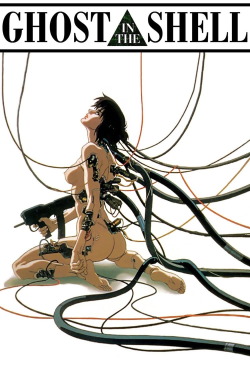
Review of Ghost in the Shell (1995) by Adam F — 22 Sep 2014
While there are some confusing, unexplained elements that make "Ghost in the Shell" the kind of movie you will need to read up on after it's done or watch again to completely understand, it's a very smart science fiction film that will drawn you into its story. It's the future, and cyborgs are common place. Motoko Kusanagi (voiced by Atsuko Tanaka) is a special agent who is on the trail of the Puppet Master. This criminal is a hacker so talented "he" is able to take control of people's bodies (through their cybernetic implants) and infiltrate anything, anywhere. With Kusanagi being an advanced cyborg who barely retains any human components, it's a case that she holds particular interest in. As she and her team come closer to finding out the identity of the Puppet Master, they become entangled into a complex story of political intrigue and deception, with the Puppet Master at the center of it.
This is a complex story, full of shady people sneaking around and trying to outwit each other. While the film begins with them trying to track down the mysterious Puppet master, the real meat of the story is when the background of this character is revealed. It's the kind of story where people know who the mastermind behind everything is and what they've done, but the tricky part is catching them in the act. Do you ever notice how so many action movies end with the hero just blowing away the bad guy? Not to criticize those films but you know that after the credits roll, there would be a lengthy police investigation and odds are our action hero would find him or herself in court having to justify all those minions they killed. That's what the characters in this story are trying to avoid. What begins as a sci-fi mystery turns into a political intrigue story and the change is seamless. It's incredibly refreshing to see a base in reality despite the science-fiction setting.
One of the elements in the film that I particularly enjoyed was the ideas. Our main character is a cyborg; a cybernetic organism. Usually that means either half human and half machine, or a person with a prosthetic limb or two. With Kusanagi, the only part of her that is truly human now is her brain, encased in a robotic body capable of incredible strength, agility and acrobatics, complete with a skin that can turn her invisible, Predator-style. That sounds pretty cool, but during conversation with one of her officers, she brings up some very interesting points. A big part of being human is the vulnerabilities that we have. We feel pain, we grow old and we die. As a cyborg, she doesn't really have those human traits anymore. No pain receptors in her limbs and she'll be beautiful forever. Catastrophic injuries just mean a trip to the garage and very little risk of actual death. It's true that if her brain was destroyed she would die, but you get the feeling that her sense of self-preservation is always in danger of disappearing because she's so detached from humanity at this point. Think about it. The reason why people don't want to die is of course because of the fear of what's after death, but when you're on the police force, a big part of it is that if you get shot, you're probably going to die painfully. Not having that pain to remind you of your vulnerabilities would make you reckless and forget that you're not completely invincible. Aware of this, the actions that our character takes to remind herself of her mortality were fascinating. You've got a really intelligent science fiction film here that is, on the surface anyway, about a cop tracking down a bad guy who can steal people's bodies, but there's so much more to this film. There are more bold ideas towards the end of the movie but I don't want to spoil them. Let's just say that if you're a fan of science fiction, you'll really appreciate this movie because it has a big brain.
Additionally, the film has some really audacious ideas about sexuality and gender identity. To be honest, I only pieced together some of the elements after the film was over in conversation so I feel like these ideas I will have to really discuss once I see the film a second time (something I look forward to) but here are a couple of quick points which I will ask myself upon re-watching the film: how does the sequence in which we see Kusanagi's body built parallel with the fact that among her lack of human traits, she doesn't have the power to reproduce? Does the fact that the character is only a woman in appearance and in name influence her behavior in combat? Keep in mind that Kusanagi's skin turns invisible, but her clothes do not so she is frequently see stripping naked in order to get a leg up on criminals. How do those themes converge in the climax when we have Kusanagi and the Puppet master talking to each other? Like I said, there's a lot going on intellectually here, ideas you can dissect and analyze for yourself once you see the movie. If you've seen "The Matrix", not only will you be able to grasp the story better, but you'll notice several similar themes; this is an influential film and the Watchowski siblings are just one of the many who expanded on some of the ideas found here.
I do have some criticisms. There are several sequences of the film which are animated using computers and they clash harshly with the rest of the beautiful, hand-drawn sequences. I can see the need to animate some of the complex ships or even some of the building in the background, but we see some scenes with Kusanagi herself being animated. It's not like it's a dream or a special state she's in, it feels like the animators showing off that they are now able to create a human shape on the screen. Yeah it looks good, but it's distracting and despite the talent on display, it doesn't look as crisp as the hand-drawn animation we see just a few seconds later. Another criticism is that the movie comes off as slightly misogynist at times. Let me explain. Our main character is a woman, and one that kicks major butt. She's shown as intelligent, competent, professional and courageous. She also appears naked constantly. The idea is that because she's a cyborg, several improvements have been made to her body, including giving her skin that can turn invisible. As an officer, that's an extremely useful skill, too bad her clothes don't turn invisible. Because she's used to this ability, she shows no shame jumping around naked, arresting suspects so we get many shots of her bare chest and while I appreciate naked women as much as the next guy, it feel unnecessary at times. If you thought the constant scenes of Jessica Alba stripping in "Fantastic Four" were gratuitous, you haven't seen anything yet. Then again, this sentiment of mine probably only emerges from the fact that prior to writing the review and discussing the film, I didn't even put together the fact that despite appearing like a woman and calling herself one, Kusanagi isn't really female. She doesn't have the necessary reproductive organs, and her body is artificial so what is there to show? Perhaps it is the fact that as a human I am so far removed from someone whose body would be entirely mechanical that we no longer understand each other very well. Perhaps this flaw is not actually a flaw at all, but yet another way to drive the point home that this is a strange world.
This is a movie that makes you think quickly and keeps you on your toes. I found myself fascinated by the story and even after carefully paying attention, turns out I missed a whole lot of it. I'm usually one to promote seeing films in their original language with subtitles, but in this case, you might be better off seeing this film dubbed in your native tongue first, and then seeing it in the original Japanese with subtitles to really get the whole of it. This way, you will be familiar with the story and be able to better grasp all of the ideas thrown around. Additionally, the story is very complex and seeing it multiple times would not hurt at all. I have to highly recommend you check it out. Not just for fans of animation, but for fans of science fiction too, who will highly appreciate the implications the whole cyborg angle bring to the story. My rating of the film is, in this case, not entirely reflective of my experience with it. I was a bit confused and thrown aback by some of the ideas which I did not recognize at first. Like me, some people will not be blown away by the film at first and that it's repeat viewing that will really make you appreciate it. Nevertheless though, this is a film that will stick with you long after it's over and there's no denying the technical achievements here. Who cares if you don't understand all of it? Do you need to hear every single lyric in a song to find the melody pleasant? I plan on revisiting "Ghost in the Shell" and carefully examining it when I have the chance and I hope you do as well. (Original Japanese version with subtitles on the big screen, January 31, 2014).
This review of Ghost in the Shell (1995) was written by Adam F on 22 Sep 2014.
Ghost in the Shell has generally received very positive reviews.
Was this review helpful?