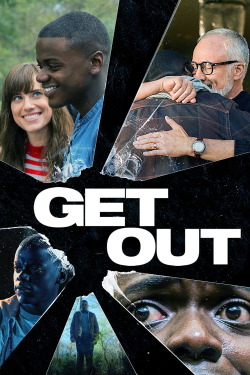
Review of Get Out (2017) by Spangle — 07 Mar 2017
Think about color. I do not mean race, just color. White, throughout cinema and life as a whole, has taken on a holy connotation. People are safe when they are in the light. Horror movies find their greatest tension at night, not the day. Things do not go bump in the broad daylight. The light shows the truth, whereas darkness hides it and obscures it turning it into the unknown. White is safety. White lights envelope characters in a hidden suit of armor. On the other side of things, black has come to be seen as death and has a far more sinister connotation. The grim reaper wears black, witches wear black, the term black magic, and the darkness itself is black. Black is, more often than not, evil. But, it is through horror movies that these preconceived notions have always been challenged. In the tremendous horror film Psycho by Alfred Hitchcock, Marion Crane (Janet Leigh) is at her greatest danger in the light. Hitchcock, knowing that people equate white with safety, dumps his protagonist in a bright, white-lit bathroom where she quickly succumbs to the violence of Norman Bates. While horror films today still rely upon people's thoughts regarding white and black, Psycho and many other films saw an opportunity to subvert expectations and show audiences that the daylight is hardly the armor they once perceived it to be. George A. Romero's Night of the Living Dead took it even a step further and it is that film that serves as the greatest influence of Jordan Peele's Get Out.
In that film, Ben (Duane Jones) is the only black character and he is also the protagonist. Alongside him are exclusively white zombies and the catatonic white girl Barbra. These portrayals served as the basis for Richard Dyer's brilliant series of essays entitled, White. In these pieces, Dyer argued that white and black came to mean something entirely different in Romero's film. While beforehand, white had always meant pure and holy, whereas black was the exact opposite, Night of the Living Dead changed the talking points. In the film, white came to mean death. It represented order and rigidity. White was lifelessness and, as a result, white people had become zombies. Meanwhile, black was the presence of life. No longer was black the absence of color (life), it was instead the very embodiment of it with it standing it contrast to the zombie-like portrayal of whites. That said, Dyer also asserts that we can only see this dichotomy when whites and blacks are portrayed together. In films with exclusively white casts, such as Sam Mendes' American Beauty, audiences are blind to the whiteness of the characters. The whiteness is simply who they are and audiences miss just how much the characters in films such as that resemble the same lifelessness and rigidity of the zombies in Night of the Living Dead. However, by presenting whites and blacks in contrast to one another, Get Out is able to explore the relationship between the two colors in an entirely racial context.
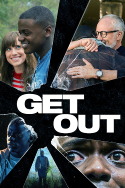
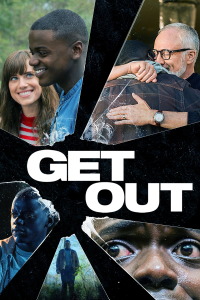
As is readily apparent in the film, the whites are zombies. They are hypnotized and robotic, they are the pure embodiment of order and rigidity. When Chris (Daniel Kaluuya) is in their presence, they all uniformly look at him and stare him down. Their manner of speech is very structured, their commentary predictable (I knew INSERT BLACK ATHLETE or the Obama comments), and their seemingly positive reception towards Chris feels pre-coded. Everything is artificial in this environment and while the film shows it in a humorous light, the lifelessness of this gathering of people is astounding. When the Armitage family throws their yearly party, which is on the same day every year, the entirety of the guests pull up at the same exact time. When they play bingo, everybody wins. While these people may not be zombies, they certainly act like mindless zombies who simply go through the motions of living and are merely watching themselves life.
This, of course, is why the Armitages and other white families utilize blacks. Kidnapping them or roping them in via Rose (Alison Williams), the people of this suburb use black people as vessels for life. Whether it is to live again, to see, or any number of reasons, the whites in the film recognize that the blacks have something they do not: life. Chris is the very embodiment of life. He is energetic and, though cautious about meeting her parents, in love with Rose. He is living life to the fullest at this point in his life and looking positively towards the future. Even better, he is black. Per Dyer, black represents life and this is very much the case in Get Out. His friend Rod (Lil Rey Howery) is boisterous and loud, spitting out comical lines at the speed of light. Compared to every white character in the film, this duo of black characters are full of energy. Every white character, aside from when they put up a facade to trick blacks, just float by.
This review of Get Out (2017) was written by Spangle on 07 Mar 2017.
Get Out has generally received very positive reviews.
Was this review helpful?