Review of Gandhi (1982) by Nick R — 13 Jul 2009
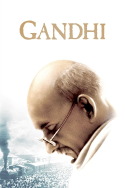
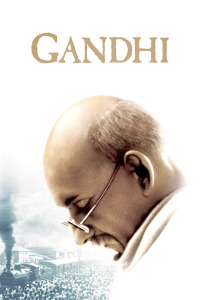
"The truth," Richard Attenborough said, "is that I never wanted to be a director at all. I just wanted to direct that film." For him, therefore, Gandhi represented a mission: Attenborough survived 20 years of delays, frustrations, ridicule, and personal financial risk to achieve his grand dream of recreating the life and times of Mohandas Kharamchand Gandhi (1869-1948), in a way that would touch audiences of East and West alike with the spiritual significance of the Mahatma.
Attenborough first conceived the project in 1962: His particular inspiration was Gandhi's dictum, "It has always been a mystery to me how men can feel themselves honored by the humiliation of their fellow beings." Already a producer, he was not to embark as a director until 1969, with Oh! What a Lovely War, and at various stages of his 18-year struggle to raise finances for Gandhi, Fred Zinnemann and David Lean was proposed as more likely and more marketable directors. Various writers, including Gerald Hanley, Donald Ogden Stuart, and Robert Bolt, tried their hand before John Briley's script masterfully captured the essence of Gandhi's life and achievement.
Over the years, generations of actors - including Alec Guinness, Dirk Bogarde, Peter Finch, Albert Finney, Tom Courtenay, Robert De Niro, Dustin Hoffman, John Hurt, and Richard Burton - were considered for the leading role. In the end the choice was the practically unknown Ben Kingsley, who had the advantage of facial features inherited from his Indian father. Kingsley dedicated himself to the role, shedding weight, taking up yoga, learning to spin cotton, and making a brave attempt to live life by Gandhi's example. The huge supporting cast included a remarkable display of stage and screen luminaries of the time.
Briley's script opens with the assassination and state funeral of Gandhi in 1948, and then flashes back to his beginnings as a young lawyer, protesting against racial discrimination in South Africa in 1893. From this it traces the main biographical landmarks of his battle against British imperial domination, and for an integrated Indian society and culture. Ironically, Gandhi's passionate commitment to peaceful protest often leads to violence and death, as well as his own lengthy imprisonment. Much of the action was filmed on the actual historic locations. The funeral scene, shot on the Rajpath using 11 camera crews, assembled an estimated 400,000 extras.
Gandhi triumphantly disproved the general tenet that films which are long in the making usually fall short of their ambition, losing the freshness of initial inspiration. Gandhi found an instant response in critical acclaim and a worldwide audience. Its eight Academy Awards marked a record, surpassed only by Ben-Hur (1959), Titanic (1997), and Lord of the Rings: Return of the King (2003). For Attenborough a greater personal satisfaction was evidently the certainty that at least some of his audience felt themselves enriched by the encounter with Gandhi, through his screen portrait. For better or worse, Gandhi was to mark his future career as a director of inspirational film biographies.
This review of Gandhi (1982) was written by Nick R on 13 Jul 2009.
Gandhi has generally received very positive reviews.
Was this review helpful?