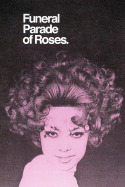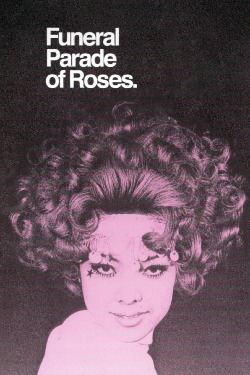
Review of Funeral Parade of Roses (1969) by Iowa B — 15 Jan 2013
Perhaps the best place to approach Matsumoto's Funeral Parade of Roses is by approaching its imagery and juxtapositions and give less time to its story. One the one hand, the film is, visually at least, very well crafted.
Many of its images may linger in one's mind long after Funeral Parade of Roses has finished because on the one hand they feel authentic on the other hand, however, they feel unearthly and some of them have the advantage of not being shown for too long.
Hence this may give some viewers the feeling they are witnessing some supernatural phenomena. On the other hand the film's stylistic menage-a-trois, if you may, is at least interesting because we have two genres that go well hand in hand: documentary and neorealism, and a third which is in a diametrically opposed neighborhood: avant-garde.
However, in Funeral Parade of Roses this combination is effective because there are moments in which nuances change: for example some documentary scenes don't feel like documentary scenes at all, but more like dream scenes or mood pieces.
Others feel like extensions to a previous scene or to a particular feeling that a scene wants to depict. This is why it works. Because it is well crafted enough so that you know that there is a payoff, but loose enough so the entire material does not feel like an academic exercise, vague enough to be eerie, but tight enough to work as some sort of a twisted story as well.
This review of Funeral Parade of Roses (1969) was written by Iowa B on 15 Jan 2013.
Funeral Parade of Roses has generally received very positive reviews.
Was this review helpful?