Review of Full Metal Jacket (1987) by Tiberio S — 15 May 2018
Full Metal Jacket is a continuation of Kubrick's floating fetus in outer space from 2001: A Space Odyssey, who initially was supposed to be observing a nuclear holocaust on Earth. But we already had nuclear war breakout in Dr. Strangelove, and Kubrick doesn't like to repeat himself. Now comes ground warfare, the mentality that makes war: infancy, which men are reduced to in order to be trained as killing machines. Right from the get-go, their heads are shaved baby bald; they're being reset to become children of the Marine Corp, their daddy Gunnery Sgt. Hartman, the heart of who they will become. We see these themes of infancy floating throughout the film, right until the final frame, after Joker gets his confirmed kill, and the men march away singing the Mickey Mouse March. Were those standing black rectangles meant to remind us of the Monolith from 2001?
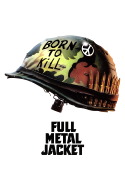
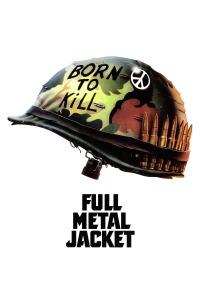
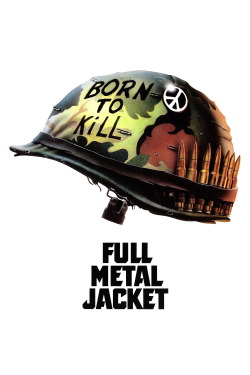
At the center of this theme is Lawrence Leonard, redubbed Private Gomer Pyle by Hartman, the most obvious manchild of the whole picture. He has a soft smiley face, baby fat intact, sucks his thumb, and is utterly helpless. He is the perfect candidate to be branded a killer into his new surrogate family, because he will undergo the worst hardship from an insurmountable origin. The cruelty he faces will not make him loyal, it will turn him. The person watching over him, the film's central character, is Private Davis, aka Joker, who's not much less of a manchild, frequently impersonating John Wayne in a way that seems to both embrace and mock the idea of American male machismo. He is the symbol of duality, as he himself declares, and by his peace pin with Born to Kill written on his helmet. He gets that things are fucked up here, he's sardonic when broached about what it means to be here in Vietnam, and he wants to kill.
It's key to remember that Joker says, 'the Marine Corp does not want robots, the Marine Corp wants killers,' separating from the pathology of 2001. HAL has a programming error, he wasn't taught to kill his crew, which is very different from the logic father Hartman instills in his men, "we kill everything we see." Full Metal Jacket deals with humanity at it's most base level, the point at which the mind can be reprogrammed. It's asinine to think any organization can condone this, creating objects of destruction whose collective attitude is cold towards mutilation of anyone besides themselves. Hartman glorifies Charles Whitman and Lee Harvey Oswald - the skills of these shooters are to be venerated.
The film is a brilliant dark comedy that has us laughing submissively at the absurdity of man's innate darkness, the chaos which makes us such a disturbing species, from the way Hartman utters racial bigotry, to his torture of the men, the attitude of their kills; the film is never without humor, and yet you wonder if you look like the bad guy for laughing. One of the most disturbing moments - where other characters are laughing, but probably not the audience - is when the field commander shows us his 'friend,' a Vietnamese corpse used as a decoration for this outfit. But then there's moments like the nutjob on the helicopter shooting at civilians, perceived solely from the chopper, far removed from the horror on the ground. As Joker and Raptor Man are sickened, we submit to laughing at the shooter's psychotic response to, "how can you shoot at women and children?" He at least thinks he's funny when he says, "easy, just don't lead them so much.".
As always, Kubrick's coverage is choice, perfectly limited, every angle complementing context and position of private vs superior, solider vs enemy, rebirth/born again suffering. Kubrick is known as the master of natural practical lighting, and it is never more evident than it is in this picture. We're never drowned with beautiful style, false light beams, or it's opposite overtly muddy, desaturated, cinema verite. There's a total plainness that draws you in more than most other war films. Of course, he artfully frames symmetrical action in the early training, which becomes handheld chaos during the war, but not so much that we lose the geography of the action. How meticulous he must've been when the men took their bunks, rifles in perfect symmetry all the way down the z-axis - they do it for Hartman, but they also do it for Kubrick; is Kubrick saying he's the same stickler Hartman is? One of my favorite dolly shots is when Hartman looks for the person who said John Wayne, the way he and the camera converge moving at opposite angles from one end of the room to the other.
For years, I complained that this was not a five star film because R Lee Ermey is too enjoyable to kill off early. Of course it's meaningful, and Kubrick is not here to merely make you laugh for two hours, but to take you on an experience of pure warfare, the breakdown of the human soul, which starts with the training. Based on his inability from the get-go, Pyle is destined to break down the furthest. Already, the soldiers could call for a PTSD discharge based on what they experience with him. But they go on to experience mass death in Vietnam; a lesser film would be about one or the other, but Kubrick gives us two films in one. The two halves are marked by a coda, "I am in a world of shit." Shit is a prominent theme, the actual desire to want to be in the shit, that it will make one grow stronger. The director of Stars & Stripes gives the colorful metaphor that everyone will be taking a bite of a giant shit sandwich when learning of the lacking support back home.
Kubrick has the uncanny ability of challenging American ideals in the context of irony and hypocrisy. Hartman is easily the most sinful of sinners, and yet makes use of religion as an ally of the Corp. In the background of Stars & Stripes, we see Mickey Mouse dolls, Snoopy, talk of Ann Margaret visiting the base, tainted by the director's desire to get pictures of her 'fur,' nude pinups on the other side of the children symbols. Kubrick previously featured Disney figures in The Shining, and had once been quoted saying that Disney films should not be the only films for children after a particularly horrible experience taking his kids to see Bambi, not knowing the content would scar them.
Kubrick famously said that whereas Paths of Glory was an anti-war film, he wanted Full Metal Jacket to be a plain war film. Kubrick maybe wanted you to think this when going to see what is obviously a harsh and critical look at the Vietnam War. That, or he just plain failed. If the latter, it was a brilliant failure. But more than likely, it was a submission to the larger themes evident in all Vietnam films, that one cannot make a film of this nature without challenging the sociopolitical and moral stance of our country. Maybe he did set out with one idea, but as with all journey's, experienced something else when rounding out at the end.
This review of Full Metal Jacket (1987) was written by Tiberio S on 15 May 2018.
Full Metal Jacket has generally received very positive reviews.
Was this review helpful?