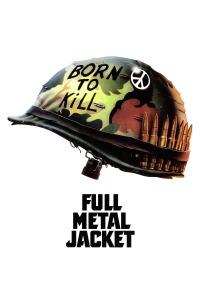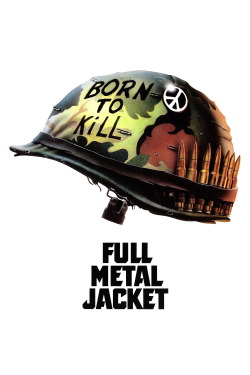
Review of Full Metal Jacket (1987) by Cameron J — 09 Jun 2013
"Next stop is Viet-nam, and it's five, six, seven, open up the pearly gates! Oh, there ain't no time to wonder why, whoopee, we're all gonna die!" I can't believe that wasn't somewhere in this film, because it, like the film itself, is oddly amusing and colorful at times, then gets really disconcerting all of a sudden, which is kind of expected, because a jacket made entirely of metal can't possibly be that comfortable. Lame jokes aside, oh man, this film is awesome, but jeez, Stanley Kubrick could sure mess with your head, so it was only a matter of time before he hit up Vietnam, or at least revisited "Paths of Glory". This film is so gritty, oscene, violent, pessimistic and, well, well-shot that it just has to be some kind of an extreme reminder of how much filmmaking sensibilities had changed between 1957 and 1987, or at least something else for Kubrick's daughter to do, because Vivian Kubrick has been doing documentaries about "The Shining", appearing in "2001", getting Peter Sellers' coffee or something, and now she's scoring this film under a different name, probably because she was even tired of her name showing up somewhere in all of Daddy's movies... except in "Paths of Glory", which came out before she was born. Huh, I guess this really was supposed to be an updated version of "Paths of Glory", and if you ask me, on top of that, it's an upgraded version, which should go without saying, seeing as how this is Kubrick's finest accomplishment, which ironically preceded his worst "accomplishment". You'd think that twelve years of build-up would make "Eyes Wide Shut" watchable, but hey, at least we have this film to remember Kubrick by, and yet, while the film is the highest mark on Kubrick's filmography, it is not without flaws that we've come to expect from a Kubrick film.
As an ensemble character study, the film is well-structured, well-acted and well-told enough to flesh things out just fine and secure your investment, but as far as actual backstory is concerned, little is said about any member of this hefty character roster, and no matter how much the film compels as a character piece, full engagement value is still challenged more than it should be by developmental shortcomings that distance you a bit, though arguably not quite as much as other pacing issues. Especially during his golden years, Stan Kubrick got to be unpredictable with pacing, as he would turn in relatively lively films and slow films that ranged from a bit bland to a bit dull, yet could never completely wash away atmospheric dry spells, and sure enough, as entertaining as this film very often is, its kick will bland up a bit at the hands of moderate atmospheric slow spells that are in no way helped by dragging in story structure, which appears to be intentional as some kind of a often genuinely effective reflection of the monotony faced by Marines during wartime, but is still very often a bit of a problem, packing the film with fat around the edges that bloats this film more than you'd expect, seeing as how it, as just under two hours, isn't as lengthy as plenty of Kubrick's other overblown projects. Dragging settles down a little bit as the film progresses, but never fully dissipates, as most every segment in the film finds itself rich with many a bloated area that not only retard momentum a bit, but leave you to spend a bit too much time with this film's segments, thus making their abandoning a bit hard to get over. The transition out of the film's first part, in which we meditate upon the lives of our leads at boot camp, - especially the life of a central Private Leonard "Gomer Pyle" Lawrence character who, by the time we enter the second part, actually ends up, not in the secondary or tertiary wing of the cast, but removed from the film and, well, any mentioning entirely - is easily the most jarring, yet there is a touch of unevenenss within segment shifts throughout the film, and while you're never so thrown off that you don't whip right back to being enthralled, all of this focal inconsistency thins structural fluidity within the narrative into a bit of aimlessness. Like the dragging in plotting, the film's aimless and uneven narrative may be a component to naturalist storytelling that gives you a grip on the leads' experiences, and as a component, it often works, but the film's narrative issues are still a bit unnerving, and their realism would be a bit easier to buy into if the film didn't slip into some subtlety issues, for although the film's dramatic range is primarily very effective, whether it be through a little bit of melodrama or simply through Kubrick's overambition as a dramatic storyteller, subtlety lapses can be found at times, proving to be detrimental to full dramatic effectiveness, much like the film's other issues, of which there are quite a few. The film has a tendency to twist most of its storytelling flaws into strengths, and at the end of the day, untainted strengths greatly outweight shortcomings, but the point is that there are, in fact, shortcomings within the final product, and no matter how excellent this effort is, you can't help but feel as though it could have explored its great concept more, and would have if it didn't have the issues that it does. Still, make mistake, through all of its flaws, this is still an excellent film that bypasses blows to engagement value enough to grip as a particularly effective war drama, and one that doesn't exactly fall short when it comes to delivering decent tunes.
Under the pseudonym Abigail Mead, Vivian Kubrick, the English daughter of this film's American director and his German third wife (Well, the Kubrick family was one culturally mixed up bag), composes a score for this film that isn't especially upstanding, slipping into some formulaic moments that water down musical kick that is limited to begin with, though not to where you can't still appreciate Kubrick's, or rather, Mead's efforts as generally decent, as well as complimentary to the effectiveness of the film's tones that aren't of a lively persuasion that is generally driven by a very good '60s soundtrack. Like plenty of other Stanley Kubrick projects, this film's musical aspects, to a certain degree, both entertain and compliment the tonal range of the final product as stylish artistic touches whose effectiveness goes challenged only by visual style, for although this first post-John Alcott Kubrick film isn't quite as photographically impressive as, say, "A Clockwork Orange", or "Barry Lyndon", or "The Shining", cinematographer Douglas Milsome still does justice to Kubrick's distinctive taste in visual style with some memorable moments of cleverly gritty play with lighting, and many a memorable moment of clever framing that finds a comfortable balance between brought and tight that intimately immerses you into this world. Stylistically, the film excells, maybe not as much as certain other, ultimately inferior Stan Kubrick projects, but certainly enough to color things up time and again with artistic tastefulness that both catches your attention and breathes a bit of life into the film's tone, at least when there aren't any action sequences to really pump up the tension. The occasions in which Kubrick played with actions sequences, say in "Paths of Glory" or "Spartacus", were underappreciated as reflections of Kubrick's knowing how to film some pretty engaging combat, and while this film was the first by Kubrick to have moments of extensive focus on action sequences in 27 years, Kubrick had not gotten rusty, staging this film's war combat sequences in a fashion that may get to be a bit too noisy at times, but generally grips as dynamic, believable and intense, whether when you're facing grandly large-scale battles or chillingly intimate standoff sequences, such as the enthralling sniper segment that serves as the film's climax. Action sequences are relatively limited in quantity, but upon arrival, they deliver on quality, marking particular heights in an almost consistent immersive intensity that compels time and again, and, by extension, does important subject matter of this type quite a bit of justice, in spite of the undeniable shortcomings in the execution of this story concept. The film chooses to be somewhat naturalist in its approach to this story that was introduced through the semi-autobiogrphical novel "The Short-Timers" by Gustav Hasford (Oh yeah, fellow Alabamian!), dragging structure in aimless unevenness that dilutes the full kick of the nevertheless excellent final product, which could very well have been great, because this basic premise is great, telling a war tell with certain refreshing beats that give you more insight into the thematic and dramatic potential within this meditation upon the experiences of war, and how they can change the innocent into hard-edged, if not unstable men of violence. There's a wealth of potential within this film's story concept, and not all of it is explored as thoroughly as it could have been, but on the whole, there is enough justice done to Hasford's story for you to be engrossed time and again by genuinely effective inspiration within storytelling, even as far back as storytelling's script stages.
The film's script, written by Stan Kubrick, Michael Herr and "The Short-Timers" writer himself, Gustav Hasford, is hardly spotless, having its share of somewhat questionable moments in experimental storytelling, though not so many that you can't look through all of the writing flaws - of which there arne't a whole lot - and see a screenplay that is generally very strong, with dialogue that ranges from decent to quite sharp, as well as cleverly organic tonal dynamicity, which graces some of the earliest acts of the film with a moderate degree of fluffiness that, I must say, is actually quite amusing at times, - especially the first post-intro sequence that revolves around R. Lee Ermey's Gunnery Sergeant Hartman character slamming his boot camp's new recruits, and is driven by dialogue primarily written by Ermey himself that may take a few too many notes from the insults by Louis Gossett, Jr. that Ermey, as a former drill instructor, actually inspired in "An Officer and a Gentlemen", but is ultimately hilarious in its unafriad plays with colorful obscenities - then slowly, but surely descends through dark depths until, by the end, we're faced with an audaciously intense dramatic thriller. While plotting's structure has its jarring moments, where the layered tone in this drama could have come off as uneven, there is a lot of care put into the slow, but sure build in intensity, ostensibly to reflect the age-old war drama theme of losing innocence in a fashion that is not only refreshing, but compliments the effectiveness within Kubrick's, Herr's and Hasford's characterization, which stands to be backed by more extensive development, but is still pretty meaty, as well as done considerable justice by portrayals behind these well-rounded characters that are generally nothing short of upstanding. As an ensemble character study, the film is driven by its hefty cast, most everyone of whose members deliver, to one degree or another, with most everyone delivering on his own memorably distinct charisma, sometimes broken up by genuinely effective dramatic range that leads to such relatively standout performances like the relatable narrating one by Matthew Modine, and the show-stealing one by part one lead Vincent D'Onofrio, whose initially sympathetic, gradually intensifying and altogether heartbreaking portrayal of the Private Leonard "Gomer Pyle" Lawrence character's descent into unbearable and crippling madness, brought on by suffering that Marines like Lawrence can't handle as they are conditioned to be prepared for death. The film's entire first part is primarily built around Lawrence, thus D'Onofrio carries the film until his sudden exit, which leaves the film to enter a second part that is more driven by the leads' comradery, which is, of course, sold by effective chemistry that graces this ensemble piece with both charm and human depth, and actually helps you in meditating upon the individual performances that go into making the film a well-acted drama, whose onscreen talents do a lot to drive the film, though not as much as a certain offscreen performance. Stan Kubrick's performance as directorial storyteller is, as I said, with questionable beats that hold the final product back a bit, but on the whole, what does about as much anything in driving this film as Kubrick's best is what is arguably Kubrick's best directorial performance, which fights dry spells more often than not enough to spark much entertainment value, - broken up by moments of genuine tension that range from gripping to fittingly disturbing - while actually drawing some effectiveness from such questionable storytelling methods as aimless dragging, which is still problematic in a lot of ways, but often played with in a clever way that gives you a feel for the experiences of the Marines who can do no more than simply wait until action, which may very cause anything from harsh change to death. When the questionable areas in Kubrick's storytelling are manipulated in just the right way, they actually help greatly in immersing you into this world, and such clever spots in storytelling are compelling enough, but what is perhaps most gripping about Kubrick's direction are the moments that aren't so much tense or lively, but emotionally resonant, for although this film will never really move you to tears, it's powerful, as Kubrick is so thoughtful with his playing up the depths of this drama that are tainted by some subtlety issues, but generally genuine enough to enthrall and define the final product. The film could have perhaps been a borderline, if not well-secured masterpiece, but there is still so very much that is done right in this film, and these strengths ultimately prevail in battling back shortcomings enough to engross as an excellent classic of the war genre.
In conclusion, the film's lack of development dilutes intrigue a bit, though not as much as the slow spells that are made all the more glaring by intentional narrative dragging that, when combined with intentional unevenness, sparks aimlessness that joins some subtlety issues in holding the final product back from borderline greatness, but not so far back that excellence isn't still firmly secured, partially by a decent soundtrack, handsome cinematography and grippingly intense action sequences, and largely by a thoroughly compelling story concept that is brought to life by clever and layered writing, strong performances and chemistry between an ensemble of charismatic talents, and a directorial performance by Stanley Kubrick that delivers on liveliness, tension, immersive value and, of course, emotional resonance that power "Full Metal Jacket" as an entertaining, grippingly intense and all around excellent war drama that, for me, easily stands as the finest accomplishment in Kubrick's legendary career.
3.5/5 - Excellent.
This review of Full Metal Jacket (1987) was written by Cameron J on 09 Jun 2013.
Full Metal Jacket has generally received very positive reviews.
Was this review helpful?