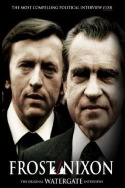
Review of Frost/Nixon: The Original Watergate Interviews (1977) by Edith N — 12 Jul 2011
Proof That David Frost Wasn't So Much With the Hard-Hitting.
I have to admit that I didn't even know these interviews existed until about the time the movie came out. Nixon is not so much my thing, and most of what I know about his presidency comes from old [i]Doonesbury[/i] strips. However, when the DVD of these interviews was released, David Frost himself went on [i]The Daily Show[/i] to talk about it. I think Jon Stewart may well even have thought more of them than Frost did himself. However, I have read two schools of thought on the subject of them. The first is that David Frost asked the Tough Questions and got Nixon to say things he never would have in any other circumstances. The latter of which is true; Nixon was interviewed by anyone, after all, and we never would have heard him say those things had he not been. The other school of thought is that David Frost didn't really know what he was doing, and Nixon talked circles around him. Having watched the interviews for myself, this is the school to which I now subscribe.
The circumstances of this are so well known that I don't really need to go into them here. Let us merely say that David Frost offered Richard Nixon a great deal of money to sit down with him and be interviewed. There were two caveats; Richard Nixon would indeed talk about Watergate, and David Frost would mostly ask him about other things. The details of this may be examined in greater detail by watching [i]Frost/Nixon[/i], the fictionalization of the events, though of course I cannot say how historically accurate that movie was. However, the practical outcome is that the two men sat down together (in a house clearly under a flight path) and discussed all manner of events from the Nixon presidency. Not just Watergate, as established. Nixon's beginning of the normalization of relations with China. The Vietnam War. Some to do with Nixon the man, mostly to do with Nixon the President. Two men sitting quietly in a room, which is the reason one of my friends couldn't understand why I'd bother seeing the movie in the theatre. Two men sitting quietly in a room, yes, but sitting quietly in a room talking about world-changing events.
The thing is, though, the questions Nixon answered were not reliably the questions Frost asked. Frost seemed unable to take any control whatsoever of the circumstances. In the later parts of the interview, which the movie has told me were conducted days later than the first of it, he is more able to interrupt to try to get Nixon back on topic. It doesn't reliably work, but he is able to try, at least. David Frost was more familiar with puff pieces. He would tell these lengthy stories which, while sometimes interesting at least, were only tangentially related to the question. It is generally considered that Nixon really won the Kennedy debates; the reason Americans thought otherwise is that the watched them on television, and Kennedy understood television in a way Nixon did not. It is clear, watching this, that Nixon learned his lesson in the nearly two decades since. He had also been fencing with the public over the three years directly preceding these interviews to avoid giving away things he didn't want to. The fifth and final segment also shows Nixon telling a story about Martha Mitchell which almost seems to be sacrificing her tragedy for his benefit.
And here's the thing I really wanted Frost to pick up--he said, at one point, that he didn't fire a few people who were involved in the burglary and cover-up because they were only suspected, and it would be inappropriate to fire them without real proof. And this infuriated me. Nixon had been involved with McCarthy and the Committee, after all, which was pretty much all about throwing mud until some of it stuck. Even if people weren't shown to have done anything wrong, the very fact of associations they might not have had anything to do with in decades was considered enough to destroy their lives. This contrasted with evidence of actual treason is errant hypocrisy. I admit that Frost, born in Kent, probably had little information about Nixon's role in the Committee, but it still really bothered me. Surely it's the sort of thing he should have gotten as part of his preparation for the interviews. If he didn't, it was irresponsible of him. If he did, it is yet more evidence that Nixon was talking rings around him.
If Nixon thought these interviews would salvage his reputation, he was wrong. To this day, he's generally considered a watchword for governmental corruption. No, we don't much talk about Spiro Agnew anymore; Nixon tries to rehabilitate him, too. (In his disbarment, he was declared "morally obtuse.") It does actually come across that he knows more than he is willing to say and lies about what he will talk about. His appeals to logic--pointing out that perjury after the pardon wouldn't be covered by the pardon--come across more as equivocations. The equivalent of Jon Lovitz's "Yeah, that's the ticket!" from [i]Saturday Night Live[/i] some ten or fifteen years after these interviews. In a way, it almost feels as though Nixon is insulting our intelligence. His claims, a lot of them, are so ludicrous that we would ourselves have to be pretty stupid to believe them. It's clear that David Frost doesn't any more than we do, but Nixon pulls the "Will you just let me finish?" gimmick intended to make the audience pity the poor person being harangued by the interviewer. It doesn't often work, and this is no exception.
This review of Frost/Nixon: The Original Watergate Interviews (1977) was written by Edith N on 12 Jul 2011.
Frost/Nixon: The Original Watergate Interviews has generally received positive reviews.
Was this review helpful?