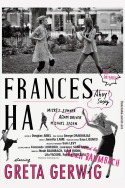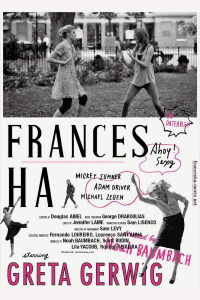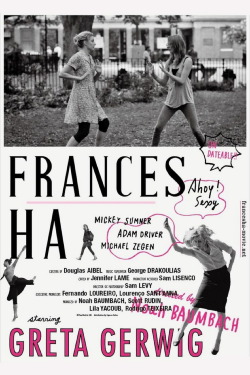
Review of Frances Ha (2013) by Shiira — 12 Jul 2014
Not only love, but sex, or rather, as Helen puts it, the "whole package", is what the art gallery curator wants from her coupling with Jessica, who insists on downplaying sex as being just one component" in a "loving and tender" relationship.
"What we have is a friendship," she protests, "best friends", even, which for her incrementally straight partner, a journalist, is enough. How did Francois Truffaut tackle the same terrain of sexual politics, as portrayed in Kissing Jessica Stein? The narrator, in Jules and Jim, recalls how "people called them Don Quixote and Sancho Panza," and that "rumors circulated behind their backs about their unusual friendship.
" Although Jules puts the kibosh on Jim's pursuance of Catherine, whom we presume to be his lover par excellence, we later learn, after both men return from war, that their marriage is marked by celibacy.
Sabine looks nothing like her father, Jim notes. Catherine's satiation, Jules admits, comes from other lovers. When he hands over Catherine without any hesitation or qualms, it's because the cuckolded husband apprizes his best friend's platonic love as being on par with his wife's feminine powers.
Bi-curious Jessica, ultimately, doesn't covet women, and yet, bawls her eyes out over Helen's departure as if she did. Whereas Jessica, and Jessica alone would subscribe to the notion that "Jules' and Jim's friendship had no equivalent in love," Frances and Sophie take delight "in the smallest things" and accept "their differences with tenderness," a shared sensibility that transcends love of all persuasions.
Manhattan settings both, essentially, Frances Ha picks up where Kissing Jessica Stein leaves off, but here, there is no analogue for Helen, since both Frances and Sophie are randy heterosexuals. "The coffee people are right.
We are like a lesbian couple that doesn't have sex anymore," Frances says, sharing both cigarette, and inside joke, in regard to the careening apogee of their avowed sexual orientation. Modern love, indeed.
Only David Bowie can explain them. When Frances' laptop light goes out, like a lover, Sophie stops the aspiring dancer from adjourning to her own room, and like a lover who nags about a partner's annoying little habits, she softly chastises Frances over her bad decorum, regarding socks in bed.
Socks are the only piece of clothing she removes, which may surprise the viewer, since all of New York can see the uninhibited pair carrying on like Don Quixote and Sancho Panza. Alas, so who is Jules? And who is Jim? The film, it would seem, casts the titular character as Jules.
Akin to the scene where Jim gives Catherine to his closest confidant, Frances, in a bequeathing of sorts, suggests that Sophie hook up with Lev, a roommate(one of her "two husbands", a Jules and Jim reference), which would reunite the Vassar graduates, turning the Manhattan apartment into something resembling her counterpart's crowded Austrian chalet.
But Sophie, like Jim, already has a partner, and this is where Frances Ha diverges from the Jules and Jim template, since Frances' bespectacled friend remains loyal to Patch, whereas the German can't choose between Catherine and his fiancee.
Frances, ever the martyr, rebuffs Lev's advances, because, perhaps, thinking ahead, she sees him as the key to luring Sophie back into her life, even though the Sacramento native thinks he's "magic".
Back home for Christmas with family and friends, this transplanted New Yorker, now signified by tract housing instead of skyscrapers, and churchgoers instead of artists, seems less like a persona than a person, and more like a woman than a man.
In NYC, she adopts the masculine role by paying for Lev's dinner, and also, Benji draws attention to her "weird man walk", suggesting that Frances is in drag, albeit less visibly than Catherine, who with chapeau and painted mustache, passes herself of as a man, one sunny day in France among the boys.
Arguably, the scene where Frances teeters along the river Seine, the same river where Catherine jumps into, is not the first direct steal from Jules and Jim. While Frances' mother pounds on the bathroom door, the daughter lies down in the tub, more or less, underwater, which abstractedly recalls Catherine's drowning, when she drives, with Jim riding shotgun, off the dock.
Like the similarly-themed Superbad, porn-lovin' Seth declares, "I don't know what I'm going to be into ten years from now," the same ambiguity imbues itself in this familial exchange: "Frances, how much longer?" asks mom.
"I'll be out in a second," responds her adult child, or, maybe give it ten years. From an objective distance, Jules and Jim lock eyes, and for emphasis, the mis-en-scene freezes. What do the eyes say? In Frances Ha, the filmmaker instead employs close-ups and a shot/countershot during the climactic staring, following Frances' first show as a choreographer.
We can see.
This review of Frances Ha (2013) was written by Shiira on 12 Jul 2014.
Frances Ha has generally received very positive reviews.
Was this review helpful?