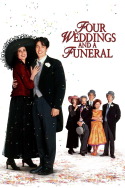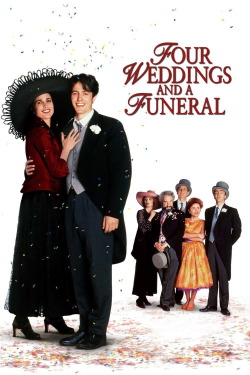
Review of Four Weddings and a Funeral (1994) by Edith N — 06 Oct 2008
I think that, when most people--at least most Americans--picture Hugh Grant, this is how they picture him. It's how [i]I[/i] picture him, certainly, and I've seen three or four of his movies other than this, including part of [i]Lair of the White Worm[/i], which my then-friend Maria's VCR died rather than play. But still, I picture him running late for a wedding. It's a horrible thing to be typecast, but then, you know, if you don't want to be typecast, perhaps you should choose different roles to play. You see, everything I've seen him in has been some kind of wacky romantic comedy. I ought to watch [i]The Englishman Who Went up a Hill and Came Down a Mountain[/i]; perhaps that's different.
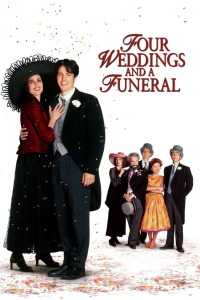
There are, indeed, four weddings and a funeral to this movie; it's the frame the whole story hangs from. Almost all the story takes place just before or just after one of them, making those few scenes which don't feel out of place, even if they do involve Andie MacDowell picking out a wedding dress. Still. Hugh Grant is Charlie, who spends all his Saturdays going to weddings. (Apparently, the screenwriter went to 72 in ten years. One rather begins to wonder how many of those were second or third or more marriages.) At one of them, in which he is the best man, he meets Carrie (MacDowell), and he spends the whole rest of the movie just missing a relationship with her. Because otherwise, you see, it would be [i]Two Weddings and It Ended Before the Funeral[/i]. Or something.
I find it an interesting choice to have one of the characters be deaf. It's certainly unusual. I mean, obviously, there [i]are[/i] deaf people, but it's rare that such a thing is thrown into a movie for no real reason. It helps build dramatic tension at the end of the movie, of course, but I'm not 100% sure that the moment needs that extra bit. What's more, they made Hugh Grant learn sign language for it. (Not American, of course, but British; I'm afraid, Heather, that you won't necessarily be able to tell a single thing that he's saying. But not to worry--there are subtitles.) He's a sweet, charming character, too. But he'd have to be--can you imagine the uproar if there were a random deaf person who also happened to be a jerk? Not that there [i]aren't[/i] deaf people who are jerks, I'm sure.
It strikes me as odd that the film went with one cliche of weddings--brides' dresses run a serious risk of looking not unlike their own cakes--but completely ignore the horror that is your average bridesmaid's dress. There's also only one batty old relative. In fact, the movie seems more interested in cliche people than cliche weddings, and while that doesn't really make it much better of a film, it does present an interesting and rather refreshing stylistic choice. I think, had it been all wedding cliches, I [i]would[/i] have turned it off halfway through. (Okay, true confession time--I did. I went to the store. But I came back and turned it back on!) That can only work so many times before you want to thump everyone involved with a mallet.
Okay, as to the bride in the last wedding--if your bride can't stand your friends, there's a problem with one of them. If your friends have always supported you in everything up to and including a wedding to a person you can't stand, you might want to reconsider your choice of bride. In fact, you should have reconsidered things long before then; maybe the difficulties between them could be worked out. Though, of course, this bride seems pretty inclined to see everything her own way and assume that she's going to get it.
This review of Four Weddings and a Funeral (1994) was written by Edith N on 06 Oct 2008.
Four Weddings and a Funeral has generally received positive reviews.
Was this review helpful?