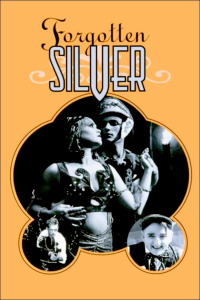
Review of Forgotten Silver (1997) by Edith N — 17 Sep 2011
Really, the [i]CSI[/i] Zoom Should Have Given It Away.
Apparently, this fooled quite a lot of people in New Zealand, where it was initially aired as a legitimate documentary. While I can understand that, I think there are plenty of clues--especially if you are, say, watching the film with one of the people actually in it, which is apparently true of someone who was fooled. For one thing, while I don't know a great deal about the cultural cues of our friends in the Southern Hemisphere, you should never trust any story which feeds into even as many of them as I do know. If you believe this story, there is now film evidence that Richard Pearse of New Zealand beat the Wright Brothers into flight by literally months. Which is proven by zooming in on a newspaper in a witness's pocket. There is footage of Gallipoli. There is proof that a native of New Zealand invented colour film, sound film, and even just the close-up. Essentially, a man from New Zealand invented the modern language of film--if you believe this.
This is the story of Colin McKenzie (Thomas Robins). Peter Jackson (actually Peter Jackson, who co-made the film with Costa Botes) discovered an entire chest of McKenzie's films in a shed, thereby unearthing the most important archive in film history--possibly, indeed, in the history of New Zealand. As a boy, trying to find a way to avoid hand-cranking his camera, McKenzie fitted one to his bicycle and invented the tracking shot. He was absolutely brilliant. He happens to have been on hand during the long-discussed but never proven Pearse flight in March of 1903. He made a film camera for his brother, Brooke (Richard Shirtcliffe), to take off to war (Colin McKenzie had flat feet), providing the only footage in the trenches with ANZAC at Gallipoli. The brothers McKenzie had been planning to make a great Biblical epic, [i]Salome[/i], but great Biblical epics were expensive. And then Brooke was killed at Gallipoli. And then there were further money problems. And finally, many years after Colin McKenzie went missing in the Spanish Civil War, Peter Jackson makes an expedition into the bush to find the remains of the city built for [i]Salome[/i].
It's actually quite a convincing documentary, if you're just looking at the style. Most of the people who would have actually known a man who disappeared in the late '30s would, of course, have been dead by 1995, when the "documentary" was made. He is given a widow, Hannah (Beatrice Ashton), who married him scant weeks before his disappearance. She is therefore able to fill in certain details but leave most of the story extremely vague--believably. She is able to say "what her husband told her before he left." And anything she doesn't know, like the location of the filming of [i]Salome[/i] and the lost footage thereof, is something he just didn't tell her in the short time they had together. Many of the photographs shown are authentic, albeit not of the characters, and Jackson and Botes went to extra effort to avoid aging the film the same way everyone else does--they did it the old fashioned way, by dragging it around on the basement floor.
This is Peter Jackson's last film before hitting it big in the US with [i]The Frighteners[/i]. And of course he would then spend the next eight years working on [i]Lord of the Rings[/i]. They mention at one point that the government of New Zealand might want to consider making the set of [i]Salome[/i] into a tourist attraction--a theme park. Which is just one more unintentional parallel between Jackson himself and Colin McKenzie. Oh, I don't think Peter Jackson is going to run off and be a war correspondent any time soon, and if he did, it would be a public relations nightmare if anything untoward happened to him. However, I think anyone naming anything about the New Zealand film industry would name Peter Jackson first. Sam Neill, interviewed for the film, has been in the international eye longer, but Peter Jackson is the face of New Zealand film so far as much of anyone is concerned. He bought a bunch of computers to make [i]The Frighteners[/i] and decided he finally had enough to make [i]Lord of the Rings[/i]. And now, of course, [i]The Hobbit[/i].
I'm not sure this movie makes me want to go out and see the movies of Colin McKenzie. (It kind of makes me want to see [i]The Frighteners[/i], actually.) Certainly [i]Salome[/i] sounds like a DeMille epic--incredible production values put to a story which really has very little to do with its Biblical origins. Doubtless this is deliberate. I think the theory is that this is a DeMille interested in more than just spectacle. Which I'll admit would be rather nice. But I think, if I were to watch any McKenzie, I would want to watch the documentary footage he himself made. One of the reasons we see so much footage of World War II is that the US actually put effort into making sure good filmmakers were in charge of the cameras. Frank Capra Goes to War and all that. And I would really like to see what a truly skilled cameraman could have done to capture the Spanish Civil War, a war I only know through, well, movies. Very few of which were any more concerned with authenticity than this is.
This review of Forgotten Silver (1997) was written by Edith N on 17 Sep 2011.
Forgotten Silver has generally received very positive reviews.
Was this review helpful?