Review of Ford v Ferrari (2019) by Bertaut1 — 01 Dec 2019
I'd have preferred to see Michael Mann's version, but this is an impressive and heartfelt study of friendship.
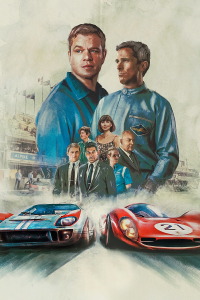
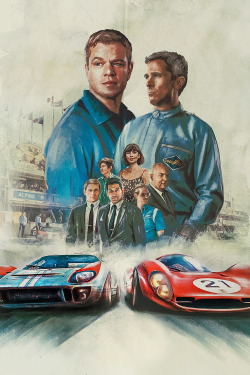
Based on A.J. Baime's Go Like Hell: Ford, Ferrari, and Their Battle for Speed and Glory at Le Mans (2009), written by Jason Keller, Jez Butterworth, and John-Henry Butterworth, and directed by James Mangold, Le Mans '66 (released in North American with the equally generic title of Ford v Ferrari) counts Michael Mann as an executive producer. This is notable, as Mann has been trying to bring an adaptation of Brock Yates's Enzo Ferrari: The Man, the Cars, the Races (1991) to the screen since 1993. Mangold is a fine director, but he's no Mann, and the film could never be accused of breaking any new ground or trying anything original. It is, in essence, a thematically broad and aesthetically anonymous pre-auteur theory audience-pleaser made with the aesthetic sensibilities of modernity. But whilst the individual parts may be unsatisfactorily safe and familiar, the whole is accomplished and enjoyable.
The film begins in 1959 as Carroll Shelby (Matt Damon) wins that year's Le Mans, only to be told he has a heart condition and must stop racing. Cut to 1963, and Henry Ford II (a superb Tracy Letts) determines to build a car capable of winning Le Mans, which Ferrari has won in 1958, 1960, 1961, 1962, and 1963. Ford Vice President and General Manager Lee Iacocca (Jon Bernthal) reaches out to Shelby to design a car, but he says they'll need a great driver as well as a well-designed car. So, he reaches out to Ken Miles (Christian Bale), one of the best drivers in the world, renowned for his ability to identify problems in test cars after only one or two laps. However, because of his volatility, few want to work with him. He comes on board, but immediately clashes with Ford Senior Executive Vice President Leo Beebe (Josh Lucas).
Le Mans '66 is somewhat similar to Michael Mann's Ali, insofar as it uses the grandiose moments of history to tell an intimate story - Mangold uses the determination to win Le Mans '66 as the background against which to examine issues such as friendship and the clash between gifted individuals for whom success is its own reward and corporations who don't see value in anything unless it's monetarily successful. Indeed, the argument could be made that the film is actually a commentary on the Hollywood studio system, with Shelby and Miles representing independent filmmakers who love the craft and see the medium as an art-form, whilst the Ford executives represent the studio, always more concerned with the bottom dollar than artistic integrity, always getting in the way of the people who, if left alone to work, could produce something spectacular.
This thematic focus, however, is not to say the film ignores the intricacies of racing; on the contrary, there's a huge amount of techno-babble concerning vectors, aerodynamics, the mathematics of torque, the torsion of metal, and the ins and outs of physics. Additionally, the aesthetic design of the races is exemplary, albeit familiar, with Mangold, cinematographer Phedon Papamichael, and sound designers David Giammarco and Jay Wilkinson crafting some truly intense moments. For the most part, there are no objective shots (for example, there are no overheads giving us a good vantage of the entire race), and there are very few shots showing us something that Miles is unable to see, which creates the sense of being in the car with him, adding a default level of intensity.
In terms of problems, there are only two of any significance. The first concerns just how safe and rudimentary the film is. Aesthetically, although the race scenes are kinetic and exciting, there isn't anything new or inventive in them; thematically, the film doesn't say anything we haven't heard before; and structurally, it walks a very well-worn path – chances are that everything that you think might happen in Le Mans '66 does happen. This is your basic underdog story, and it adheres rigidly to that template. This is seen most clearly in the character of Beebe, the film's token villain (you can't have an underdog story without a token villain). A Swiss army knife character he is a one-size-fits-all bad guy without an iota of nuance or interiority. The second problem concerns Shelby, who's one-dimensional (at best), as we learn absolutely nothing about his personal life. Who is the film's Carroll Shelby, and why should non-racing fans care about him? We never get an answer.
Although these issues are significant in isolation, Le Mans '66 is so well made, it rises above the clichéd and overly-familiar nature of many of the individual scenes, resulting in a whole that is much more than the sum of its parts. It doesn't take any risks, nor does it bend any rules, but for all that, I couldn't help but enjoy it. It won't surprise you, it probably won't move you, it certainly won't change your life, but it's a journey well worth taking.
This review of Ford v Ferrari (2019) was written by Bertaut1 on 01 Dec 2019.
Ford v Ferrari has generally received very positive reviews.
Was this review helpful?