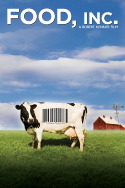
Review of Food, Inc. (2008) by Sergio E — 13 May 2011
Narrator: The way we eat has changed more in the last 50 years than in the previous 10,000.
Joel Salatin: A culture that just uses a pig as a pile of protoplasmic inanimate structure, to be manipulated by whatever creative design the human can foist on that critter, will probably view individuals within its community, and other cultures in the community of nations, with the same type of disdain and disrespect and controlling type mentalities.
Joel Salatin: I'm always struck by how successful we have been at hitting the bull's-eye of the wrong target. I mean we have learned- for example, in cattle we have learned how to plant, fertilize and harvest corn using global positioning satellite technology, and nobody sits back and asks, "But should we be feeding cows corn?" We've become a culture of technicians. We're all into the how of it and nobody's stepping back and saying "But why?".
Eric Schlosser: These companies have legions of attorneys. And they may sue, even if they know they can't win, just to send a message.
Joel Salatin: I think it's one of the most important battles for consumers to fight: the right to know what's in their food, and how it was grown.
Joel Salatin: Even if you don't eat at a fast food restaurant, you're now eating food that's produced by this system.
This movie is a wake up call on everyone but everything is hand in hand Health and Food. To me one of the mos intelligent comments were done by Joel Salatin. He is not your Dumb whatever it's corn, it's chicken, it's money in my pocket kind of guy he is actually more than that and he explains it in the movie so be sure to watch it and there are some other people that make such intelligent remarks and point out all that is wrong with us and some of the exits are so easy but it will cost too much money to this Billion dollars companies and in the end it is all about the money I really hope the time comes when they will have to eat their money to live or money just becomes worthless I know it is farfetched but maybe we will get wise someday.
The message of 'Food, Inc.' is that most of what Americans now eat is produced by a handful of highly centralized mega-businesses,and that this situation is detrimental to health, environment, even our very humanity. The ugly facts of animal mistreatment, food contamination, and government collusion are covered up by a secretive industry that wouldn't talk to the filmmakers or let the interiors of their chicken farms, cattle ranches, slaughterhouses, and meatpacking plants be filmed.
Informed by the voices and outlook of bestseller authors Eric Schlosser ('Fast Food Nation') and Michael Pollen ('The Omnivore's Dilemma'), this new film is an exposé that offers some hope that things can be made better through grassroots efforts. True, Kenner points out, Monsanto, Smithfield, Perdue, et al. are rich and powerful. But so were the tobacco companies, and if Philip Morris and Reynolds could be fought successfully, so can the food industry. The fact that the vast Walmart is switching to organic foods because customers want them shows people vote effectively with their pocketbooks every time they buy a meal.
Other documentaries have covered this ground before. The 2008 French documentary 'The World According to Monsanto' (2008) focused on how that company, with government support, monopolizes seed planting, and Deborah Koons' 2004 'The Future of Food' went over similar ground. Jennifer Abbott and Mark Achbar's sweeping 2003 film 'The Corporation' (2003) touched on Monsanto's monopoly too. In more general terms, the ominous, narration-free German documentary 'Our Daily Bread' (Nikolaus Geyrhalter, 2003) delivered 'Food, Inc.'s' message about dehumanized factory-style food production with a European focus. Richard Linklater's 2006 'Fast Food Nation' grew out of Schlosser's book about how bad and disgusting American fast food is and how it undermines the health. These are all good films, and there are and will be lots more. As this new film mentions, exploitation and malpractice in the meat industry were exposed as far back as Upton Sinclair's 1906 muckraking book, 'The Jungle.'.
'Food, Inc.' is a populist and practical film that speaks with the voices of farmers, advocates, and journalists, and focuses on food, what's wrong with it, and what we can do about it. Kenner offers lots of practical information and appeals to everyday people. The film goes back to the Fifties to show how the rise of fast food contributed to centralized, less diverse American food production. MacDonald's now much of the chicken, beef, potatoes, and many other foods produced in the country. The film explains that only a handful of companies control not only most of the beef, pork, chicken, and corn produced in the US but most other food products as well. Moreover not only is corn the major feed given to food animals, but a surprising amount of the tens of thousands of products sold at today's supermarket -- that packaged junk racked in the center of the store that Atkins and now Pollen have told us to avoid, are also derived from corn. Because of the way certain food products have government support, hamburgers are cheaper than fresh vegetables. Kenner focuses on a low-income Orozcos who both work and feel forced to rely on fast food meals because they fill them and their kids more economically than fresh produce bought at the market.
The new industry has developed chickens that grow bigger faster with more breast meat. They're kept in closed dark pens. The story is the same for all these poor mass produced critters, crammed together in great numbers, filled with antibiotics, deformed, suffering, ankle deep in their own excrement, brutally killed. The film has good footage of the big southern meat producer, Smithfield, showing how the new mega-food industry feeds off of exploited low-wage illegal immigrants who it treats as expendable, just like the animals.
An important spokesman in 'Food, Inc.' is an organic farmer (you could just say a stubbornly old-fashioned one) called Joel Salatin of Polyface Farm in Swoope, Virginia, who's also an author, though the movie doesn't mention his books. His cattle are grass-fed and watching them, we realize that's the way nature meant them to be. They roams free, living a healthy life, trimming back the grass while fertilizing it so it will grow back. Cattle weren't meant to live on corn, and doing so has led to infection. The industry solution to such problems is not to change back to earlier methods, but to add more chemicals. They're doing crazy things like adding bleach to hamburger filler to keep the burgers from being poison.
It's hard to keep a balance in such a documentary but Kenner tries. That Hispanic family is important. Slow food and organics have been a thing of the rich, as their dilemma illustrates. There could be more focus on everyday people and their difficult daily choices. The Walmart story is important too: Walmart customers are everyday people. It's easy enough for well heeled families to buy boutique produce at farmer's markets. Average Joes don't always have the time or the money for that. Also important is Barbara Kowalcyk, who works in Washington with her mother as an advocate for stricter laws. Her 2 1/2-year-old son Kevin died in 12 days from a virulent form of E. coli after eating a hamburger on vacation. She wants not sympathy but control of an indifferent industry. Carole Morison is another vivid voice: she is a southern chicken farmer who lost her contract with Perdue for refusing to switch to dark enclosed tunnel chicken coops, the latest in a series of enforced "improvements" that lead to more production at the cost of more cruelty. She also explains how the farmers in thrall to these big companies are kept in debt like indentured servants.
Armed with witty, clear graphics and ironically bright color, 'Food, Inc.' has a chance of gaining more converts to "slow," organic, local food and opponents to crooked food regulation and monopolistic industry. This seems one of the most balanced and humane treatments of the subject yet.
The current method of raw food production is largely a response to the growth of the fast food industry since the 1950s. The production of food overall has more drastically changed since that time than the several thousand years prior. Controlled primarily by a handful of multinational corporations, the global food production business - with an emphasis on the business - has as its unwritten goals production of large quantities of food at low direct inputs (most often subsidized) resulting in enormous profits, which in turn results in greater control of the global supply of food sources within these few companies. Health and safety (of the food itself, of the animals produced themselves, of the workers on the assembly lines, and of the consumers actually eating the food) are often overlooked by the companies, and are often overlooked by government in an effort to provide cheap food regardless of these negative consequences. Many of the changes are based on advancements in science and technology, but often have negative side effects. The answer that the companies have come up with is to throw more science at the problems to bandage the issues but not the root causes. The global food supply may be in crisis with lack of biodiversity, but can be changed on the demand side of the equation.
This review of Food, Inc. (2008) was written by Sergio E on 13 May 2011.
Food, Inc. has generally received very positive reviews.
Was this review helpful?