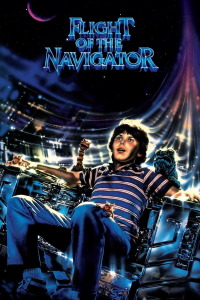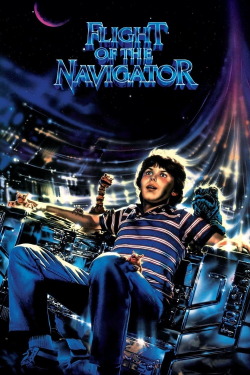
Review of Flight of the Navigator (1986) by ~Kit ~ — 01 Jan 2008
Okay, I have to say one thing that [i]really[/i] bothers me about this movie before we get started. It's a line you'll find a lot of other places, too, such as the Harry Dresden books by Jim Butcher. Every time someone says it, it jolts me out of the world of the story, because it's not true; we know it's not true; there has never been any evidence that it [i]is[/i] true. We do [i]not[/i] "only use 10% of our brains." We use 100% of our brains; just not all at once. Think about it from an evolutionary standpoint. [i]Why[/i] would an organ evolve that took up 25% of the body's resources if we only used 10% of it? That just doesn't make any sense. We're dangers to our mothers at birth because of our big brains; there's no reason they'd be that big if we didn't use them. And certainly any culture capable of building a self-operating starship that travels at superluminal speeds would know that.
Okay, I'm better.
Actually, some of the science here is astonishingly good, given that it's a children's movie from 1986. (I saw it in the theatre; yes, I'm old.) The craft is, as I said, superluminal, and that's why David Freeman doesn't age even though he's been gone for eight years. To him, because he is travelling faster than the speed of light, he's only been gone "2.2 solar hours" each way. According to Wikipedia, wherein someone better at it than I has apparently done the math, that's [i]2.25 million[/i] times the speed of light, given that Phaelon, the planet he was taken to, was said to have been 560 lightyears away. (Yes, kids, a "lightyear" is a measure of distance, not time. So, come to that, is a "parsec," but Han's error on that one has been retconned away.).
These two pieces of science, the good one and the bad one, are the structure on which the story is built. In 1978, David Freeman goes into the woods from his family home in Fort Lauderdale, Florida, to pick up his younger brother, Jeff. Jeff jumps out at him and scares him; David starts to chase him but falls down an embankment and blacks out. When he comes to, he heads home--but his family doesn't live there anymore; they haven't for years. It turns out that it is now 1986, and David has already been declared legally dead.
At about the same time, a strange silver ship crashes into some powerlines in an unidentified South Florida area. NASA takes it over, but they can find no way into it and no way to communicate with it. Then, David's brainwaves turn out to have produced an image of that ship, so NASA takes him, too. In another one of those good portrayal/bad portrayal moments, Howard Hesseman plays a character called Dr. Faraday, an obvious reference to famous scientist Michael Faraday. On the other hand, NASA's got some pretty intense authority; they're able to keep David against his parents' wishes and shut his parents in their house later in the movie. Anyway, the ship calls David to it, and when he's inside, it informs him that it loaded star charts into the "empty" 90% of his mind, and it lost its own when it hit the powerlines. It must take the knowledge from David's head. When it does, some of his personality goes with it, making the ship more a "he" than an "it.".
The special effects on this are amazing, especially given that there's little CGI here. The exterior shots of the ship in motion are, and that's practically it. They made models for the exterior at rest, and the really cool door dissolve was actually old-fashioned stop-motion animation. Max, the Paul Reubens robot character, is obviously a puppet, which is a more intelligent way to do it, if you can. It's almost certainly cheaper, for one! The stairs aren't CGI, either; they were built on supports that were designed to allow limited camera movement around them and still hold Joey Cramer's weight. (He's the kid who played David.).
I like this movie a lot. It still holds up pretty well, even 20+ years later. I like the handful of psych-outs in the early minutes of the film, where there are quite a few things that look like a ship . . . and then, when David [i]is[/i] abducted, we don't see it happen. I like that his mom is Veronica Cartwright, who was Cassandra Spender, herself an abductee, on [i]The X-Files[/i] some ten years later--and had been Lambert in [i]Alien[/i] some time before. This is even from the days when I still liked Sarah Jessica Parker.
This review of Flight of the Navigator (1986) was written by ~Kit ~ on 01 Jan 2008.
Flight of the Navigator has generally received positive reviews.
Was this review helpful?