Review of Flags of Our Fathers (2006) by Jay L — 16 Apr 2011
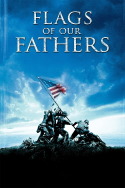
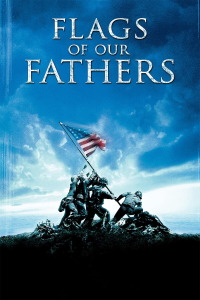
Riddled with over-sentimentality, "Flags of our Fathers" isn't nearly as effective as it could and should be. There's not necessarily one moment I can point to and say, "this scene is far too melodramatic." But there's an underlying tone, an insistence that we feel sympathy for these men, that eventually wears me down as a viewer and starts to annoy me.
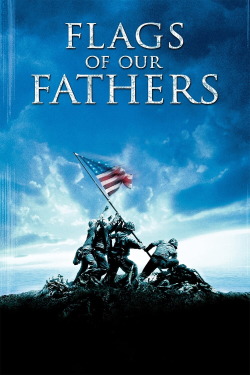
It chronicles the paths of six soldiers who raised the American Flag at Iwo Jima. That moment was photographed, and is now probably the most famous American war photo ever taken. We follow those who died, and those who lived on to come home. The movie tries to sell us on the notion that perhaps those who died were better off.
Three of these six men who came home are (possibly unfairly) manipulated into becoming soldier celebrities, and then are cut off once no longer needed. They're asked to give speeches, make public appearances, reenact the flag-raising, all in order to encourage American citizens to buy war bonds. We never get a sense as to how far their efforts actually go toward assisting the cause.
The three soldiers handle this newfound fame in very different ways. Doc Bradley (Ryan Phillippe), Ira Hayes (Adam Beach), and Rene Gagnon (Jesse Bradford) are our protagonists. We get to know Ira the best of the three, probably because as someone of American Indian heritage, he's got the most interesting story. He is the least emotionally stable of the three, has a drinking problem, and is occasionally harassed for his tan skin. Ira's character is also the center of the movie's over-sentimentality problem, and you can easily tell how that story could sink into "cheesy tear-jerker" mode.
The other two are not so interesting. In fact I'm not sure I'd call Ira "interesting," but the movie at least pays him attention. The other two don't have such a luxury, and if I were Jesse or Ryan I might be a little miffed at how "vanilla" I appear in the final cut. It's very difficult for me to describe these men because we know so little about them. They talk and act like soldiers, but we never get to see much of the human being underneath. It's not typical of a Clint Eastwood film to gloss over the character details, but this one does.
The war scenes themselves, however, are near impeccable. Eastwood tosses in a glimpse of war strategy into the action scenes which makes it feel all the more authentic. He tosses in the usual bits of heroism as comrades die, but again, it's difficult to feel much. Even when it's not overdramatized, all of the other characters are shallowly drawn. We get some specifics about many, but not many specifics about any. I find this approach to be eventually tiresome, as it gives the film a TV-war-movie-special type quality that it's never quite able to overcome.
Many say that "Letters From Iwo Jima" is a superior picture. It was nominated for academy awards, and "Flags of our Fathers" was not. Remember way back at the beginning of this review when I said there weren't any moments I could point to where I'd say "this scene is far too melodramatic"? Well, Iwo Jima has plenty of those, yet much more character depth. Take what you will. They're both overdramatic war movies in their own little ways, and in the end, as time passes, they will both likely be near the bottom of the list of AFI's "100 Best War Films.".
This review of Flags of Our Fathers (2006) was written by Jay L on 16 Apr 2011.
Flags of Our Fathers has generally received positive reviews.
Was this review helpful?