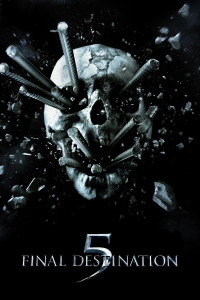
Review of Final Destination 5 (2011) by Shiira — 12 Sep 2011
As the incoming waves ripple nearby, an exhausted knight, recumbently inacitve on a rock-laden shoreline, starts to question the legitimacy of the cross, so proudly embossed on his chain mail vest, as he stares vacantly at god's kingdom, where from his vantage point on the primordial beach, sees only clouds and sky, and an eagle traversing across a gutted sky, recently secularized by the knives of devotional uncertainty.
Next, he washes his face in the ocean, violently shaking off the **** from righteous hands which killed in god's name; red-stained hands that are guilty of spilling Muslim blood across a European battlefield.
If Antonius Block, the skeptical mounted soldier in Ingmar Bergman's "The Seventh Seal", had the gift of premonition to foresee his own demise, like Alex Browning from the original "Final Destination", would he have bowed out of the crusade, and encourage his squire Jons, already a full-blown infidel, to do so likewise? For the sake of argument, let's say that Antonius cheated his ill-fated outcome, prompting death to come for the knight, who deserted the ongoing clash, thereby messing with the Grim Reaper's wicked designs.
Newly informed by the "Final Destination" films, Antonius gets cast in a new light when death pays the knight a visit, solving, for some, a long-standing question as to why the shrouded figure comes for the crusader now, having just survived the most perilous of situations, only to be sentenced, somewhat unfairly, during peacetime.
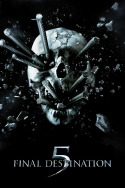
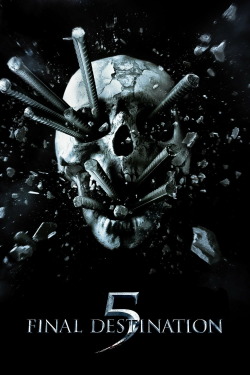
Like the bridge that collapses in "Final Destination 5", the unsavory side of life goes on, with or without Sam and his co-workers, as was the case with the Ninth Crusade, which when filtered through "Final Destination" and its sequels, continued on without the knight and his squire's participation.
Antonius doesn't seem at all surprised by his black company, conceding that this expropriation was long in the making. "My flesh is afraid, but I am not," replies Antonius to death's question about his departure from the corporeal world, a blatant lie that directly addresses the disgraced knight's conflicting spirituality.
Antonius, plagued with doubts about the existence of heaven, challenges the darkest adversary to a game of chess, in order to buy time for his devotional restoration, whose flagging conviction in god led to this crusader's resignation from the ranks of the soldiered brethren.
For the knight, the visage on the witch's face, as the men prepare to burn the young girl at the stake, looks all-too-familiar. "Her poor mind is making a discovery," observes the squire. Antonius knows.
He has seen the "emptiness", on the battlefield. Interestingly enough, "Final Destination 2" proposes the same godless diegesis as "The Seventh Seal", when during the film's opening credits, a talk-show guest differentiates death from the devil as the unseen malevolent force that struck down the survivors of Flight 180.
Instead of chess, in essence, these captive participants are playing hide and seek. Of note, Clear Waters hides out at a mental hospital(and not a church). Moreover, tropes innate to this horror series can be applied retroactively to the Bergman classic.
For the time being, death skips Antonius, intervening on the knight's behalf by agreeing to the proposed chess match, so as a result, Skat dies instead, when the black-robed figure fells the tree he was hiding in.
It's really no different from the case of Billy, who in the original, gets decapitated near the rails, after Alex pulls Carter out of his car, which he left lying across the railroad tracks, just before the collision which prompts the errant scrap metal toward their once-headed friend's direction.
The theater director, who runs off with a blacksmith's wife during his troupe's performance in a small hamlet, was slated to die anyways. Death skips him(and the married woman) because of the squire's calming influence on the cuckolded artisan.
Jons also saves a mute girl from being raped and murdered by a corrupt clergyman. However, as death and Antonius near the endgame to their chess match, the black figure says, "No one escapes me,", but Jof and Mia, Skat's actors, give it a go, even though, like the "Final Destination" films, wind signifies death's presence, as they flee by horse and carriage, thanks to the knight who, once again, meddles with the plan by creating a distraction with knocked-over chess pieces.
(Alas, the wind will return.) True to his word, Antonius and his friends follow death up a hill to their final destination; their hands interlocked, like a chain. It was predestined, but the knight changed death's plan.
Jof sees them from afar. The actor may have been lying about seeing the Virgin Mary, but not this. To the knight's disappointment, in death, he's probably not going to light up like Patrick Swayze in "Ghost".
Antonius Block won't be meeting the gymnast, or any of the other eviscerated victims in heaven.
This review of Final Destination 5 (2011) was written by Shiira on 12 Sep 2011.
Final Destination 5 has generally received mixed reviews.
Was this review helpful?