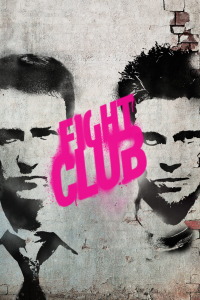
Review of Fight Club (1999) by Blake P — 03 Dec 2015
The hunt for grounded masculinity when surrounded by disaffection can be a tireless venture, and "Fight Club," a kinetic black comedy with a taste for brutality, seems to speak directly to angsty youths searching for their identity in a world where political correctness and selflessness reigns. It is a spiteful social commentary arguing against the patriarchy and vying for anarchy, looking for expression through bare knuckle fist fights and violent inflictions. And yet, it is quick-witted, fast-paced, and tireless in its movement - we can almost forgive it for its depravity, but not quite.
The last film in David Fincher's notable '90s ("Se7en," "The Game"), it is certainly his most controversial movie, his most insolent, and, arguably, his most artistically inspired. His best films almost exclusively deal with the hidden evils of human life, drenching themselves in near sepia with a darkness that seems to funnel through every situation, even if the given situation takes place at the center of a city on a particularly sunny afternoon. He can convincingly bring doom and gloom to a scene that suggests otherwise, and "Fight Club's" jokey-but-also-not flavors of villainy complement his oft near masochistic filmmaking sauces.
The film is narrated by and stars an unnamed Edward Norton, who plays an insomniac twenty-something depressed by office work and life itself. Never sleeping and never with much reason to live, he is emotionally deadened - to smile is a sequence forgotten by the Jane Fonda workout series. Desperate for something to enable him to feel, he begins attending local support group meetings, spilling his faux guts out to victims of testicular cancer and incest, to name a few. A great guy, if you ask me.
His innocent but morally wrong sneakiness is suddenly disintegrated by Marla (Helena Bonham Carter), another victim of life imitating his new hobby that optimistically sees something as traumatizing as devouring an entire bottle of pills as being a ticklish cry for help. So the joy he once felt during these meetings begins to plateau, making him decide to reignite an old habit that saw him taking aimless cross country flights just to escape the duties of his actual life.
On one such journey, he meets Tyler (Brad Pitt), a cocky soap maker who wants to see the world burn, but in a slow, chaotic way. At first, The Narrator sees him as a quick friend you meet on a flight only to never see again, but, as fate would have it, he arrives home to see his apartment burnt to a crisp. In desperation, he calls the number on Tyler's business card for living purposes, and, before long, they become a dysfunctional Bert and Ernie. Their nights enjoy little specks of anarchy here and there, most exemplified when Tyler challenges The Narrator to a fight one blistery night. But a couple of punches in the jaw and the latter feels more awake than ever: who needs therapy groups when able to put his knuckles to good use?
Unwisely, the two decide to start and curate an underground fight club, where morals are slippery and blood is spilled incessantly. For The Narrator, it is a perfect way to unleash the demons kept bottled up during office hours. But after Tyler begins to move forward and turn the group into a semi-terrorist organization, he ponders if getting involved with such a demented sadist was a very good idea to begin with.
"Fight Club" is widely seen as a cruel commentary reflecting the dissatisfaction of young men in the unforgiving world, dramatically using violence to relieve their repressions, but I like it better when it's looked at as a steep, stirring fantasy involving the famous "my own worst enemy" trope, where self-interest and binding mistakes can be more harmful than anything Batman or The Flash ever faced in their heydays. "Fight Club" goes hard and far with this idea, and when the infamous plot twist crashes onto the screen, we're left white knuckling the armrests of our movie seats as we predict just how our narrator is going to make it out of the situation he so precariously has gotten himself into.
I also fancied the performances, which all pass by with a slightly unhinged electricity rabid in their demeanor and their characterizational novelty. Norton, unreliable and despicably disturbed, is an effectual anti-hero in over his head but too cowardly to do anything about it - but what would we do in his shoes? Pitt brings manic menace to the role in the same way he did in "12 Monkeys" in 1995; he is charismatic, sure, but the further you travel down his ethically ambiguous road, the more you'll find yourself a man wanted for all the wrong reasons. Best is Carter, who is blustery, chain-smoking, and frenetic, an anti-love interest for an era.
But when not cheering on its performers, and when not attempting to analyze its purpose, I don't think "Fight Club" is as deep or as insightful as many of its fanatics tout it to be - for me, it's less satire and more a culmination of kept-hidden-but-now-out-front violent daydreams, testosterone-fueled and a bit grotesque. I don't want to like it, and yet it's so feverish, fast, energetic, darkly funny; a cinematic fish-out-of-water that manages to thrive despite the odds. You'll hate it, you'll like it, or you'll love it. Or, if you're like me, you won't know what to think about it.
This review of Fight Club (1999) was written by Blake P on 03 Dec 2015.
Fight Club has generally received very positive reviews.
Was this review helpful?