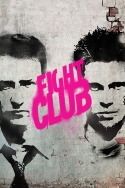
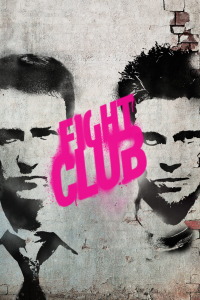
Review of Fight Club (1999) by Lina Y — 26 Apr 2017
Applying a Marxist- Freudian Critical Lens to Fight Club.
By: Lina Yagan.
In this review, a political analysis of Fight Club will be conducted under the light of Marxist and Freudian philosophy. Marxism is a philosophy based on a reaction against Capitalism that aims for a fair distribution of wealth among different social classes while Freud targets the motivations of the unconscious mind. Within Fight Club, an interplay of themes regarding the issues of architecture of containment by the mind and deliverance of social justice are addressed. It is critical to note that the character of Tyler Durden constitutes a fabric of the narrator's unconscious as it forces the viewer to reconstruct the narrative.
The narrator remains unnamed in Fight Club in order to signify the extent to which he is an insignificant drone, an unmotivated office job worker going through the motions of everyday life to earn money used to purchase temporal possessions. He is depicted as a man with the ideal American lifestyle championed by advertisements. Thus, he is set up as a universal, mundane man, one that the audience can easily connect with, especially in such a market driven society. His character is mainly defined by the contents of his suitcase, his designer clothing, and his IKEA furniture in his apartment. Marx would define his existence as one that is at mercy of corporations and conglomerates. His conformity to consumerism culture inflicts him with emptiness and a lack of meaning in life. He is left in a state primed for a transformation.
At a critical turning point in the film when his apartment burns down and he loses all material possessions, he rejects all principles of Capitalism and turns to its binary opposite, Communism. In a Marxist sense, as Tyler or the narrator destroys his own apartment, he is initiating the first step of saving himself from corporate enslavement and materialism. Freud would comment on how his living arrangements symbolize the state of his mind. When his apartment burns down and becomes the site of explosion, the destruction marked by the setting symbolizes the narrator's mind. The build up of unconscious dissatisfaction literally erupted and drove the narrator to tear down his manufactured consumer-self and reduce it to rubble. This shift is accompanied by the prominence of Tyler Durden's role as a character, who is presented as completely emancipated and free of normal social conventions. He has no stable job and is committed to tearing down old established institutions such as banks. Thus, he serves as an anarchistic antithesis to the narrator. Once the narrator moves in with Tyler, in a dark, run down home, the narrator achieves a newfound identity. The house is in disarray which represents how the narrator attempts to navigate the multiplicities of his identity as it is split between himself and Tyler. As the film progresses, the setting becomes overpopulated and filled with volatile soap, foreshadowing the upcoming psychic breakdown of the narrator as he is unable to unify his identity and his sense of fragmentation worsens.
Tyler advocates a return to a primal version of masculinity through violence.
Violence in Fight Club is a crucial binding component of members as it provides them with a concrete experience of their ability to overcome pain and fear. These acts of violence portrayed in the brutality of the fights and acid burns are glorified for their cathartic release for working class men seeking redemption and justice in a society that consumes them. Fight Club in itself is a destructive movement for the greater purpose of achieving economic equality. Project Mayhem, primarily directed by Tyler, gives these corporate drones a sense of transcendence of strict societal boundaries. This idea of escaping consumerist culture is the main motivation behind joining Fight Club in order to break the monotony of their daily routine.
The Club serves as a portrayal of Communism in how all of the members are stripped of their individual clothes, their IDs, and names. They all become part of a homogenized culture denoted as 'space monkeys'. According to Freud, the film gratifies men's repressed rage underneath their civilized façade. In joining Fight Club, these men have reached a certain level of discontent with their surroundings that demands a release of pressure from institutionalized control. Ironically, as it would be detailed by Marx, they have created a new herd led by Tyler after breaking from consumer society.
In laying out the rules of Fight Club and illuminating the injustices of corporate society in a speech designed to emotionally move the crowd of space monkeys, the camera zooms in on Tyler's face in several close up shots to suggest that he is speaking for the club and its unconscious ideology.
Once the line between redeeming masculine power, cathartic release of pain and murder of one of the members of the club through barbaric acts of terrorism become blurred, Jack realizes that the social order he has created has effectively become more dangerous than the one he set out to replace. When Jack attempts to stop the planned bombings, he is threatened to be castrated by members of Project Mayhem, and by extension threaten to emasculate him. Jack salvages his manhood by confronting Tyler and ridding himself of the immense unconscious control imposed by his dangerous alter ego.
Fight Club is a movie that details the pursuit to live free of the external pressures of society. However, the ending of the film notes that such a life does not go without consequences. Although Tyler emerges as the figurehead of Communism, as his ideas become more radical, he is more in alignment with anarchy. The film critiques Capitalism, yet observes how the alternative does not provide a viable option either. Jack is able to liberate himself of his unconscious tension through the creation of Tyler, but ends by reclaiming his civilization. However, when an obscene flash at the end of the movie occurs, which serves as a reference to one of Tyler's part time jobs of changing projectors, the audience is left questioning whether the unconscious influence of Tyler truly subsides or if it could be reawakened.
Ultimately, Fight Club's exploration of the sociological to the psychological marks the heavy Freudian and Marxist influence in this film.
This review of Fight Club (1999) was written by Lina Y on 26 Apr 2017.
Fight Club has generally received very positive reviews.
Was this review helpful?