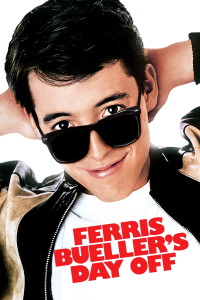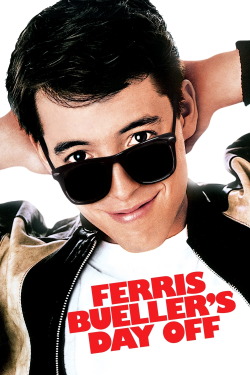
Review of Ferris Bueller's Day Off (1986) by Roberto B — 06 Dec 2014
"Ferris Bueller" has its moments, and most of the best ones are of its own making. The much greater number of moments that don't work are a mix of atonal original content and otiose memes of better films.
Almost immediately, Ferris sets the movie outside the bounds of realism by talking to the camera. The technique suits Matthew Broderick's characteristic sense of detachment from the process of acting, his ability to exist on screen without seeming to even try to act but without seeming at all natural either. The cold eyes and feces-eating grin that accompany his verbal asides, though, give the impression that something more is going on in the film than whimsy. There is a darkness-not exactly a darkness, but a kind of menacing quality to the movie, as though it were a prank, and the audience is forever suspended in the instant of dawning horror and appreciation. It as as if John Hughes and a real-life Ferris Bueller are out joyriding in our cars while we are trying to figure out what we are watching, and realizing that it is both a joke for us and a joke on us.
The laugh-out-loud bits are played fairly straight. Ben Stein's steady drone in front of catatonic students. Charlie Sheen's cameo in which "drugs" is an inevitable but perfectly-timed punchline. The cheery profanity of a seemingly old-fashioned school secretary. A glorious song and dance number in the middle of the movie fills the streets of Chicago with color, and the spectacle seems as rich with directorial intent as it is with pure exuberance. John Hughes' placement of WASP city fathers on one side of the street, the ethnic European element of the city in the center, and the black community on the other side is undoubtedly conscious, and is appropriate for Chicago. There is probably no attempt at a social message here; it is part of the movie's non-judgmental celebration of the Windy City, and to portray the city as integrated would have been false.
A gawking fixation on Chicago adds to the sense that there is a movie going on beneath the movie, because there is no way that a kid like Ferris would choose this itinerary for his dream day. The Sears Tower? It's only for tourists. The Art Institute and its collection of 19th and 20th century masterpieces? Please. A black tie restaurant? I'd expect a real teenager to prefer deep-dish pizza and brats. Maybe the secret to understanding Ferris is that he's having the dream day that adults wish they had had, but only if they had known then what they know now.
But if Ferris is such a figure of fantasy, and so above the movie, why does Hughes burden him and his friends with the serious suburban anxieties that some people decades later derisively dub "affluenza"? Hughes had covered that ground very well in "The Breakfast Club," a film whose kids are much more real. In this movie, with its cultivated sense of superiority and apathy, the periodic downshift produces whiplash and slows the pace to an intolerable crawl. Alan Ruck is a good actor, but his best friend character is designed to be a drag and succeeds at it better than intended. Mia Sara's idealized, sexualized girlfriend character is a drag, too, because she has so much less mold-breaking individuality than Ally Sheedy and Molly Ringwold had brought to their earlier collaborations with John Hughes and Matthew Broderick.
Yet "Ferris Bueller" prefigures 21st-century entertainment in a way that the thoroughly dated brat pack films do not. Its use of antihumor, wherein a joke is held in abeyance for a long time while anticipation builds, and in which the big payoff is often understated, paved the way for postmodern high school comedies like "Napoleon Dynamite." This approach to humor is best exemplified by the additional content that plays during the movie's closing credits. Such stingers are rarely seen before "Ferris Bueller" but became a staple of the genre afterward. Instead of using 80s hits, the movie's musical cues are more timeless, like John Lennon and the theme from "Star Wars." Frequently, though, its pop culture references feel arbitrary and meaningless. Why bring "Alien" or Wayne Newton into this? They're drawn from a hat, like a "Family Guy" joke or an internet gif. Like them, the uneven "Ferris Bueller" is sometimes funny, sometimes obnoxious, and sometimes just puzzling.
This review of Ferris Bueller's Day Off (1986) was written by Roberto B on 06 Dec 2014.
Ferris Bueller's Day Off has generally received very positive reviews.
Was this review helpful?