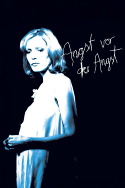
Review of Fear of Fear (1975) by Lina A — 02 Feb 2009
This buried treasure of loneliness views Ali, a young Moroccan "guest worker," and Emmi, a widowed cleaning woman. They are roughly thirty years apart in age. They meet when Emmi dodges inside a bar, obliged by the rain and enticed by the foreign music. The German bartender suggests Ali ask Emmi to dance, and she agrees. An odd and uncommon closeness stems, then a romance and ultimately they briskly choose to marry. Gossipy neighbors, normally Emmi's friends, treat them with scorn. Emmi is ignored by her colleagues, and Ali meets intolerance constantly. When Emmi, whose first husband was a Polish worker she married against her Hitler-loving father's wishes, invites her three married children to meet her husband, they viciously reject him.
Fassbinder's mid-career film, an admirably cynical response to the work of Douglas Sirk, was shot in just under a couple of weeks, and was intended as an exercise for Fassbinder, to occupy the time in his schedule flanked by the work on two other films. I think it speaks volumes that, with that in mind, this film is regarded as one of his best. He may have never stopped to take a breath, and he may have really made so many films at such an unheard-of frequency because he wanted to stay busy, but, judging by this film, that is not to say he churned them out half-assed. There is a lot of nuance and significance in this film.
Fassbinder may well have been an embittered soul, for he knew so well how to be nasty to his characters. He establishes an unusual social state of affairs and watches coldly through scenes of agonizing shame and grief. It is a careful though natural mockery of soap opera. He spends the resources of melodrama, but with a frankness and fondness of chance plot progressions that evoke a detachment from the accepted structure. No matter how unusual, unlikely, weird and wonderful the relationship is between an old white woman and a young black man at that time in that place, they are still unwitting clichés, just like everyone is when they are in love. Thusly, no matter how unlikely a social situation this film depicts, it is still made of melodramatic formula. Fassbinder wants us to be aware of this.
There is a dichotomy to the film, as one can also view it as subjectively as one would and see something just as organic and sad, the vicious cruelty of society en masse, archaic followers with their ears perpetually to the ground for information about others to absorb and spread through their networks of superficial acquaintances, never looking within themselves, never able to accept those who can, those who are different, and virtually incapable of accepting those who are one of them who is in fact willing to accept those who are different.
This West German romantic drama has a rather inconsistent cast, providing good performances, namely from Bridgitte Mira, and not-so-good performances, but its technical work is remarkable. It is almost entirely constructed out of people looking and watching, expressionistically frozen as they overtly stare in judgment and hostile analysis of those off- camera, or those in the foreground. We rarely see that in real life, but if we stripped away the false exteriors of so many people in public, we certainly would.
This review of Fear of Fear (1975) was written by Lina A on 02 Feb 2009.
Fear of Fear has generally received very positive reviews.
Was this review helpful?