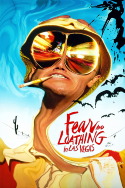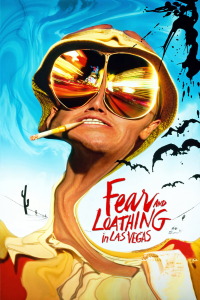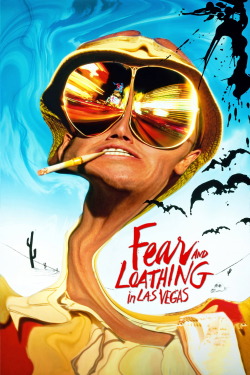
Review of Fear and Loathing in Las Vegas (1998) by John L — 13 Oct 2013
This film is not as strong as Gilliam's Time Bandits, Brazil, Twelve Monkeys or Fisher King. Similar to Kerouac's "On The Road," the original publication of which is a rambling 'Roman a Clef' road trip novel, the eponymous book on which this film is based is similar in structure. (Kerouac's original On The Road manuscript scroll containing the real names and places was subsequently published decades later.).
To begin to comprehend the film, one must see it as an expose of the failed 1960's reality-warping psychedelic drug counterculture continuing to be pursued by two traveling buddy protagonists, amidst the excesses of a coarse materialistic and hedonistic 1970's consumerism culture epitomized by Las Vegas. The lurid novel is considered a prime example of Thompson's first-person "Gonzo Journalism." Characterized by some as a "Dark Comedy," it wasn't that comedic to me, albeit comic relief is used here and there a few times. I classify it as a very surreal drama, with reality warped and twisted through the psychedelic haze of Depp's character. The two clashing cultures are exaggerated and caricatured as viewed through the drug-induced psychedelic haze of Raoul Duke, the author protagonist (Dr. Gonzo, the other protagonist is is traveling companion attorney). Some understanding of Timothy Leary's "Turn on, tune in, and drop out" mantra (credited to Marshall McLuhan: "drop out" is not its normal interpretation; the phrase is widely misunderstood), and mid-1960's San Francisco Haight-Ashbury district Hippy culture helps to understand the "mind expanding enlightenment" Raoul Duke (Depp) continues to pursue for his journalism, chasing an elusive "American Dream" with his drug and drinking buddy Dr. Gonzo (Del Toro), but fails to find.
Some reviewers negatively cite the film as meandering, repetitive and aimless. That's exactly the most important point they've missed. It represents the demise of the 1960's psychedelic counterculture in its failure to achieve an "American Dream" it can neither find nor create. Thompson's novel defied a number of attempts to adapt it to cinema prior to Johnny Depp portraying Raoul Duke (Thompson) and Terry Gilliam directing. Screenplay by Cox was dumped and Gilliam had about 10 days or so to come up with a new one. Adapting the novel was difficult at best. Doing so in under two weeks resulted in a screenplay that did not convey the novel as well as could have been achieved with more time. The film will very likely always have mixed reviews among critics, who either understand the underlying Thompson's "Gonzo Journalism" and 1960's counterculture, and those who do not, or cannot accept the film's basic premise of the counterculture failure and how it's portrayed.
Gets a positive 3 stars from me as it's a worthy effort but doesn't convey its points as well as it could have, keeping in mind that others prior to Gilliam never got off the ground with it. One must have some knowledge and understanding about Hunter S. Thompson, his "Gonzo Journalism," and the mid-1960's psychedelic counterculture to grasp this film in its depth. Otherwise it comes across superficially as a Drug Laden Frat Party Road Trip Documentary. Overall it's worth seeing, but it's not among the best of Gilliam's work because it requires this prior knowledge, and eliminating that necessity would be quite difficult. Perhaps that difficulty is why others could not get a cinema adaptation off the ground.
This review of Fear and Loathing in Las Vegas (1998) was written by John L on 13 Oct 2013.
Fear and Loathing in Las Vegas has generally received positive reviews.
Was this review helpful?