Review of Far from Heaven (2002) by Manny C — 11 Jan 2011
What interest could a movie about a housewife in 1957 Connecticut generate? Plenty, it turns out. That was the case in 2002, and I nothing's changed. Todd Haynes' Far From Heaven is a new modern classic, book ended by the brilliant performances if its stars Julianne Moore and Dennis Quaid. It's also the chick-flick genre raised to the level of art, form the director who guided Moore through the stunning 1995 feature Safe. Here is a movie that is rapturous in its impact, and astonishingly riveting.
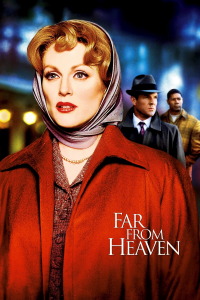
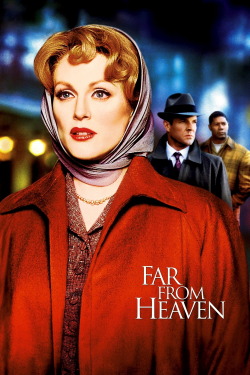
In Far From Heaven, 1950's America comes off like an exotic parallel universe, sort of like the 1950's we see in the movie Pleasantville, only alive with thrilling color, a sign that the era was very, very real. Moor is Cathy Whitaker, the ideal housewife, coiffed and costumed like a sitcom wife. She's married to Magnatech TV executive Frank (Quaid) and mother to their two children. She's also a girl who likes to have fun, as in the scenes where she dons an apron and high heels, giggling with her girlfriends over daiquiris. Cathy is so well-regarded that the local paper showers her with praise, calling her a 'woman as devoted to her family as she is kind to Negroes.'.
But this isn't some campfest a la John Waters. An impending shadow is about to loom over Cathy's perfect world. Though there is plenty to chuckle at in Far From Heaven (like the aforementioned newspaper praise), the laugh are more likely to come with a sting. Frank begins cruising men, and when Cathy catches him with another man at his office, Frank immediately goes to a doctor for a 'cure' that has no effect. Cathy is so traumatized she won't even tell her best friend, Eleanor (Patricia Clarkson, deliciously witty). She does confide in Raymond (Dennis Haysbert), her handsome gardener. Raymond get Cathy to let her guard down and be comfortable. But Raymond is also black. Consequently, more scandal engulfs Cathy's life.
Cathy becomes a social outcast, uprooted from a life of complacency into a rude awakening of her reality as a woman in America. Moore is astonishing in the role, digging so deep into Cathy they seem to share the same nerve endings. Here actress and character breathe as one entity. And Quaid is just as excellent, far from leading man heroics. His performance is revelatory. Quaid ably finds the aching heart and the unearthed heat in a man plagued by identity crises and prone to casual bouts of cruelty to his wife.
And then there's Haysbert, deftly playing Raymond for real and not for show or caricature. Raymond boldly takes Cathy out for a drink at a 'colored' restaurant. She's mesmerized by his tenderness. But each one is an unwelcome presence in their respective worlds. Cathy was always polite but distant to her black maid Sybil (the lovely Viola Davis). It's that discovery of her own biases and hang-ups that sets puts Cathy in a new light and puts her life adrift. Indeed the scene where her lilac chiffon scarf flies off of her head can be a metaphor for her old life giving way to a new existence. Raymond happens to find the scarf. 'I had a feeling this might be yours. The color. Just seemed right.'.
Color is a major focal point of Haynes' directorial eye, signifying the codes and trademarks that define these characters. It's the cinematic foil of the color schemes used by Wes Anderson in The Royal Tenenbaums. In that film color was an illustration of the cartoonish, here it's the symbol of what roles these individuals are supposed to fulfill according to society's whims. This helps makes Haynes an authentic disciple of Douglas Sirk, the German director who made a name for himself in the 1950's with a series of women's pictures (Magnificent Obsession, Written On The Wind, Imitation of Life) that were thinly veiled attacks on societal conformity. Sirk was best known for a visual style that implemented flamboyant colors, shadows and light, articulating the forbidden and taboo.
Haynes uses Sirk's classic All That Heaven Allows as his template. That 1955 weepie starred Jane Wyman as a widow who becomes a social pariah when she begins dating her gardener, a significantly younger man. That that man was played by the iconic Rock Hudson, himself a closeted homosexual at the time, serves as a perfect subversion of the genre. In Haynes' film, cinematographer Ed Lachman--in a glorious display of visual poetry--floods the screen with color, complemented by the buoyantly romantic score by the late Elmer Bernstein.
Far From Heaven is no mere copycat film. Rather it's a reinvention, one that allows the underlying passions of Sirk's film explode on the screen. Haynes and his producer Christine Vachon aren't searching for cheap nostalgia. This is imitation of life as is, in all its harsh brutality, both figuratively and literally. It's a cracked mirror to the here and now, even ten years later, with fears about race, sexuality and feminism stil prevalent. Those same fears existed back then, and just like today they were sold in packages of religion flag and jingoistic patriotism. These themes were hardly unheard of in George W.'s America, nor are they extinct today. Far From Heaven is movie heaven, it's raw emotion devoid of irony. The past decade produced no end of splashy, gargantuan movies, but few cut as deep as this beauty.
This review of Far from Heaven (2002) was written by Manny C on 11 Jan 2011.
Far from Heaven has generally received very positive reviews.
Was this review helpful?