Review of Fantastic Mr. Fox (2009) by Brett C — 19 Nov 2014
Review In A Nutshell:
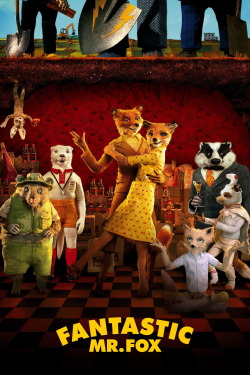
Animation has been, in recent years, a bit predictable and safe. Disney films, with only some as an exception, have taken familiar a formula to drive almost all of their films with only a minor set of tweaks, hoping it would be enough to create a sense of originality. In the hand-drawn animation department, Studio Ghibli is winning the battle with their bold and graceful artistic choices, fuelled by a sense of imagination and hidden symbolism. Pixar has established themselves as the leaders of three-dimensional computer graphic animations to create wonderful stories that deliver multi-generational accessibility and richly appealing characters and worlds. Fantastic Mr. Fox belongs in the underrated category of stop-animation films, which is an area of animated filmmaking that rarely gains a large audience, as some feel it lacks the realism and wonder that other modes of animation could deliver, and the difficult process of creating such a feature does not entirely justify the benefits of the finished product.
I believe that animation should not be limited by its two popular options. There are gems found in a stop-motion animated film that easily becomes lost when told in another medium. If Fantastic Mr. Fox was told through hand-drawn animation then all of its three-dimensional charm is lost, creating flat characters and a world lacking in complexity. Using three-dimensional computer graphics could achieve that extra dimensions that the hand-drawn animations lack, but they tend to give that smooth texture that keeps the film from seeming life-like, also the comedic aspect of the film wouldn't have been achieved as effectively if told in this way. Stop-motion animation may not be the most deliver the smoothest of movement from its characters, but it doesn't have to because what we are seeing are actual living objects that are interacting with one another, which is hard to convey with the other two options.
The film was under the direction of visual director, Wes Anderson, and what he brings to this is a sense of style that is certainly familiar to the fans that have been long following his work, but it also brings something entirely different and unique to the realm of stop-motion animation; the film is leaps and bounds beyond Chicken Little and the Wallace and Gromit films. Anderson's visual and artistic trademarks are here and they are on full display, giving the characters and their world a sense of strangeness and eccentricity, gaining a sense of escape during the experience; but since Anderson is handling fictional characters rather than human projections, their personalities do not seem as odd or intense as his previous films. It actually allows it to become easier for a person, who is unfamiliar with the director, to come into this and still feel like they just experienced another run-of-the-mill animated film; and Anderson knew his target audience and what their expectations were. If he decided to crank up his usual style to maximum, just so the film would really stand out from its peers, then it's going to have people turn their heads and probably lose the natural charm that made the film so appealing.
I cannot note in this review whether the film remained true to Roald Dahl's novel, as I have yet to read it; therefore do not expect any comparisons here, and everything I would state or judge on the film's story would be purely based on the film itself. Wes Anderson returns as the film's screenwriter, collaborating once again with his friend Noah Baumbach to create Fantastic Mr. Fox. I was a little sceptical on whether or not I would find myself pleased with the film, as when they both worked together previously on The Life Aquatic with Steve Zissou, I was left disappointed and so far I have regarded it as Anderson's weakest film. After watching this, I was a little stunned on how much I actually enjoyed it. It provided a simple and accessible story, but made it feel mature and complex in its core relationships. They treat the film's characters with effort and respect, demonstrating layers that shape their outer personality and acts as drives to the logic of their decision-making. Dialogue is another thing that the film does wonderfully well, with characters seemingly distinctive and back and forth chatter that is not only hilarious but also thoughtful; it coveys its themes through the intentions and values of its characters, ensuring that the film is about them and not something much larger, like what was done in The Darjeeling Limited. The film also manages to be risky in its choice of words, bringing up themes that seem inappropriate for a young person to hear but hidden cleverly enough behind their hilarious remarks and witty substitution of particular words. They achieve all of this while also providing, assumingly, a faithful interpretation from the source material. Anderson and Baumbach have delivered a screenplay that is both superficially entertaining and emotionally insightful.
The film starts off as a fox couple who live their lives as bandits, benefiting from the riches of their loot, then suddenly Mrs. Fox announces her pregnancy which forces both of them to turn their life around and become a settled and honest family. From there, years later Mr. Fox decides to get back in the game and do one more grand scheme, but then things get out of hand and their entire community becomes affected by his actions. His journey was fun, wild, and tense; there were sequences in here that I would probably never forget, but the film is not really about the spectacle, it's about the relationships and drives of its characters. Mr. Fox is an individual who is driven by his ego, who basks in the glow of success. His sudden change to a "normal" life was manageable at first, but as time went by, it becomes much more difficult to live such a mundane and tedious life where no one even appreciates the writing contributions he brings to the local newspaper. His personality and high expectations also contributes to the dysfunction between him and his son, which is something Anderson treads on frequently with his films. He expects his son to be naturally talented, similar to himself, and passively shows disappointment when he isn't able to fulfil his expectations. It is relationships like these in the film, that makes these characters feel real and complex, rather than empty vessels who's aim is to push the plot forward; it also gives the film naturally earned emotions that aid in the growth of its characters.
Along with its themes of ego and family dysfunction, the film also touches on the idea of adaptation. The film shows us by the end of the film, the determination of these characters to survive in such a difficult and selfish world. In whatever habitat that these animals are put in, they are able to make the best of it, and slowly in their own way fighting and taking back from humans what is rightfully theirs.
Robert Yeoman sadly does not come back here for Fantastic Mr. Fox, and that is understandable as it would take a person who has deep experience of stop-motion animation, and who better than Tristan Oliver, who has previously worked on films including Chicken Run and Wallace and Gromit: The Curse of the Were-Rabbit. He is able to do this while still staying close to the vision of the director, emphasising the centred shots and the sudden push-ins and pull-outs. I also cherished the film's orange-brown warm glow to its image, giving it that earth-like feel to it. It was also disappointing to find that Mark Mothersbaugh did not come back to compose the score for Fantastic Mr. Fox, and instead done so by Alexandre Desplat. Desplat is an amazing composer, and his so-far three films with Anderson have been fantastic but there is just something about a long-time collaboration that makes it seem more connected and fantastic. Mothersbaugh brought a lot of charm to Anderson's films, and because of him a lot of his early films sound and feel beautiful. Desplat has a different approach, it has this magical, larger than life quality to his scores, and Fantastic Mr. Fox is one of his more grounded and child-like works, which suited to the film's story and characters. I don't know why I even decided to make a comparison if Desplat did an equally strong enough job in this film. I think I just cannot help but wonder on what the film would have sounded like if it Mothersbaugh was under the role instead.
The film's cast was fantastic, as expected, with new members joining Anderson's troupe; George Clooney and Meryl Streep. Both were perfect choices of casting, demonstrating effective and heavy chemistry between the two, allowing the emotional scenes of the film feel natural. The rest of the cast are familiar members of Anderson's filmography; Bill Murray, Owen Wilson, Jason Schwartzman, Willem Dafoe, Michael Gambon, Adrien Brody and Brian Cox. All of them do a wonderful job with their characters, especially Jason Schwartzman.
Fantastic Mr. Fox feels like a refinement of Steve Zissou, executing character-driven stories with large and ambitious action sequences; laying the groundwork for his audience of the direction of his future as a filmmaker.
This review of Fantastic Mr. Fox (2009) was written by Brett C on 19 Nov 2014.
Fantastic Mr. Fox has generally received very positive reviews.
Was this review helpful?