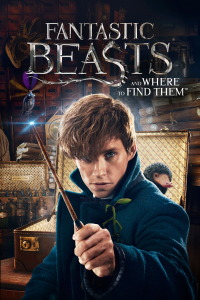
Review of Fantastic Beasts and Where to Find Them (2016) by Blake P — 02 Jan 2017
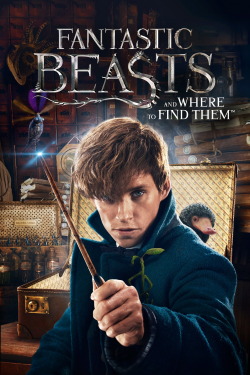
Only a handful of writers are able to capture the imagination as exquisitely as J.K. Rowling, and 2016's "Fantastic Beasts and Where to Find Them" (based upon a fanciful textbook discussed in the "Harry Potter" series that was later published in 2001) retains Rowling's unmistakably vivid way of transporting her audience into a dreamworld of fantastical proportion. The film, visually glorious and old-fashionedly adventurous, stars the adeptly cast Eddie Redmayne as Newt Scamander, a British wizard and magizoologist briefly stopping in New York City en route to Arizona.
What's supposed to be a nonchalant couple days starts to resemble something of a fiasco, however, when a mix-up leads to an average Joe of a baker, the kindly Kowalski (Dan Fogler), ends up with Newt's suitcase. With Kowalski being a No-Maj (or Muggle, a term made famous by Harry Potter and all his friends), this could spell disaster, especially since the suitcase is hardly a suitcase at all but a magically-expanded piece of luggage wherein all of Newt's captured beasts reside.
Irked by the magizoologist's haste, ex-Auror Porpetina Goldstein (Katherine Waterston) takes the man to MACUSA (Magical Congress of the United States of America) headquarters in hopes of the guy getting some sort of fitting punishment. But such a mission is thrown off course by the abounding instances of wrongdoing on the part of dark wizard Gellert Grindelwald (played by not one but two Hollywood big-wigs not to be revealed) and the rising wrath of Mary Lou Barebone (Samantha Morton), the leader of the New Salem Philanthropic Society who wants nothing more than to expose the wizarding community and create a new sort of civil war.
With such intrigue overflowing, it's unavoidable that "Fantastic Beasts and Where to Find Them" be anything other than overstuffed. Like all Rowling's Harry Potter centered works, so much is in store that neither a book nor a film seems enough to completely grasp her vision and the responding fantasies that expectedly thrive in her audience's active imagination. Doubtlessly is this the reason why her body of work has never faded in its near two decades of existing in the public eye.
And "Fantastic Beasts," a pre-Depression era prequel to the misadventures Harry, Ron, and Hermione faced in their youth, is a breathtaking reminder as to why her ageless series is still a vital part of much of the population's childhood. Once again are we made to remember that no other writer working today is as magnificently inventive as Rowling -- watch the film's special effects and see its many fantastic beasts and we once again turn into the easily amused children we were when we were first introduced to Quidditch, to the Invisibility Cloak, to the Chamber of Secrets. How revitalizing it is, then, when the versatile talents of computer imagery are used ingeniously rather than for the sake of supplementing intense action sequences. I particular love the many warped takes on 1920s American culture, from journeys into goblin-run speakeasies to the stereotypically swanky costumery featuring dashes of whimsy, and the way everyday tasks are made awesome to behold, from the way a scene sees an entire dinner being made by disembodied hands to the way transportation goes from subway dependent to teleportation bent.
For all its instances of gasping wizardry, though, "Fantastic Beasts and Where to Find Them" struggles in (or, at least, is slow about) deciding what direction it's trying to move in. Its prologue informs us of the aforementioned Grindelwald's terrorization of the magical population, and so we're safe to infer that his existence will likely be pivotal toward the film's finale. But Rowling forgets to develop why the man's such a threat and what he gains from his exploitation of weaker characters connected to Morton's Barebone. Antagonistic development is generally thrust downward into the throes of ultra vague foreshadowing for far too long. We love the protagonists of "Fantastic Beasts," and that's immediate from the get-go. But we spend so much time with them and the clever special effects that surround them that it's never crystalline, at least until the first hour of the film commences, as to what the threat that will someday face them will be or where the film's moving on an overarching level. It's playful, stakleless, for too long. When it starts to go somewhere, our interest has already waned.
But it does eventually pick up, and the world created is enough to keep us at least slightly dazzled when everything else is without shape. Its cast ever charming, too (Fogler, along with Alison Sudol as Tina's girlish sister, is a revelation), there's almost enough charisma in store to keep us distracted from "Fantastic Beasts and Where to Find Them's" many setbacks. Almost.
This review of Fantastic Beasts and Where to Find Them (2016) was written by Blake P on 02 Jan 2017.
Fantastic Beasts and Where to Find Them has generally received positive reviews.
Was this review helpful?