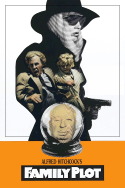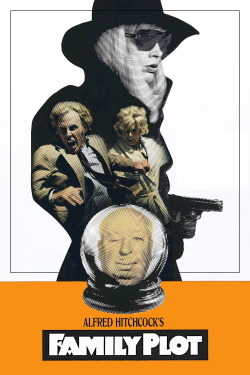
Review of Family Plot (1976) by The Movie W — 11 Aug 2012
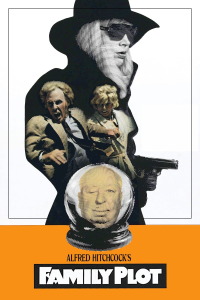
Hitch's final film is a convoluted and talky affair which plays more like the TV movies of it's era.
The director had prided himself throughout his career on his ability to sidestep plot, dialogue and character, three aspects of film-making that are given far too much credence today. His last film is brimming with all three, to it's detriment. It plays more like a made for TV Coen brothers film than a work of the master of suspense.
Harris is a fake psychic who, with boyfriend Dern, attempts to swindle money from an elderly client by tracking down her long lost son. That son is actually Devane, a jeweller who stays in business through kidnap and extortion, aided by his lover, Black. When Devane realises Harris and Dern are about to expose him he sets out to have them killed.
This film is unbearably talky, by anyone's standards, let alone Hitchcock. The opening scene alone contains more exposition than his entire output of the previous twenty years. It's script is written by Ernest Lehmann who penned the great "North by NorthWest", a shining example of visual storytelling if ever there was one. That movie had no plot, it didn't require one. Hitchcock actually mocked plot driven films by having the one moment when a character is about to explain all drowned out by a loud airplane engine. The roar of a jumbo jet would be far preferable over the stream of badly written dialogue offered up here.
Naturally there are some impressive visuals but they occur all too rarely. The most famous shot involves a crane into a huge close up of a diamond hidden in a chandelier. Hitchcock was the primary influence on the makers of Italian thrillers in the seventies and here he gives them a nod in a great tracking shot following Black, disguised in the sort of outfit the villain of a giallo might sport, as she picks up a ransom from a police station. Lady Gaga, of all people, referenced this scene in one of her music videos.
At this stage in his life, Hitch was in troublesome physical condition. During filming of "Family Plot" he would receive a telephone call from the studio execs each morning who had him place the receiver against his chest in order to determine if his heart rate allowed him to film that day. His lack of mobility is the primary reason for this film's absence of visual inventiveness. By 1976 the idea of filming a scene in a car on a sound stage was old hat but Hitch's health prevented him from location shooting. As a result the scene where Dern tries to control a car with sabotaged brakes resembles something from an Ed Wood movie, the projected backgrounds moving at a ridiculously fast speed. No doubt realising it would look absurd, Hitch has Dern and Harris play the scene for laughs which makes it even more cringeworthy.
Another problem is the soundtrack by John Williams, fresh off his iconic work on "Jaws". A criticism often leveled at the composer is that his music is often overbearing and that's certainly the case here. The central harpsichord theme (again familiar to fans of Lady Gaga) is irritating and gives the film a cheap "Movie of the Week" feel. At one point the camera pans to an open window to reveal a character has just made his exit. Williams wanted the score to swell when the window comes into view but Hitch wisely cut the music instead to give the image more impact. He was showing the composer that often less is more but if you've seen any Spielberg movie of the last two decades you can't help but wonder if Williams was paying attention.
The first scene Hitch shot on this film was set in a cemetary and the fake tombstones were embellished with the names of members of the press he had invited to witness filming. Bizarrely, this film has a cult following amongst Mormons who believe the director was secretly enamored of their faith. They believe there are references to Mormonism throughout Hitch's films and the cemetary used here belongs to their order.
It was clear to everyone around him that this would most likely be Hitch's final film and Dern urged him to make his famous cameo at the end of the film by walking down a set of stairs and winking at the camera in the movie's final shot. Understandably Hitch objected as he felt he would be sealing his faith but he does have Harris end the movie with a wink to the audience. I like to think this is Hitch's way of acknowledging the decades of joy and suspense he and his fans have shared at the expense of his characters.
This review of Family Plot (1976) was written by The Movie W on 11 Aug 2012.
Family Plot has generally received positive reviews.
Was this review helpful?