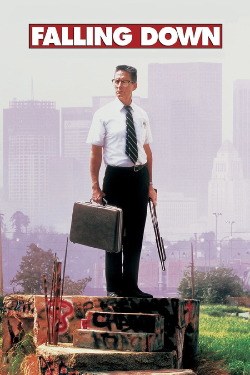
Review of Falling Down (1993) by Sam K — 11 Sep 2012
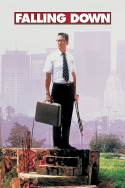
Falling Down (1993).
*HEAVY SPOILERS*.
"Falling Down" is proof that not all Joel Schumacher films suck, mainly just his Batman movies.
Falling down is a great movie that I believe should be known as a classic, among the ranks of the "Scar Face", "Die Hard", and other timeless must see movies. (That is the quick review should you read no more.).
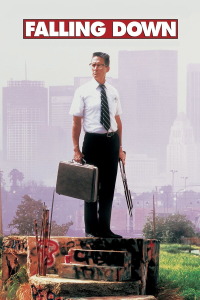
"Falling Down" is a self proclaimed "tale of urban reality", which has a meaning that becomes more clear as you watch the movie. The movie feels like an epic of the life of William Foster, his decline from normality into the destructive being he is by the end of the film. William Foster, played by Michael Douglas, is listed in the credits as "D-fens" which is also the name on the vanity plate of his car, the name has a meaning which is later revealed in the movie. Almost all of the background information of the character is revealed in one point close to the end. This is good because it leaves the character mysterious and much more interesting than it would if they revealed the information earlier on.
The Character of William Foster is what really pushes the movie towards greatness, and the portrayal of the character of William Foster by Michael Douglas solidifies the character as one of the greatest movie characters and is a character I would like to know more about. He will be on my upcoming top ten list "top ten most interesting characters.".
The movie starts when D-fens is pretty much at his breaking point already but is still retaining shreds of dignity and self respect, as well as shards of his sanity. The film starts with D-fens in his car stuck in grid-lock traffic, he freaks out and ends up running from his car off through a small forest and onto main roads in a very bad part of town, leaving his car in the way of the traffic, which also introduces the largest sub-character detective Prendergast played by Robert Duval. D-fens has a small suitcase with him as he walks through the streets and the case plays two key roles in establishing his character:
#1. Men try to take his briefcase and he wont have it. He stands up for himself and ends up beating them back and leaves with his briefcase and one of their knives which I will mention again shortly. He almost gets killed trying to keep his briefcase and he is well aware of what will happen to him if he doesn't give it to them. This makes you very interested to know what is inside the case.
The 2nd part the briefcase plays is to help in developing his character. He later gives away his briefcase to a bum saying "I don't need it anymore" when the bum opens the case it only contains a sandwich and an apple. Now I believe this means two things. The first is to show how the case itself wasn't what he was trying to preserve, it was the idea behind it. It wouldn't matter whether the case was empty or whether it contained a million dollars, he would defend it the same, for the principles behind it. the second thing that this establishes comes from the line he said "I don't need it anymore." I think the briefcase in a way represents what is left of his humanity or perhaps normality. This is after he has the gun bag and in a way him keeping the gun bag and leaving the suitcase he started with shows how he passed the point of no return and that he has traded his old lifestyle choices for his new found attitude. Soon after he ditches the suitcase he also changes his clothes into an old army jumpsuit and his glasses get broken. By this point he has completely changed throughout the movie, he doesn't even look the same as he did in the beginning, the rest of the movie before this he looks extremely out of place in geeky glasses and a white shirt and tie and now he has transformed into what he finds is actually more rewarding.
D-fens has a very interesting progression even down to the terms of his weapon progression. He begins with no weapon then takes a baseball bat from a man whose shop he destroys, next he takes a butterfly knife from some gang members, then a large gym bag full of guns, and later he even finds a rocket launcher. The progression was very interesting and complimented his personal progression into the being he is by the end of the film.
"Falling Down".
Part 2.
As previously mentioned he takes a baseball bat from a man whose shop he destroys. This is the very beginning of the film, the first thing he does after ditching his car is go to use a pay-phone, which he uses to call his (ex) wife but doesn't actually say anything, nerves get to him and a story arch is later completed with him and his former family, that is trying to maintain a role in, however unwanted his role is. After hanging up he wants to call again immediately but doesn't have the change, that is why he goes into the shop. The guy will not give him change unless he buy's something, so he does, or tries to anyway. Now in the year 2012 the price needs to be adjusted for inflation but the point still gets across. The point is that the soda he wants to buy is over-priced along with everything in the shop. The shop owner is Korean, and the conversation is the start of why people believe that D-fens is racist. I don't think that is really racist but just extremely patriotic. He doesn't have a problem with the guy because he is Asian but instead because he feels the man coming to his country and not even bothering to learn English is what he find's offensive.
After destroying the shop the man say's "just take it, take whatever you want" D-fens is extremely offended by this. "I'm not a thief, is that what you think I am" he say's before paying for his soda and leaving. He has morals and stealing is against his morals. He is actually a man who really values morals. Stealing is bad in his book but destroying a man's shop is okay because he feels it is deserved for how he is treated, and as the movie progresses he starts using violence more and more to solve his problems because he see's how easy it really is, and pisses him off that he has worked so hard his whole life and not accomplished or been recognized for his achievements when he could have just been doing things the easy way all along and maybe ended up better off.
Things that push him to violence become smaller and more insignificant as he becomes more complacent with his violent actions. I think the writer really used little things that piss him off to use as things that push D-fens to violence. Most things that push D-fens are things that deals with everyday but he just wont take it anymore. He's done putting up with it and now he's making them pay for it. Little issues people have with everyday life such as gang occupation, plastic surgeons being more wealthy than people more deserving, unnecessary construction projects just to meet the budget, he even pulls a gun out in a Whammy Burger because they won't serve him breakfast. The situation escalates when false advertising makes its way into the standoff. He even ends up deciding that he doesn't really even want breakfast after holding a gun to the manager because of breakfast in the first place, again showing how it isn't really the act that angers him it's the methods behind it. False advertising is because of the burger he gets is flat and compares it to the picture while trying to have a somewhat casual conversation he has put in danger in the restaurant, even talking to a little kid asking him questions. In the same scene is another important character development moment. He is supposed to be an average guy pushed too far, and an average guy isn't an action hero or an expert with guns. In the restaurant he accidentally fires the gun into the ceiling which really adds realism and reminds you of the "average guy" element. A similar moment happens later with the rocket launcher. He has a kid show him how to use it (and he still does it wrong).
From the beginning he doesn't look for trouble, trouble finds him, in the beginning he tries to avoid conflict while being completely willing to follow through at the same time. But he has an extreme temper and when his anger builds up enough, that's when he goes berserk.
Realism is really important in this movie and without a powerful sense of realism the movie wouldn't be half as good. Good thing the realism factor is handled extremely well. The movie has many far away helicopter shots where the character of D-fens blends right into the crowds. There are so many pedestrians and random civilians all over the place it really makes the situations more intense and realistic. Pedestrians get caught in the way of all the violence; people on the street get shot in drive by's, D-fens terrorizes a golf course and almost uses a family as hostages without realizing it. When he does eventually realize it he is mad at himself because he hurt the little girl by accident.
Speaking of little girls, his own little girl is what gives him direction to move in his destructive journey. Throughout the movie he is trying to get to his daughters birthday party, and people just keep getting in his way. A darker reality surfaces with his family making a little bit less of an average guy but a little more twisted than previously led to believe.
The movie ends with a confrontation between the characters played by Robert Duval and Michael Douglas. Michael Douglas delivers his line "I'm the bad guy?" he finally comes to terms with the fact that he is doing bad things, the entire time he thought what he was doing was justified and the right thing. Upon this realization he makes the cop kill him by pulling a fake gun and getting shot. The ending is great, he gets shot, breaks the railing and bounces back up to his feet to deliver one last line before falling over the railing to his assumed death (he fell into the water and there is a slight chance he could have survived the gunshot wound) but he is most likely dead, which is the most appropriate ending possible.
The story arch of D-fens is similar to the story arch of Tony Montana from the movie "Scar Face". Both characters have a rise and fall both ending in they're deaths. Both become corrupted in a sense and to a different extent hate themselves for what they have become. Neither start off as particularly good people but they grow significantly worse progressively throughout the film.
"Falling Down" is a Fantastic movie that deserves more recognition than it has. The following of the movie is small enough to have the movie be known as a cult classic. The movie is extremely underrated. The movie is very deep but even without analyzing it and seeing the deeper meanings I think the movie would still be enjoyable but to a lesser extent. I think the main message is that life isn't fair but you have to deal with it, lose your cool and your world will come crashing down around you.
This review of Falling Down (1993) was written by Sam K on 11 Sep 2012.
Falling Down has generally received positive reviews.
Was this review helpful?