Review of Exodus (1960) by Erin M — 19 Jan 2009
Self aware recreation of biblical movements by the players (both in the history and Preminger's epic), tribalism vs. multiculturalism/cosmopolitanism. The Biblical Book referenced in the title includes Moses' most famous line, repeated by Newman's white warrior. There is also a subtle reminder that biblical gestures lose their immanence in the era of publicity. At least #2 or 3 in Preminger and screenwriters bullet points must have been the fact that Jews look like gentiles, as there are several dialogue lessons and reminders of this. There are alternate reminders of racial permanence and the post-racial communitarian, perhaps a hope on the part of the filmmakers for a balance between the two.
Sal Mineo's tormented teen returns from "Rebel Without a Cause", Paul Newmans stoic hardhead warrior learns to loosen up via Eva Marie Saint's gentile love interest.
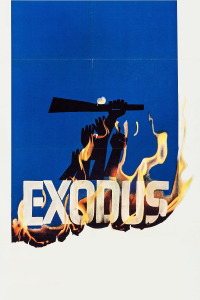
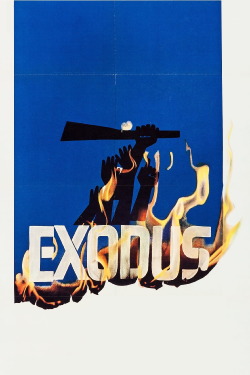
The brightness of blue sky in every shot matches the tone of the stark/austere opening titles with the eternal flame flickering in the foreground, a rifle illustration lies beneath the main title card.
Landscapes and land with shadows falling across is the recurring formal motif, and a theme that history is predicated on a recognition of communal identity. The main immutable recognized by Preminger's film is the history of suffering. "Follow the rules" Judaism took the greatest hit from secular Hollywood, The Christians malleable origin story aligns more easily with kitsch than the biblical blood truths. Preminger's Jewish liberation epic is more of a staunch recognition of the racially immutable than Spike Lee's Malcolm X, as Eva Marie Saintâ's gentle Presbyterian love interest learns that differences between people are not "made up." However, Malcolm X. rejected the help of the college white girl, while Jewish identity politics sometimes explicitly resisted and requested intervention from outside.
White Supremacists Tom Metzger and James N. Mason were the first within the movement to openly admire the Jews in order to both demystify the magic and also destroy God via an endless war against His people. The basis for Preminger's prestige epic is tied to a similar recognition of the exalting effects of tribal/racial recognitions. Since this is an early and not a late 60s movie event, its awareness of history not too much infused with secular therapeutic "feelings." "Follow the rules" Judaism (and any narrative manifestation thereof) remains the most effective shorthand for communicating the worthwhile overlap between the obstinate and the transcendent.
Militancy alongside stoic suffering, uprising section plays as a tangent, departure into a succinct and separate prison break film.
The ending makeshift funeral eulogy delivered by Newman is moving, circular procession matched by the exit of trucks, film ending in limbo amidst war.
Subtle and paranoid implications by the filmmakers that the Arabs are patsies of Eurpoean Anti-Semites in the war for Israel.
This review of Exodus (1960) was written by Erin M on 19 Jan 2009.
Exodus has generally received positive reviews.
Was this review helpful?