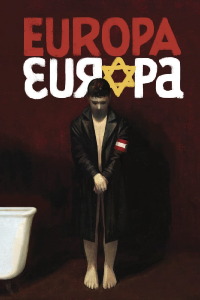
Review of Europa Europa (1990) by Edith N — 21 Oct 2009
Turn Coat and Turn Again.
Back in Los Angeles, at the Simon Weisenthal Center, there is the Museum of Tolerance. As you enter the part of the museum about the Camps, they give you the information about one person who entered the Camps for real. (It might have been just children.) It is my understanding that, more than a year after the museum opened, no one had yet drawn someone who survived. (Well--as I recall, mine did. But only for about six months after the war, so it kind of doesn't count.) It might have been some other project. The point is, surviving the Holocaust was not an easy thing to do. There were people who tried all sorts of ways to do it. In hiding. With forged papers. Any way people could think of, at least one person tried. Some of the ways were more improbable than others; this may well be the most improbable of them all. The more so because it actually worked--this is based on a true story.
Solomon Perel (Marco Hofschneider) probably self-identifies as German as much as anything else; he is not alone in that. His father owns a shoe store, and while they practice Jewish tradition--and, most important to our story, "Salek" has been circumcised--he doesn't really get into it. However, when the Nazis rise to power, his father (Klaus Abramowsky), who is also far more devout, knows they will not be safe. He takes the family to Łódź, Poland, which we of course know was not the safest place in the end. And, indeed, when the Nazis invade Poland, his father sends him east, because even the invading Soviets have to be better than the invading Germans. Salek is separated from his brother, Isaak (René Hofschneider), and ends up tracing a path that is nigh unbelievable--from living in a Soviet orphanage, he ends up a German soldier and the pride of the Hitler Youth. The time he spends in Germany is, of course, complicated by that little operation he had as an infant.
In some ways, the most heartbreaking character is Leni (Julie Delpy), who is so fixated with Hitler and Nazi ideals that she intentionally goes off to get pregnant with as Aryan a man as she can find--so she can give her baby to the Reich. Salek, known to her as Josef Peters, cannot tell her his secret, even though he desperately wants to tell someone. She has, in fact, told him that she longs to meet a Jew so she can slit that Jew's throat. After all he's gone through, Salek would prefer that not to be his. It's true that she does not suffer the sort of fate Salek's family does, given that his father starves to death, and no matter what happened to Leni, it wouldn't be that. However, we spend more time with Leni, and it's clear that she is not now who she once was. Her mother (Helena Labonarska) even says that she doesn't know her own daughter anymore.
Very late in the movie, a Soviet officer refers to Salek as "another one who didn't know." Salek seems to believe that all the Jews have been sent to Madagascar, which is either self-delusion or else a lack of awareness as to just how out of resources the German army was. I would imagine he'd have a fear of being the last one, the only Jew in all of the Reich. On his vacation, he takes the trolley through the Łódź ghetto over and over in the hopes of seeing his family. He thinks he sees his mother (Michèle Gleizer) once, but only once and he cannot be sure. (She was gassed in one of the trucks the Germans used for the purpose before they used chambers.) Even then, she is the only relative he ever sees. In the film, his sister, Bertha (Marta Sandrowicz), is killed in front of them, though in real life, she is shot later, in a death march. No, he can't know their fates, and he really does seem to believe the Madagascar story. How much of that is just hope, though, is hard to say.
No matter where Salek goes in the film, he seems surrounded by blondes. True, a woman he meets likes his dark hair and dark eyes, because they remind her of Hitler. (She really likes Hitler, if you know what I mean.) However, even in the orphanage, there are all those blonde Poles. Oh, yes, there aren't quite as many as there seem to be in retrospect. However, the impression that there are is rather important, I think. We must see Salek as alone. He must keep everything about himself a secret from just about everyone he meets through the entire movie. The Soviets don't really like him because his father owned a store. The Nazis, of course, despise him because he's Jewish. There is, in the entire war, no place really safe for Salek. On the other hand, he's hardly alone in that.
This review of Europa Europa (1990) was written by Edith N on 21 Oct 2009.
Europa Europa has generally received very positive reviews.
Was this review helpful?