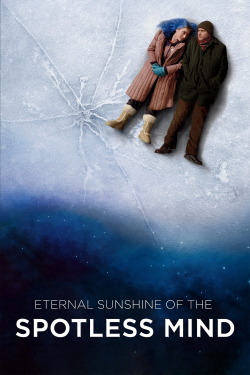
Review of Eternal Sunshine of the Spotless Mind (2004) by Seth S — 28 Jan 2015
"If you could go back and change one thing in your past, what would it be?" How many times have you heard that question posed? If you had the chance to erase something painful, or awkward, or tragic from your past, would you take that opportunity? That is the question that floats at the center of Eternal Sunshine of the Spotless Mind.
There are two trains of thought. One the one hand, removing the bad memory could be a good thing. Living without a certain pain or heartbreak could make life easier, simpler, bearable. When asked the, "If you could change one thing..." question, it's impossible not to relive a hundred memories that would be easier to deal with if they were different. Changing one extremely painful moment is an undeniably attractive option.
There is a second school of thought of course, the school of thought that says all of our failures and tragedies make us the people we are today. Removing even one memory would lessen or change us to our core. This mindset believes that our failures, not our successes, make us grow. This mindset is explored by Joel Barish.
Joel is in love, or was in love, or is falling in love, it is never entirely clear. He meets Clementine, a woman as eccentric as her name would suggest. They form a relationship that lasts two years, but when it comes to an end, it does not resolve amicably. Both Joel and Clementine separately decide to use a firm called Lacuna to erase their memories of each other. Halfway through the process, Joel realizes that he might not want to live without the memory of Clementine.
One of the most appealing aspects of the film is the attitude with which it is brought to the screen. Directed by Michael Gondry and written by the always imaginative Charlie Kaufman, the movie walks to the beat of its own drum. There is a freshness to the filmmaking that is absolutely engrossing. Truth be told, when I watched this movie, I was running on three hours of sleep over the past thirty-six hours. And yet, I was enthralled by the story (and the storytelling) from start to finish. The film does an excellent job of keeping the audience guessing, leading to a distinct lack of watch-checking throughout.
So, I was captivated by the story, my thoughts were provoked by the message(s), but I am still partially torn on the movie. I can't bring myself to decide whether the movie simply has what it takes to be great, or if it has that little extra something to make it amazing. Is it a four star movie, or a four and a half star movie? I'm still not entirely convinced one way or the other.
The only thing preventing me from fully committing to unmitigated love for Eternal Sunshine of the Spotless Mind is "young Joel." There are a couple scenes in the middle of the movie that feature Jim Carrey playing a younger version of himself. Carrey's adult form is literally shrunk to child size, and the visual effect, coupled with these scenes purpose in the film, can't help but feel hokey and out-of-place. Taking these scenes out of the equation, the movie is such an infectious blend of imagination, romance, and drama. But these scenes lend the film an aspect of goofiness that feels entirely detached from the remainder of the narrative.
Whether it's Jack Black in Bernie, Steve Carell in Foxcatcher, or Jim Carrey in this movie, I absolutely love being surprised by dramatic performances from comedic actors (or vice versa). Carrey's performance as Joel is, above all else, restrained. The character is a homebody, conservative, subdued, soft-spoken ... everything we have come not to expect from Jim Carrey. I was equally impressed with the actor's performance in The Truman Show, but there is a level of subtlety in Joel that I have never seen from Carrey before. Honestly, I found that I identified with Joel more than any other film character in recent memory.
In a movie starring Jim Carrey and Kate Winslet, one would assume that Carrey would give the fun, peculiar performance. But no, it is Winslet who gets to let loose with a wonderfully unexpected turn. Kate Winslet is, perhaps, at her best when she is not restricted by the trappings of a period drama. And here, she is more uninhibited than she has ever been. The chemistry she shares with Jim Carrey never fails to bring a smile. I think the movie is so special, in part, due to the flipping of the assumed roles between Carrey and Winslet.
The supporting cast offers its own set of pleasures. The opening credits reveal that Mark Ruffalo, Tom Wilkinson, Kirsten Dunst, and Elijah Wood all lend their talents. There is nary a weak link in the cast, with Dunst and Ruffalo sharing an especially well-acted scene near the end of the film.
If a film requires a Jon Brion-esque score, it is best to hire Jon Brion. The style of Eternal Sunshine of the Spotless Mind lends itself entirely to the composer's music. He provides a delightful little score! The very brief "Elephant Parade" cue is so wonderful, in the movie and out.
Eternal Sunshine of the Spotless Mind is poetic in the delivery of its message. It features career subversive performances by Jim Carrey and Kate Winslet. The script by Charlie Kaufman and the filmmaking by Michael Gondry is inspired, while only falling into needless eccentricity for a few brief scenes. Time will tell if I can eventually peg the film as a masterpiece. But as it stands, the movie is a delightful example of marvelous filmmaking, teetering on the edge of genius.
"How happy is the blameless vestal's lot!
The world forgetting, by the world forgot.
Eternal sunshine of the spotless mind!
Each pray'r accepted, and each wish resign'd." 8.5/10.
This review of Eternal Sunshine of the Spotless Mind (2004) was written by Seth S on 28 Jan 2015.
Eternal Sunshine of the Spotless Mind has generally received very positive reviews.
Was this review helpful?