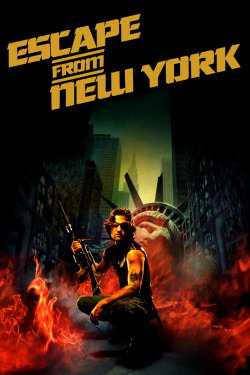
Review of Escape from New York (1981) by Harry W — 17 Jul 2016
Being a notorious cult classic that paired together the powerful team of John Carpenter and Kurt Russell for their third collaboration.
The concept for Escape from New York is brilliant. It's a simple action-escapist story set within an incredibly original setting. Envisioning a dystopian society which could factually exist one day, Escape from New York crafts a story with brilliant political commentary to it. Originally written as a response to the Watergate scandal, Escape from New York depicts a future which is far more totalitarian; a government which is far more obsessive and corrupt with their disregard for human life. John Carpenter's vision is one not only definitive of its time, but consistently relevant over the following decades. Given the recent discovery of the 2013 NSA scandal, the government has proven again and again how obsessively controlling the American government can be, as well as how little the public can trust them. This is the exact theme driving the story in Escape from New York, and the disturbing realism in a story of science fiction makes for really powerful drama.
Even though New York is said to be packed full of criminals deserving of a life sentence, one of the first things viewers see when the story reaches its titular setting is a collection of dirty-clothed gentlemen watching others put on a stage production. They are simple humans enjoying the entertainment they can procure for themselves, and this is the first example of John Carpenters humanizing his character. He later does the same thing for his protagonist by displaying that he is prone to injuries, ensuring not to detract from his fearless persona in the process. Ultimately there is only a handful of things that actually occur within Escape from New York, but the implied universe challenges audiences to really consider the meaning behind everything that is happening and the motivations of its characters. Nothing is made explicit, it is all very subtle. Less intelligent viewers who have come strictly for the action fare might not be too impressed by the way the film focuses mainly on story, but I would definitely consider Escape from New York to be a thinking man's action film. There is a solid quantity of action in the film, and audiences are kept entertained in between it all by the intelligent writing.
The dialogue in the film varies between each character; Snake Plissken is a fearless hero is incredibly blunt, Bob Hauk intelligently describes the political state of the universe and the mission the protagonist must complete while matching his blunt nature with one of his own, the President of the United States is a self-obsessed coward and Cabbie provides comic relief. This is just a handful of the characters in the film as there are many who are relevant to the story in interesting ways, yet none of them distract the story progression with their own arbitrary subplots. Everyone is an archetype in one way or another yet nobody feels generic, and there is just enough characterization to be interesting while also capitalizing on the natural charms of the actors who play them. In essence, Escape from New York presents viewers with an interesting world and strong characters to go with them which keeps the natural drama of the film enticing.
Visually, Escape from New York is executed very well. The New society looks much like the gangland America depicted in Walter Hill's The Warriors (1979). As a result, this makes the dystopian society of the story feel all the more relevant due to its contemporary realism. Given that the premise depicts a group of criminals attempting to escape back to their home turf in a society where everyone is driven by violence, the similarities between the two stories is hard to disregard. The Warriors similarly did not explore the full extent of its setting but rather focused on being an era-defined exercise in style; Escape from New York goes much deeper through implications in the screenplay and the motivations of different characters. The actual exploration of the film's setting may not live up to its maximum potential due to budgetary constraints, but the extent that John Carpenter takes it to for a meagre $6 million is truly stunning. We only get to see a handful of settings in Manhattan while the rest of the world is left to implications and a few tracking shots, but it's still enough to give believability to the story. The scenery is decorated with a tenacious eye for detail, depicting a world torn apart by destruction and mayhem where the people that the world has failed have been left to rot. The production design in Escape from New York is solid, and the sporadic use of visual effects helps it along the way. The action scenes are also awesome as they use choreographed practical stunts rather than relying on the special effects.
The cinematography that captures all this is great since it manages to use tracking shots to depict the larger parts of the story world while everything else is shot from atmospheric angles that make capital use of the dark lighting without preventing audiences from being able to see anything. Perhaps the best shot in the film comes from the beginning of the story where Kurt Russell and Lee Van Cleef make negotiations at opposing ends of a table. The way this scene is structured is clearly a throwback to the intense scene at the beginning of Sergio Leone's The Good, the Bad and the Ugly (1966) where Lee Van Cleef is interrogating a local whom he is about to execute. It just serves as a reminder of John Carpenter's love for the violent west.
And to keep the entire experience atmospheric, Escape from New York uses John Carpenter's distinctive skill for crafting a brilliant musical score. As tradition with John Carpenter films, the first thing audiences get to experience with Escape from New York is the grace of his musical score. As the film rolls its title credits, John Carpenter's distinctively 80's and restrained yet incredibly groovy theme song plays out for all the viewers to soak up. This gives an awesome setup to the film before it later follows the same path as Halloween (1978) in the sense that it uses simple series of beats to give the entire film its full experience. The musical score is perfectly eerie and energetic in a subtle fashion, simply building upon the genuine tension constructed by everything else in the film and bringing its edge to the max.
And with such a rich script supporting Escape from New York, the talents of the cast are given a real opportunity to shine.
Once again, John Carpenter proves that he is capable of getting the best possible acting charisma out of Kurt Russell. In perhaps his most distinctive role to date, Kurt Russell solidifies his status as an action hero with his effort as Snake Plissken in Escape from New York. The entire film is he blunt; monotonous without being shallow, fearless and cold. There is always a remorseless stare of death in Kurt Russell's eyes which makes him an intimidating presence at all times, and he supports it with a blunt line delivery that makes him seem like a badass at every moment. The man has an iconic design to him, and Kurt Russell's fearless performance truly immortalizes it as an unforgettable character. Kurt Russell characterizes Snake Plissken as a fearless antihero with a nihilistic view of the world we can all see eye to eye with, and the elements of humanism in the character support the realism in this all. Kurt Russell defines Snake Plissken as one of cinematic history's greatest action heroes with a badass attitude that most contemporary action stars can barely even mimic, so it is definitely one of the greatest performances of his career.
Lee Van Cleef's performance is his finest in years. With such a grand legacy behind him, Lee Van Cleef is a most welcome addition to the cast of Escape from New York. His scenes are mostly interactions with Kurt Russell where we see the two playing games with each other as their similar lack of actual emotion creates a vastly entertaining conflict between the two. Lee Van Cleef has a fearless confidence to him which creates an effective chemistry between him and and Kurt Russell, so their moments together are some of the best scenes of character-building in the film.
Ernest Borgnine also stands out through supplying brilliant comic relief to the film. The man plays so heavily to his distinctive iconic charm that fans should easily rejoice, yet he does it without seeming ridiculous. It's slightly cheesy, but that's part of the 80's theme in the film. Ernest Borgnine creates a really friendly presence, and his funniest moment comes from the scene where he first picks up Snake Plissken in his Taxicab and keeps talking while casually throwing a molotov cocktail at a local gang. Ernest Borgnine is funny but also conveys a sense of real passion in his performance, refusing to take it for granted and making audiences laugh without detracting from the serious nature of the film.
Adrienne Barbeau is a notable solid presence. Her character Maggie is an extremely progressive one since she is as fearless as Snake Plissken and even more so at times, yet nobody ever comments on her gender. She is just another character and one of the most fearless, and her gender is not exploited for the role. Admittedly she is given a costume designed to make subtle emphasis on her sex appeal at times, but as far as the character goes Maggie is just a real badass who Adrienne Barbeau is a perfect fit to be playing. The woman is a major badass.
Harry Dean Stanton brings his natural charm to the film and Isaac Hayes' love of The Duke of New York's relentless power gives him a confident villainy. Donald Pleasance is also a great cast member due to his ability to act really scared one minute and thoughtlessly selfish the next.
Escape from New York relies largely on the implications of its screenplay to explore the concept behind the universe it presents, but it is an extremely well-written film with a lot of thought-provoking themes, John Carpenter's distinct sense of style and Kurt Russell's most badass performance to date.
This review of Escape from New York (1981) was written by Harry W on 17 Jul 2016.
Escape from New York has generally received positive reviews.
Was this review helpful?