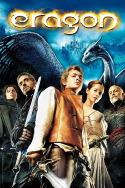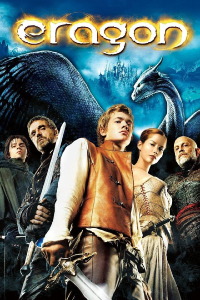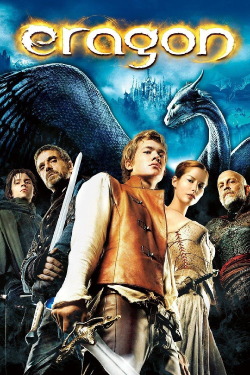
Review of Eragon (2006) by Harry W — 13 Sep 2015
Though critically panned and based on terrible source material, I had some slight hopes that Eragon would deliver some visual panache.
Eragon was not a book that I enjoyed reading. Written by a 15 year old and completed by 17, I felt this was too obvious due to its derivative and thinly written story which was backed up by frustrating language. And on top of that, there was nothing in terms of character being offered as everyone is some kind of generic fantasy archetype. And the way that the novel leaves the protagonist interacting with a dragon through a telepathic link was not just an underdeveloped and overly simplistic concept, but not something which could be adapted and remain sensible. The only way this could transfer to film is through the use of voice-over narration which everybody knows is the easy way out. Basically, all things considered the source material is just too much of a juvenile construction of weak writing and I expected the film to be the same. Yet I hoped to find greater success in the film adaptation so that the action envisioned in the narrative could be presented to me with $100 million production values. Alas, the story, or lack thereof overwhelms the viewer with its incompetence.
One of the most common criticisms of the Eragon film is that it feels like a massive rip-off of Star Wars. I don't know what audiences were expecting when they saw the film because that's exactly what the novel was. Eragon is a book that attempts to cross over the universes of Star Wars and Lord of the Rings by combining the fantasy context of the latter with a plot device identical to that of Star Wars Episode IV: A New Hope. In that sense, it delivers on some of the promises of the novel. But that is nothing to boast about, and neither are the changes that occur within adaptation. With a story condensed into a mere 99 minute running time, Eragon is clearly more concerned about appealing to a commercial audience than pretending that it has any substance. In a sense this is good because really there was none and I'd rather the film get to the point, but it also cuts through any slight potential for the film to actively transcend the thin scripting of the source novel. This is made most obvious in one particular scene. After Saphira is born, she is at first characterized as a driving force behind a wider narrative but rather as strictly a gimmick that Eraon can enjoy the idea of possessing. But soon after, she flies off into the sky and then returns momentarily to have aged a great many years. This is a weak plot substitute for an already weak story that was given by the source material, but at least the novel made an effort in this part. Christopher Paolini wrote the story out so that Eragon and Saphira establish a bond by growing up together, and though it was characterized with weak writing, it at least made more of an effort than Peter Buchman's script. Essentially, in an effort to condense Eragon into a period of a meagre 99 minutes, much of the story is rushed. This forsakes the notion of any narrative transcendence whatsoever. And on top of that, when Eragon's uncle dies nobody could honestly care less. It's not even played off as a subplot, it's less relevant to the story than the many Varden that die in the final battle.
But like I said at the start of this review, I came into Eragon with the hope of some visual panache. Despite costing $100 million, Eragon even failed to deliver on that. The scenery used in the film is overly basic while the production design feels somewhat cheap. Most of the film simply depicts characters running across the land aimlessly, as if the film was shot by John Ford in a forest. The difference is that John Ford films are about the land and not the journey yet Eragon thinks at has a story, and as a result is more focused on the actors than the beauty of the landscape. There is a lack of innovative cinematography utilized in Eragon, but it doesn't really have that much to capture anyway. Even the visual effects are not transcendent despite being arguably the best part of the film. At least director Stefen Fangmeier saw fit to give Saphira a good appearance because she is cute as a baby and majestic as an adult. Yet her movements seem a little too animated at times, and the sight of Eragon riding her becomes commonly all too obvious as unfolding in front of a green screen. This doesn't prove of any assistance when the film reaches what should be its greatest point, the climactic battle at the end. The final action scene is plagued by poor lighting and overly quick editing which bury the battle beneath an incomprehensible visual experience. It's the lighting that really damages it because the choreography is decent and some of the set pieces are used well. It's just that there is too much damn shadow to actually embrace it.
So with everything buried beneath overblown yet underedeveloped direction, it is no surprise when the cast is left to falter.
Edward Speleers is another person making a debut on Eragon, but not making a credible effort. The boy has his handsome charms, but for a first film role he is given too much of a burden. He has to carry an incompetent film on his shoulders, and he does not have the experience to prove close to succeeding. For one thing, he has a problem with facial expressions. While the voice over work depicting the telepathic communication between Eragon and Saphira plays out, Edward Speleers fails to depict any engagement with the character. He simply stares stiffly into the distance while a voice happens to play in the background, displaying no emotion whatsoever. But when he does show emotion, the experience is even worse. Whenever Saphira is aorund, the only thing he can do is smile. This happens regardless of the context, regardless of the fact that someone close to him may have just been killed or of the fact that the situation is too intense to be happy about. Edward Speleers seems to be having fun in his role which is reflected through the gleeful nature of the character, but it is the furthest thing from the appropriate intense nature of the character. Edward Speleers is simply thrown into the deep end with his first film while Stefen Fangmeier puts less emphasis on giving the actor an actual character than he does on repeatedly displaying the man collapsing in slow motion which ultimately becomes laughable by the end of the film. Edward Speleers delivers a performance as thin as the character himself, and whatever potential charm he has becomes buried under misguided direction.
John Malkovich is condemned to the role of the underdeveloped antagonist Galbatorix. In the novel, nobody ever encounters Galbatorix as he is simply an unseen force believed to be the epitome of all evil. In that sense, there is no character to adapt and so Galbatorix is an entirely new reation for the film. Since Patrick Buchman had no idea how to adapt the novel, expecting him to create something original is not promising. So when he delivers a character who simply drags down the presence of accomplished actor John Malkovich, the experience is depressing. John Malkovich is an actor who was able to turn the role of Cyrus Grissom from Con Air into an actual memorable character, and so the fact that he cannot do the same thing to Galbatorix really says something about how poor the writing is. Never in a million years would I blame a talented actor like John Malkovich for the performance that he gives because it could not be the fault of a man of his talent. In the film adaptation, the narrative cuts back and forth between what Eragon is experiencing and what is happening in the home of Galbatorix's empire, as well as his own experiences. This removes the sense of mystery and unpredictability that was present in the novel, the one unpredictable thing that came from a book that took everything from Star Wars. John Malkovich's screen time ends up too short to actively have any effect, so I couldn't help but ask "What's the point?". I would guess that he did as well and that's why he couldn't be bothered with the character, but there is no sense blaming him when his lack of interest overshadows the melodramatic attempts of the other actors.
The natural presence of an accomplished actor like Jeremy Irons should benefit Eragon, but with the film determined on ruining the efforts of every cast member there is ultimately nothing to boast about. In his second appearance in a dragon mythology film that rips off Star Wars following 2000's Dungeons & Dragons, Jeremy Irons sinks into a lesser character which leaves him delivering all this uninspired dialogue as such. Jeremy Irons is likable strictly for being Jeremy Irons, but not for being Brom. And he fails to convey anything close to the supposed wisdom that is meant to come with the archetype, even though he proves capable of contributing to a sword fight.
And in terms of Saphira, the voice of Rachel Weisz is of no benefit. Saphira is supposed to be a dragon, not a pompous British girl. And as much as she tries, she is simply miscast in the role and therefore unconvincing from the get go. There is nothing beastly about her, and so the contrast in her voice to the appearance of the character is too much to look past.
The only cast member who really delivers any charisma is Garrett Hedlund. In one of his earliest screen appearances, Garrett Hedlund manages to do for Murtagh what Edward Speleers should have done for Eragon. He remains intense the entire time with physical engagement with the action and even a touch of likable youthful charm as part of his natural spirit. His brief appearance means that he leaves before we see anything majorly wrong with the character, but either way Garrett Hedlund is able to deliver a charismatic effort which brings out some much needed spirit in such a dreary feature.
So due to the case of Eragon being a film director making his debut with a $100 million to spend on an adaptation of a novel written by a 15 year old that casts another newcomer in the titular role, the surface value of Eragon's production should obviously predict the resulting failure of the movie. And the lack of experience in everyone is reflected in a narrative which embraces all of the bad elements of the source material and none of the potential.
This review of Eragon (2006) was written by Harry W on 13 Sep 2015.
Eragon has generally received mixed reviews.
Was this review helpful?