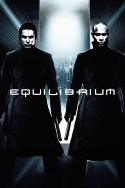
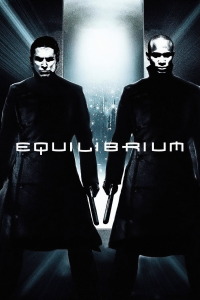
Review of Equilibrium (2002) by Augusta M — 18 Jan 2013
An underrated piece of art, this bleak future where emotions are forbidden has an ironic emotional core to it. It doesn't surround itself with blatant copies of Fahrenheit 451 and 1984, in fact, what many people would assume are carbon copies I would prefer to call references, harking back to other dystopian films while also being a standalone film in its own right. Equilibrium treats the matter with mild stoicism, foreshadowing particular events in a neat way that manages to explode in a thrilling yet thoughtful way.
The ignorance of many critics that assumed the worst, didn't seem to see the whole picture. None of this was about the fact that censorship exists or that you could be executed for certain crimes. The whole idea of the film was to make you see how people behaved through lack of emotion, with the failure to see that emotion is what makes us human. Rather than take a purely political motive, it manages to incorporate perhaps a majorly ethical motive.
The action that is contained in this film is not just for showing off. The stylistic features render the action scenes mindblowing, but no less helping to drive the core theme of the story - besides, the main character is a cleric, trained in the art of Gun Kata (a thrilling name for a sadly non-existent masterpiece of fighting style) who manages to put a chink in Libria's armour as we see through his perspective by realising he can use this weapon against the system that attempts and fails to betray him as someone who is 'feeling'.
When I first regarded this film, I became fascinated about how, amongst the close-ups and wider shots, the main character seems to obviously show some kind of emotion without the intrusion of the system demanding why on earth he hasn't been arrested for his crimes. This ultimately came to the climax, whereby the foreshadowing managed to sneak its way in at the beginning. The fact that Christian Bale was chosen for this role makes me wonder why some people didn't think this was good, considering how deft he was in executing the action, the visual non-speaking scenes and the dialogue.
To the amazing use of irony, a number of heart-rending scenes kept up the core theme, and the stylistic use of camera focus on Christian Bale emphasised the distress that we could feel he was going through, one being his flinching when we don't see the dogs being shot, but we can feel it by way of his reaction. However, I thought one of the most chilling scenes was during a raid of someone's apartment, with fires burning and people spattered with blood, was the simplicity of a dying man running into the main character, known as John Preston, bleeding, desperation and hope glittering in his eyes as he slides down, leaving Preston aghast and completely horrified, reflecting the man's pain. The expression on his face could not have been possibly matched, Christian Bale just executed that so perfectly that I could feel myself choking up and stopping dead.
So this film, by none the way anything completely copied from other films, is a masterpiece in its own right. By way of insulting the stylistic features to convey emotion and provide thrilling action that shaped the film, the amazingly well-acted characters that were to no end incredibly fascinating, the amazingly clever storyline, you are refusing to take it to the light of some of the world's greatest films and distastefully making the biggest mistake of throwing it away. Like the scene in the film, whereby Preston awakes from a nightmare with shock and overwhelming emotion, tears away the fabric from the window to reveal glimmering light on the horizon and a rainbow glowing in the rain, it strips away the layers as the film goes on, lulling you into a false sense of security, but instead just brings you surprises exploding onto the scene, leaving you brimming with hope at the end. Look out for the poignant reference of Yeats.
So, despite it being compared to other dystopian films, this is more terrifyingly realistic, with its future being more like a parallel world with its own parable instead.
This review of Equilibrium (2002) was written by Augusta M on 18 Jan 2013.
Equilibrium has generally received positive reviews.
Was this review helpful?