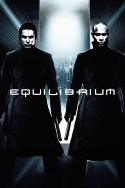
Review of Equilibrium (2002) by Harry W — 07 Feb 2017
Praised as an underrated sci-fi action film, Equilibrium sounded like an exciting genre piece.
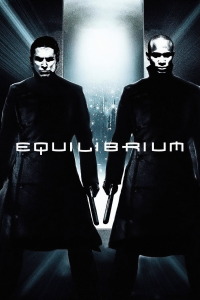
A common criticism of Equilibrium is that it is a derivative science fiction piece, a factor hard to ignore in the experience. The derivative nature of the story becomes clear relatively quickly as it is heavily rooted in the predictable nature of the story formula. Equilibrium's formula is one which dates back through countless science fiction narratives such as the recent Repo Men (2010) and as far back as Logan's Run (1976) in which the protagonist is an outstanding member of a government task force at first before later beginning to question the structure of their society, going rogue and changing the world. The entire black suit aesthetic of the society as well as the combination of science fiction and martial arts also echoes clear similarity to The Matrix (1999). There are a few minor twists along the way with the supporting characters gaining arbitrary relevance to the story, but there ends up being few surprises in Equilibrium.
Beyond its derivative nature, the story in Equilibrium fails to capture its full potential. The intro points out that a new war has changed the face of humanity without explaining the finer details of who was involved in the war or exactly what political implications were either behind it or resulting from it. This plot point is essentially a token story element to create a generic dystopian setting in which serves as the backdrop for an action thriller with the deeper meaning in the story being very sporadic. Yet even though the film functions better as an action film, the generic story still takes top priority. So audiences are dragged through an abundance of predictable and cliche plot points with a lot of talking and different attempts at universe building. The dialogue is fairly solid as it captures the tone of the film without ever being cringe-worthy, but the universe building in Equilibrium is blunted by the film's inability to delve into its deeper ambitions. Ultimately, the story in Equilibrium really lets audiences down while the action is too rare and brief for it to hide behind.
Nevertheless, director Kurt Wimmer deserves praise for his stylistic ambition. Despite the limited depth in the story, the fact is that he creates a very convincing and visually appealing universe for Equilibrium on a very modest budget. At the cost of only $20 million, the man proves capable of creating a convincing and grim dystopia. The production design carries both the technological brilliance of a futuristic society and the dry emptiness of a world in shambles while the monotonous and grim colour scheme captures the bleak uniformity of the society. The scenery provides a powerful backdrop to this all while the costume design infuses it to the characters. If you really try and focus on how the film got away on such a small budget you'll pick up on the fact that the trick is to mediate the use of semi-detailed scenery and focus on the protagonist's story as a means of keeping the scale small. The dialogue in the film also serves as a constant reminder for what is going on in the world. Equilibrium proves a strong testament to Kurt Wimmer's strong eye for imagery and ability to realize his vision on such a modest budget.
An important thing to note in Equilibrium is the action, particularly considering that the cinematography in these scenes proves very experimental, for better and for worse. Director of photography Dion Beebe utilizes many innovative angles and experiments with some strong close-up techniques, but he also has a tendency to use too many of them. The action in Equilibrium uses a lot of close-ups, quick cuts, missing frames and pace alteration which has proven to damage the credibility of lesser action films such as Taken 2 (2012) or A Good Day to Die Hard (2013). Equilibrium teeters on the point of excess without actively crossing it. The abundance of cuts may be overwhelming for some viewers, but action junkies should be able to appreciate its ambitions. And most importantly, it does not disguise the fact that there has clearly been a strong supply of stunt choreography at the roots of the production. The style of action in Equilibrium is rather experimental which may deter some audiences just as it impresses others, but ultimately the combination of shootouts and gun-fu are a pleasure to look at. The entire concept of gun kata is in itself a very original concept and remains the most memorable aspect of Equilibrium.
And for what it's worth, Christian Bale delivers a very solid leading performance. Given that the film is very shallow in terms of both story and characterization, the fact that Christian Bale delivers such a powerful performance gives a lot of credibility to the man. John Preston is a man whose submissive totalitarian values are challenged by his first direct confrontation with the concept of emotion. With this simplistic characterization in mind, Christian Bale proves himself able to walk a very strong line between being an emotionless sociopath and a man struggling with the discovery of his own humanity. With the fearless charisma of an authority figure, Christian Bale takes command as a powerful action hero and delivers as much justice to his firm line delivery as he does to the gun kata. The man kicks major ass with his fighting skills and remains a firm and intimidating presence, yet as he becomes more in touch with his emotions we see an intense vulnerability begin to brew inside him. He loses inner security and begins to channel his emotions at an intelligently progressive rate as he adds elements of angry ambition into the role. Christian Bale never loses his edge, whatever state of mind John Preston may be in. And the manner in which he consistently carries himself through every moment in the story with fearless tenacity stands as one of the finest aspects of Equilibrium.
Equilibrium boasts an intensively dedicated performance from Christian Bale and some stylish directorial work from Kurt Wimmer, but the generic and underdeveloped narrative ends up unengaging and short on action.
This review of Equilibrium (2002) was written by Harry W on 07 Feb 2017.
Equilibrium has generally received positive reviews.
Was this review helpful?