Review of Elizabeth: The Golden Age (2007) by Noname — 18 Sep 2014
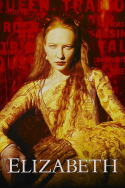
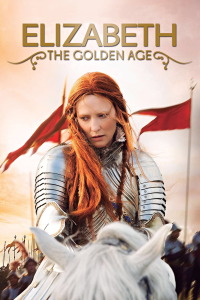
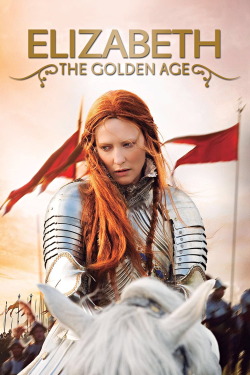
Man, Lizzy's getting old, so maybe they should call this "Elizabeth: The Golden Girl"... or something less cheesy, and less clichéd than "The Golden Age". Nearly ten years is a long time to release a sequel, but in 2007, the last time we saw Queen Elizabeth I, she was in an HBO miniseries being played by Helen Mirren, so she's looking like a spring chicken here. It doesn't exactly hurt that Lizzy is sassier than ever, tossing in so many nifty lines that if it wasn't for all of the white make-up, I wouldn't have been able to tell if I was watching a film about Queen Elizabeth or Queen Latifah. ...So, uh, yeah, the fact of the matter is that Elizabeth is back, and she's still getting on Catholics' nerves somehow, probably because she's still keeping that Hindu around. Shekhar Kapur didn't do but one film between this and its predecessor, and as much as I liked 2002's "The Four Feathers", I have to admit that with its box office numbers and lasting power, Kapur may as well have not done it, so, seriously, how much of a challenge was it going to be to get the original's director back on board? I just think it's bizarre that they're even making near-indulgently expansive, pseudo-blockbuster sequels to period dramas now, although I am looking forward to "Anne Boleyn: The Revenge"... you know, because there aren't enough films about Anne Boleyn. Shoot, there are more than enough films about Queen Elizabeth I, but I'll take it, because this subject matter can apparently still making a movie that is not simply good, but mighty strong, for all its shortcomings, that is.
It's so hard to do something unique with films like this, and even though the original "Elizabeth" had plenty of refreshing elements, it ultimately succumb to a number of conventions, so, seeing as how this particular formula has already been done by "Elizabeth", and by a number of films that "Elizabeth" has since influenced, this film is even more familiar, handling its tropes better than most, but nonetheless having no shortage of them. Among these conventions is, of course, slow spots, for there are occasions of meandering that go backed by a hint of tonal dryness, and ultimately try your patience, even though the final product is ultimately much less repetitious and slow than its predecessor. This sequel does a much better job of breaking monotony, at least in pacing, although it often has to resort to fluff to do so, finding hints of tonal unevenness within a more distinct sense of humor, but mostly finding superficiality within certain melodramatics, or at least certain overdramatic atmospherics, whose excessive intensity occasionally wears you down, despite not being as excessive as the layers that are handled so overambitiously. There's much more going on in this film than in the predecessor, with dramatic and thematic versatility and intrigue that are both more plentiful and handled better, and yet, the predecessor had enough trouble transcending convolution, so it should come as no surprise that this epic is also hard to follow, especially when the focal shifts prove to be jarring and detrimental to the focus of the plot. The predecessor may have gotten convoluted, but it rarely, if ever got all that uneven with its focus, whereas this sequel, despite its best efforts to establish an enthralling sense of importance within each layer, goes all over the place, perhaps because it, being both grander and shorter than its predecessor, doesn't have the time to really flesh out the connections between the layers, whose undercooking also causes the film to rush along its points, wearing you down until meanderings come into play, further challenging your investment. I suppose this reflects just how well-made the film is, because for all of the trials to your patience, the final product stands strong, its issues overshadowed pretty solidly more often than not by inspiration and tight composition, but when the grip of the engrossing storytelling loosens, things really get a little messy, more so than they did in the ultimately inferior predecessor, thus, I cannot promise that one's investment will stand its ground against all of the conventions, overambition, and flimsy structuring and pacing in this simultaneously overblown and rushed epic. There are some points of excellence in this film, and plenty of points of misguidance, but, honestly, this drama is never less than compelling, and between the missteps and the occasions of excellence, in addition to the prominent moments of strength, the final product rewards much more thoroughly than I expected, while being about as aesthetically outstanding as one might predict.
For this film's score, Shekhar Kapur snuck in fellow Indian A. R. Rahman, as well as the gifted, Shakespearean-style composer Craig Armstrong, and such an ambitious union pays off, for although this film's soundtrack isn't brand-speaking-new, it's stellar, with beautiful lows, enthralling midranges, and soaring, often whimsically symphonic highs, all of which play a major role in livening this film up, to one degree or another, while bringing life to the resonance and grandness of this intimate, but rich epic. Just that can be said about Remi Adefarasin's exquisite cinematography, whose crisp coloration and lighting always carries a certain portraitist glaze, - which, upon falling over gothic and lyrical visuals that heavily stress light and the abence of it, is utterly breathtaking on a level that has to be seen in order to be believed, maybe even recognized as a triumph in cinematic photography - as well as a tight scope that is both intimate and broad, in order to immerse you, with a great deal of help from Alexandra Byrne's stunning costume designs and Guy Hendrix Dyas' expansive production designs, all tightly orchestrated through lavish art direction by David Allday, Jason Knox-Johnston, Phil Sims and Andy Thomson that restores the Elizabethan Era with so distinctly, so transportively, and all around so meticulously that it's utterly awe-inspiring. The impact of this epic thrives on its aesthetic value in a lot of ways, for the film is very decidedly superior than its predecessor on a technical level, and yet, when it comes to substance that accompanies the style, there is admittedly more potential, for although this story concept is convolutedly and unevenly overblown, perhaps even soapishly histrionic, every single layer is thoroughly intriguing in this study on Queen Elizabeth I's struggle to maintain her composure and purity amidst a juicy romantic conflict, aging, threats on her life, treason, politically charged propositions for marriage, and imperial warfare. Yeah, based on that story description, you see what I'm talking about when I say that this epic bites off more than it can chew, and yet, even though convolution and unevenness are more-or-less unavoidable, this film does as well as it can to keep things tight and fleshed out, largely through a script by William Nicholson and Michael Hirst, writer of the original "Elizabeth", that offers more clever humor and subtly colorful set pieces in order to hold you over with entertain until the plot thickens, to a point that is beyond total control, but handled tightly enough for you to grasp the nuance of the individual layers, and the significance of this plot. In concept, this is an intimate, but sprawling epic, and in under two hours, Nicholson and Hirsch manage to bring a great deal of life to their ambitious and noble vision, which couldn't have hit so hard if it wasn't for Shekhar Kapur, whose directorial style delivers on plenty of flash, - especially during a final act that delivers on marvelous, technically spectacular battle sequences - but is much more controlled than it was in the often overstylized predecessor, being celebratory of the drama's environment and weight, sometimes to an overdramatic extent, but largely to an extent that transports viewers into this world, capturing a sense of expansion that was lacking in the more repetitious predecessor through a grand scale, as well as tight intimacy. I don't really get the complaints that there is a lack of emotional connection with this film, for I found myself very invested in the characters, do to their being so distinguished and nuanced by Nicholson and Hirst, so complimentary to a dramatic tone that Kapur molds with inspiration, and, of course, so well-portrayed by a cast full of talents, such as the charismatic Clive Owen, the beautiful Abbie Cornish, the distinguished Geoffrey Rush, and, above all, leading woman Cate Blanchett, whose reprisal of the role that broke her out as a revelation of better than ever, with an esteemed charisma that sells the stature of Queen Elizabeth I, and a sweeping dramatic range that captures the lead's humanity, complete with vulnerability and, of course, flaws. Watching Elizabeth come into power through grave danger and maturing in the predecessor was enchanting, but the true journey is beholding Elizabeth struggle to overpower corruption and a dehumanizing feeling of invincibility and power that ironically derives from human error, because where the transformations of this iconic role could have felt uneven in this heavily layered character study, Blanchett's effortless emotional conviction and well-rounded transformation milks every drop of nuance in this intimate drama in a performance that stands as a testament to the actress' being one of the more gifted performers alive, while joining an inspired telling of a sweeping story in transcending the many shortcomings and overambitions and making a drama that borders on outstanding in its effectiveness and realization.
In the end, one's investment is sure to find something of a challenge in familiarity, slow spots and tonal inconsistencies, and great challenges in storytelling so overblown that it begets convolution, unevenness and near-exhausting business, thus, there is plenty to complain about, but plenty more to, not simply compliment, but laud, because through phenomenal score work, breathtaking cinematography and lavish art direction, the film proves to be an outstanding aesthetic experience, while the scale and dramatic value of a grand, heavily layered story is done great justice by the wit and predominantly well-rounded tightness of William Nicholson's and Michael Hirst's script, the flashy style and sweeping, emotionally charged inspiration of Shekhar Kapur's direction, and the across-the-board strength of a talent cast that Cate Blanchett heads with a stellar performance that surpasses her revelatory performance in the predecessor, and defines the inspiration that, through all of the many shortcomings, defines "Elizabeth: The Golden Age" as a, for me, decidedly superior sequel to a classic, as well as a generally deeply rewarding dramatic epic by its own right.
3.25/5 - Strong.
This review of Elizabeth: The Golden Age (2007) was written by Noname on 18 Sep 2014.
Elizabeth: The Golden Age has generally received mixed reviews.
Was this review helpful?