Review of Election (1999) by Paul Z — 08 May 2010
In its scenarios and each and every one of its ensemble of colorfully introduced, pitch-perfect characters, Election is a distillation of US culture and politics. For instance, there is a cleverly subversive scene where schoolteacher Jim McAllister asks school football star Paul what his favorite fruit is. Paul says, "Pears. No wait! Apples." Mr. McAllister then proceeds, "Great, now say that everyday you had an apple. An apple, an apple and more apples. You probably thought that apples were pretty good, even if you got a rotten one every once in awhile. Then one day there was an orange. Now you can choose, do you want an apple or do you want an orange? That's democracy." Paul then delivers the key line, "I also like bananas." Indeed, every line is key. In some sense or another, they are all satirical punch lines. Each character narrates, so what we get are indeed apples and oranges. In their own unique ways, they let us know their take on each turning point that concerns them. Then when they all converge, like in a campaign rally scene in the school gym, we are aware of all contexts and perspectives, and what gets a reaction out of the student body and what leaves them quiet and bored hits several satirical bull's eyes at once.
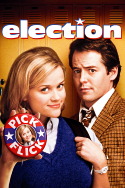
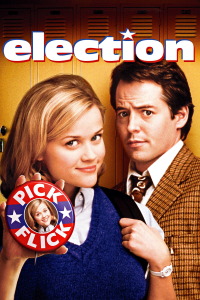
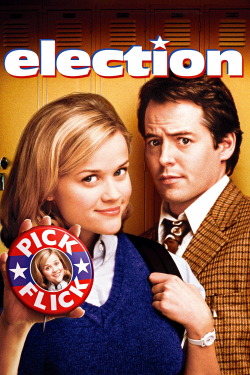
We recall classmates like Tracy Flick, the egghead who invariably has her hand in the air, while the teacher hopelessly scans for someone else to call on. She's one character in Alexander Payne's Election, an expert send-up about an election for student government president, a post Tracy craves to conquer to go along with her accumulation of every other prize in school. Tracy is played by Reese Witherspoon, who gave the seminal performance of her career in Election as a driven, calculating climber who tells Mr. McAllister she hopes they can collaborate "harmoniously" in the next school year.
Jim McAllister's subsequent deception is the ironic and catastrophic truth that stands as the metaphor for contemporary US politics. He is in charge of organizing the student government, and begrudges Tracy for personal reasons, so he puppeteers the dim-witted, polite and hugely popular jock Paul, who can't play football this year, by pitting him against Tracy to draw out her vindictiveness. McAllister is played by Matthew Broderick, who narrates the film in a pitch tempered between awe and revulsion, and his performance is great in the sense of maintaining that equilibrium. Paul is played by Chris Klein in what might be his only truly good performance. Instead of a sweet walk-on hunk in a shallow teen movie, Payne exercises all of those qualities in him, the result being that he is perfect for the role.
Perhaps my favorite character is Paul's sister, Tammy, the kind of student who is so completely her own person, so wise beyond her years, practically invisible in the shallow haze of Midwestern social mores, but that's no bother to her. She is dumped by her lover, classmate Lisa, who says that she is straight and was just experimenting. Lisa turns around to suddenly be Paul's new girlfriend and campaign manager, mostly to hurt Tammy. In response, Tammy runs for president too, with a platform that student government is all b.s. During the school assembly to hear their speeches, after Tracy merely gains a golf clap and Paul gets a strong reaction simply for his quarterback stardom, Tammy effortlessly voices an audacious speech reproaching the election and that she will get rid of the student government if elected. Thunderous standing ovation, followed by a total hair-pin turn in the story.
Few commercially successful independent filmmakers of the 1990s cared as much about the incisive political realities of the Midwestern United States as Alexander Payne. Payne is a satirical filmmaker who doesn't take basic aim and bombard it. He stations in the center of his story and ambushes on all sides. Election is by no means just about a scandalous student. It's also about a weak teacher, inflexible authority, and a student body that is predominantly just coasting along until it can go out into the world and overrun useful room. The movie is not nasty about any of its characters. I kind of liked everybody some of the time (loved Tammy!), and even felt a little sorry for each one. Payne doesn't take pleasure in scapegoats and derision. What he's shooting for is an allegory for elections overall, in which the voters have to pick between the sorts of people who have been running for office ever since high school.
This review of Election (1999) was written by Paul Z on 08 May 2010.
Election has generally received very positive reviews.
Was this review helpful?