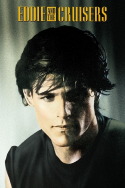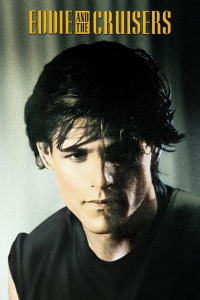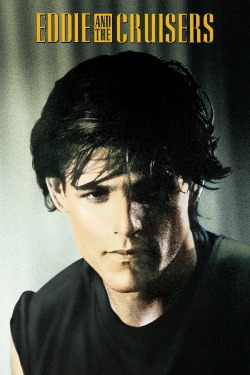
Review of Eddie and the Cruisers (1983) by Edith N — 26 Feb 2013
A Cult of Which I Am Not a Member.
I think I only became aware of this movie when the sequel came out in 1989. I am assured that this was made into a cult classic by frequent appearances on cable, but today was the first time I'd ever seen it for all that. Once again, we may have hit on a problem caused by seeing it at the wrong time or in the wrong era; maybe, if I'd seen it in the '80s, I would have been caught up in it. As it was, I found it rather dull. The music wasn't bad, though of course it was anachronistic in places, but it still didn't even make me interested enough to brave the sequel, and all that would have taken was flipping over the disc. I decided to pass, and I don't regret the decision. I'm honestly not sure how the disc ended up on my Netflix queue in the first place beyond morbid curiosity.
In 1963, Eddie Wilson (Michael Paré) was on the verge of stardom. A few of the band's songs had charted, but Eddie was taking the band in a new direction, and the money people didn't like it. Then one night, Eddie drove away from the home of bandmate Joann Carlino (Helen Schneider) and crashed his car, destroying it utterly--though of course his body was never found. Twenty years later, reporter Maggie Foley (Ellen Barkin) is trying to track down everything she can about Eddie and the Cruisers, including the whereabouts of the tapes of those last sessions, which might now be released and make the living Cruisers quite a lot of money. One of the people in the band was Frank Ridgeway (Tom Berenger), then a songwriter and pianist and now a high school teacher. He begins an investigation on his own, and it turns out that someone who might be Eddie is calling Joann at night.
I don't understand why Wendell Newton (Michael "Tunes" Antunes) dies. To be fair, I'm not entirely sure [i]how[/i] he dies, either--I assume an overdose of some sort, even if it's just something as prosaic as alcohol. However, that bothered me less. I think his death was intended to show that Eddie was beginning to come apart at the seams, and certainly, the best way to do that was probably to show his reaction to something major. It's also true that Wendell is a member of the band and yet such a minor character that he doesn't even have any lines. Maybe it's also a moment that lets characters say, "That's when it all started going wrong." And of course, "You're only remembering the good parts!" And so forth. However, he's the only character who's actually black, instead of just believed to be black, and he gets no lines and then dies. It's a little jarring, and I don't think it did much for the plot.
I'll also admit to having been bothered by the character of Joann, who seems to have been the token girl. I'm not entirely sure what she did with the band, but there she was onstage, ready to make the most of the opportune moment. I can understand that she was good friends with Eddie while not being in a romantic relationship with him; for one thing, that leaves her open for entanglement with Frank. I've had several male friends with whom I would go on late-night wanders or drives, depending on circumstances, and I've even had a male friend or two for whom I would have dropped just about anything if I thought they were coming back into my life after twenty years. That end of things didn't bother me; what did was what she was doing with the group in the first place. She was undefined, and probably for much the same reason Wendell was.
This seems in some ways to be a bit of a cut-rate rock-'n'-roll [i]Citizen Kane[/i], with everything that implies. Oh, to be sure, we'd get more focus on Ellen Barkin in a more accurate play on the film. However, I suppose Tom Berenger is to this story as Joseph Cotten is to that one--the old friend who is left standing over the grave, trying to piece everything together. Not that Eddie Wilson had a grave. Certainly Eddie didn't come from wealth the way Charles Foster Kane did. However, there is still that way of piecing a life together by showing only what could be seen from the outside. Both men are left incomplete by that way of telling things; the difference is that we are supposed to realize that we can never know Kane through others' eyes, whereas I'm not sure how much else there is to Eddie Wilson.
This review of Eddie and the Cruisers (1983) was written by Edith N on 26 Feb 2013.
Eddie and the Cruisers has generally received positive reviews.
Was this review helpful?