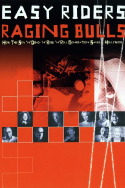
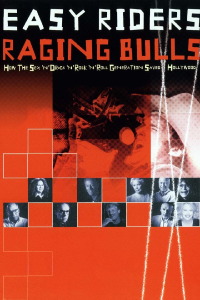
Review of Easy Riders, Raging Bulls: How the Sex 'n' Drugs 'n' Rock 'n' Roll Generation Saved Hollywood (2003) by Ian D — 26 Aug 2008
It may seem rather pointless to write a film review on a documentary. After all, is a documentary's point itself not to raise awareness of a subject that is either widely or grossly overlooked? Whether they are an amazing and inspiring true story of survival or a view of a larger political, social or historical event, documentaries themselves tell you everything that you need to know. Of course, documentaries can be biased. Documentary filmmakers can bend truths in order to sex up the facts and give themselves more credence in the process of doing so. So too can they supply you with inaccurate information, presenting opinion as fact or even fabrication in place of fact. Ultimately it is up to the viewer what they believe and what they do not; unfortunately it is not always a case of an audience being supplied with the facts and nothing more.
I personally believe that documentary filmmaking is one of the most important aspects of the film industry. Nestled in amongst the blockbusters and the TV spin-offs are gems of modern cinema, diamonds in the rough waiting to be sought out by those of us who crave a little more than what Hollywood has to offer. It is refreshing and rewarding to witness something that perhaps means a little more than the average film, interesting to learn about things that have happened, events that have shaped the world as we know it today. Above all else, it is important to gain an understanding of things that matter. This is subjective, of course; what matters to one person matters not to the next. But all films are subjective; if they weren't there would be no need for genres.
The full title of this film is 'Easy Riders, Raging Bulls: How the Sex 'n' Drugs 'n' Rock 'n' Roll Generation Saved Hollywood' and it is based on the bestselling book by Peter Biskind of the same name. That book is viewed by many as the best insight into the film industry during a time of crisis, excess and power struggles. If nothing else, it serves as a fantastic expose, painting a truthful (and not always favourable) portrait of a number of now Hollywood megastars. Interesting? Erm, yes...
'Easy Riders, Raging Bulls' recounts a period in Hollywood where things were not going to plan. As the title suggests, this period is roughly from the release of Dennis Hopper's groundbreaking 'Easy Rider' in 1969 through to the release of arguably Martin Scorsese's finest picture, 'Raging Bull' in 1980. This period is as notable for the shift in power between the major studios and young directors as it is for the films that came out of it. You see, Hollywood has not always been the powerhouse of world cinema that its current dominance suggests - since its rise to power it has taken some huge blows, some of which very seriously threatened to end its governance. In the 1960s, with the advent of television and the growing youth market, for which the aging heads of the major studios did not know how to cater for, the American film industry was in desperate danger of becoming entirely irrelevant.
The new consumers wanted sex, violence and drugs and the people at the top had no idea how to supply this type of entertainment - they didn't even see it as entertainment. Hollywood was in limbo and no existing studio personnel knew how to push things forward. Enter the new generation of filmmakers: Dennis Hopper, Peter Bogdanovich, Sam Peckinpah, Martin Scorsese, George Lucas, Steven Spielberg, Roman Polanski, and Francis Ford Coppola. Now legends, portrayed here as unknown idealists, it was up to this group of aspiring filmmakers to change Hollywood forever. 'Easy Riders, Raging Bulls' tells the story of how that happened - explaining and exampling through a number of first-person accounts how the balance in power shifted from the Hollywood majors to the new wave of American directors. And given the current situation in Hollywood, how it shifted back again.
As with most documentaries, style is secondary to function. Popular inclusions in documentary filmmaking include the use of archive footage, talking heads, re-enactments or dramatisations and montage sequences with or without voiceover commentary. In 'Easy Riders...' all but dramatisations form the basis through which we are told about the subject in question. There is nothing out of the ordinary here, no specific stylistic qualities that deserve highlighting, just old-fashioned, efficient anecdotes corroborated by classic film clips. Voiceover narration is provided by William H. Macy, whose voice lends itself well to the capacity in which it is used. It seems that celebrities, especially actors, are keen to carry out this kind of work - Tom Cruise narrates 'A Life in Pictures', the Stanley Kubrick biography and Robert Downey Jr. lends his vocal chords to 'It/ll Be Better Tomorrow', the Hubert Selby Jr. documentary. I assume that the stars in question are keen to have their names associated with the subjects of the documentaries themselves, whether it be for personal or publicity reasons. Perhaps it is just out of interest.
It is a shame that Bowser was unable to arrange any of the major players themselves to be interviewed as talking heads. Scorsese, Coppola, Lucas, Spielberg and Polanski (for obvious reasons) are all notable by their absence. Of course these are all very busy men, so their omissions are forgiven but it would have made for an entirely different picture if Bowser had pulled off such a coup. That is not to undermine the efforts of any involved in the film; after all we are still treated to Hopper, Bogdanovich, John Millius, Peter Fonda, Kris Kristofferson, Richard Dreyfuss and many more. It is perhaps possible that the inclusion of such Hollywood megastars would have threatened the integrity of the documentary - it is certainly the case that the big names have more to lose than the people on display here. The fact that we are hearing from industry insiders who have no way of covering up their mistakes and nothing to lose by talking about them makes for a more frank account of what really happened during this period. Aside from this fact, do Spielberg et al need even more screen time?
Archive footage, including film excerpts, still images of film productions and one or two interesting interviews, are used to great effect in the film. The style and tone of the excerpts map the change in the tone of Hollywood itself and therefore there is a sense that we are not just being told about what happened, we are seeing it - it is tangible and due to this we can gain a better understanding of it. It is good fun to see a few famous clips here and there and learn a little bit about what was going on behind the scenes, who was out of their mind on drugs etc. The short section of the film that deals with the Manson family and the Sharon Tate murders proves to be the most interesting in my opinion; a short clip of an emotional Roman Polanski fighting off rumours that his and his wife's Hollywood lifestyle was to blame for the slayings is upsetting. Given that this took place before Polanski's arrest and subsequent fleeing of the country for statutory rape (originally he was tried for rape) it is possible to sympathise with the man.
'Raging Bull' is the documentary's ace in the hole. Shown last of all, the film serves as a movie milestone that signifies the end of an era. No more would directors have the power to run the studios ragged, the majors would again call the shots. The final clip acts as a metaphor for the film industry's journey through the 10 or so years focused on by 'Easy Riders...' As De Niro's Jake LaMotta is ruthlessly beaten to a pulp by Sugar Ray Robinson, his blood splattered sickeningly over the ringside spectators, one is reminded of the 'warts n all' nature of the Hollywood film industry. LaMotta's needless taunt to Robinson after the fight has ended, "you never got me down, Ray", perfectly sums up the stance of the major studios who were threatened, down and out and had to suffer the indignity of drafting in the so called 'brat pack' to save themselves. But after all the turmoil they were back on top, running the show.
You may think that you know all there is to know about Hollywood, but the chances are that you don't. 'Easy Riders, Raging Bulls' tells the story of an industry in crisis, a crisis that not many people even know existed in an industry that we have all embraced at some point in our lives. There is a documentary for everyone out there, and this one is perfect for people who are interested in cinema.
--------------------------------------------------.
If this film has alerted you to an aspect of the Hollywood film industry that you were unaware of and you are interested in other historical points of interest, read up on the Paramount Decree of 1948, which spelt the end of vertical integration in the Hollywood film industry and the Hollywood Blacklist of 1947-1960, in which approximately 300 directors, screenwriters and actors were banned from working due to their sympathy (real and suspected) towards the American Communist Party. Both are important events that too sent the industry into crisis. Further related areas of interest are the exploitation movement, which eventually gave rise to the Hollywood Blockbuster as we now know it and the blaxploitation movement in which Hollywood attempted to target black audiences to improve profit margins.
This review of Easy Riders, Raging Bulls: How the Sex 'n' Drugs 'n' Rock 'n' Roll Generation Saved Hollywood (2003) was written by Ian D on 26 Aug 2008.
Easy Riders, Raging Bulls: How the Sex 'n' Drugs 'n' Rock 'n' Roll Generation Saved Hollywood has generally received very positive reviews.
Was this review helpful?