Review of Easter Parade (1948) by Steven B — 27 Sep 2009
Part of my Musicals class at U of M involved watching the only film with Fred Astaire and Judy Garland, Easter Parade. The film is your standard musical fare, lively and saccharine with little character development but interesting dance numbers.
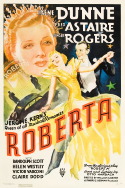
Easter Parade features Astaire as a dancer whose partner has decided she's had enough with him. To prove that he doesn't need her and can teach any woman in the world to be a good dancer, he enlists Judy Garland, a dancer at a bar, to be his new partner. After seeing so many movies in which Astaire was paired with Ginger Rogers, you can't help but wonder if this plotline was at all inspired by her, or if there was any kind of bad blood between them after their split.
This was one of Astaire's later films, and his character seems to reflect his increasing age in all the worst ways. In Easter Parade, Astaire comes off as arrogant, grouchy, and overall a crotchety old man. It would have been fine if the movie acknowledged it, but it moves along as if Astaire is your average likeable hero, ignoring the fact that his very first scene involves him stealing a drum from a little boy. In accordance with this take, Garland falls in love with Astaire despite his cold shoulders, possibly only because he's a famous dancer.
And yet it's hardly surprising that this happens. Old movies, especially musicals, tend to have weak female characters who only serve as a sort of plot device for the male star to move around. This is also evident in the fact that Astaire receives a number of solo dances and songs, while Garland only receives one (I Want to Go Back to Michigan; Irving Berlin apparently liked to rhyme unusual words like Michigan, but I don't think the fellow has ever been to the state. I live there, and it's nothing like the farms and rural living that Garland sings about).
Another aspect of the film that I assume lies with its age is its slight anti-intellectual theme. It's not prominent or anything, but it's definitely there, as the archetypal wise bartender dispenses more knowledge than any old school books could. And it's also hard to ignore the fact that minorities are only featured in servant positions.
But besides these problems that plague most pre-1960 films, the movie is fine. It's upbeat and colorful; in fact, I think that when the filmmakers realized they were doing this in color they decided to go all out with it. The result is a sometimes over-saturated amount of colors on screen, which can occasionally be distracting. Also distracting were a few scenes that just seemed out of place. There was an over-eccentric waiter who really gets into describing his salad, and a completely random shot of Astaire dancing in slow motion while his back-up dancers dance in real-time. Both of these instances brought me out of the film and made me question it, something that I imagine colorful musicals aren't trying to make you do.
Judy Garland can seem a bit hoakey at times, but honestly, it's a thing that works for her so it's okay. Ann Miller, who co-stars as Astaire's ex-partner, does a fantastic job if not in acting then at least in dancing. Her solo tap-dancing number was a possible highlight of the film, and makes me able to say that one of the best tap dancing numbers I've ever seen was done by a female. Peter Lawford also co-stars, and you just end up feeling bad for his wholesome character who gets shafted out of a love interest. If you know your musicals like I (for better or worse) do now, you might be interested in the allusion to Rogers' feather dress from Top Hat here, as Garland wears a dress that similarly sheds during a performance.
Overall, I imagine one would only like this film if they really liked old time musicals. I'm not sure whether or not I can consider myself part of that camp, and my opinion of the film is almost entirely neutral. There are a few catchy songs and visually exciting numbers, but the film is fluffy and airheaded. I guess it's worth taking a look at two of the greatest classical movie stars together in a feature, but I wouldn't rush out to rent it.
Final rating: 6/10.
--James A. Janisse.
This review of Easter Parade (1948) was written by Steven B on 27 Sep 2009.
Easter Parade has generally received very positive reviews.
Was this review helpful?