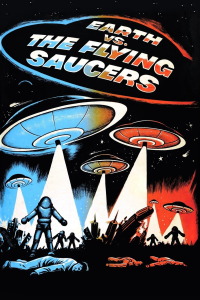
Review of Earth vs. the Flying Saucers (1956) by Mel V — 26 Mar 2008
As a film genre, science fiction really hit its stride in the 1950s. While movie studios released the occasional science fiction epic (e.g., [i]Metropolis[/i] in the 1920s, [i]Things to Come[/i] in the 1930s[/i]), most of what was then available was of the low-budget, pulpy variety (e.g., [i]Flash Gordon[/i], [i]Buck Rogers[/i] serials). With nuclear confrontation between the United States and the Soviet Union likely, and the threat of another devastating war on everyone?s minds, it?s not surprising that those Cold War fears and anxieties would slip into the science fiction genre, starting with [i]The Day the Earth Stood Still[/i] and [i]The Thing From Another World[/i] (a.k.a., [i]The Thing[/i]), both released in 1951. [i]The Day the Earth Stood Still[/i] took a more benevolent view of visitors from outer space while the alien in [i]The Thing[/i] was anything but benevolent.
With its anti-intellectualism, xenophobia, and aggressive militarism (force was always the appropriate response), [i]The Thing[/i], a B-movie effort produced by Howard Hawks (who, by most accounts, directed it too), became a template for the science films that followed over the next nine or ten years. The two closest in tone and outlook, [i]The War of the Worlds[/i], an adaptation of H.G. Wells? 1899 novel transposed to 1950s and the United States, and [i]Invaders from Mars[/i], a Cold War allegory involving mind control, sleeper agents, and deification of the military, both borrowed and expanded on [i]The Thing?s[/i] themes. Not coincidentally, [i]The War of the Worlds[/i] and [i]Invaders from Mars[/i] were both released in the same year, 1953. Only [i]It Came From Outer Space[/i], also released the same year, offered a view of human-alien contact that didn?t end in bloodshed.
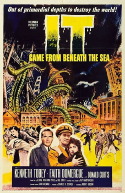
Between Cold War fears and anxieties and an epidemic of UFO sightings, an enterprising producer was bound to combine the two, borrowing from [i]The War of the Worlds[/i] as needed., Leafing through Donald Keyhoe?s non-fiction bestseller, [i]Flying Saucers from Outer Space[/i], producer Charles Schneer saw a potentially profitable B-movie. Schneer tapped Ray Harryhausen, a stop-motion animator who?d made a name for himself with [i]The Beast from 20,000 Fathoms[/i] and [i]It Came From Beneath the Sea[/i], released in 1953 and 1955 respectively. Harryhausen would handle all of the flying saucer effects, from animating them in flight to the destruction of several monuments and landmarks in Washington, D.C. Harryhausen worked alone, a decision that resulted in a lengthy, post-production process.
Schneer hired Curt Siodmak, a prolific German émigré whose career in Hollywood covered four decades and more than fifty writing credits, including [i]The Beast with Five Fingers[/i], [i]I Walked with a Zombie[/i], [i]Frankenstein Meets the Wolfman[/i], [i]The Invisible Man Returns[/i], to write the screenplay. His novel, [i]Donovan?s Brain[/i] was also adapted into a film. Despite his background and experience, there?s little in [i]Earth vs. the Flying Saucers[/i] that suggests a talented writer. More likely than not, Schneer gave Siodmak Keyhoe?s book, the premise, direction to follow [i]The War of the Worlds[/i] closely (but not too closely, given the usual qualms about copyright infringement), and a tight deadline.
[i]Earth vs. the Flying Saucers[/i] follows Dr. Russell A. Marvin (Hugh Marlowe), a government scientist working on a project that will send twelve communications satellites into orbit around the earth (Sputnik was still a year away). Marvin has his ex-secretary-turned wife, Carol (Joan Taylor) on hand for emotional support. On the way to the army airbase where the next satellite is scheduled to launch, a low-flying saucer buzzes Russell and Carol. After the launch fails, Russell discovers a message on his tape recorder that, when played slowly, reveals a message from the aliens. The message warns Russell that additional satellite launches will result in a forceful response by the aliens. Russell and Carol?s father, Brig. Gen. John Hanley (Morris Ankrum), however, refuse to stop the next satellite launch. Unsurprisingly, the aliens attack the alien base.
The aliens broadcast a global message promising additional destruction if the world?s governments don?t surrender. And here?s where [i]Earth vs. the Flying Saucers[/i] goes off the rails. Luckily for Russell and the U.S. government, the aliens don?t attack right away or even give them a short window in which to reply. The aliens give the earthmen 56 days to think things over and, of course, come up with a plan to defeat the aliens, a plan involving ultrasonic guns that will be interrupt the flying saucers? propulsion systems. The slow-motion race against time results in several, brief confrontations with the aliens and their flying saucers before the final battle over the skies of Washington, D.C.
Unfortunately, Siodmak?s derivative, by-the-numbers screenplay is matched by the late, definitely not-so-great Fred F. Sears ([i]The Giant Claw[/i], [i]The Werewolf[/i], [i]Teen-Age Crime Wave[/i]), whose directing here is stiff and unimaginative. To be fair, Sears had to work with a miniscule budget, including lots of stock footage, and a short production schedule, but that?s little excuse for the lack of energy that seems to permeate every scene and a cast that seems happy to recite their lines with a minimum of effort. Sears was a journeyman director for good reason: his barely competent direction probably came at a bargain rate.
If [i]Earth vs. the Flying Saucers[/i] is worth seeing, it?s not for the script or the direction (definitely not either), but for Ray Harryhausen?s visual effects work. While the effects look crude and unpolished by today?s computer-animated standards, they were on par or even better than what other science fiction films of the decade had to offer. Harryhausen, then as now better known for the stop motion animation of characters and not objects, added just enough visual flair to the flying saucers to make them stand out. Harryhausen?s destruction of the Washington Monument and the Capitol Building shaped the genre?s predilection for spectacle over substance. It was also remembered fondly by filmmakers who encountered Harryhausen?s work in movie theaters, on television, or on video (e.g., Tim Burton?s [i]Mars Attacks![/i], Roland Emmerich?s [i]Independence Day[/i]).
This review of Earth vs. the Flying Saucers (1956) was written by Mel V on 26 Mar 2008.
Earth vs. the Flying Saucers has generally received mixed reviews.
Was this review helpful?