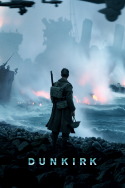
Review of Dunkirk (2017) by William L — 21 Oct 2017
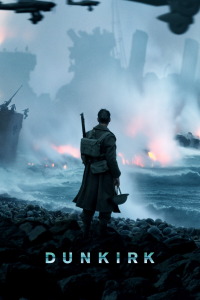
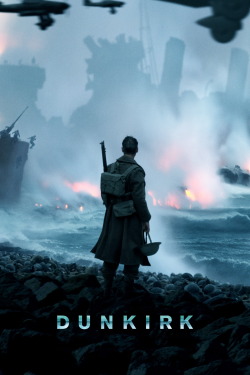
I gotta hand it to Christopher Nolan for continuing to make intelligent and provocative movies. The first thing to consider with this flick, though, is that it isn't a "war movie" in the traditional sense, even though its subject matter concerns the military operation that took place in Dunkirk, France, during the Second World War, May 10, 1940. Most war movies are linear, telling their story in a fairly straightforward manner. They may involve heroism, carnage, things blowing up, but they normally progress from point A to point B in order to retell dramatically the events of the historic event. They also generally follow a single protagonist (or a handful of characters) who inevitably survives the event. This film, however, is using the vehicle of the historical event to explore the themes present in Nolan's general corpus of work so far; namely, the nature of time, the feeling of being trapped, memory, and heroism in the face of defeat. To that end the film is a great success because it is reflecting on the response of individuals to an inexorable catastrophe. In fact, the film struck me as Nolan's commentary on the terrorist attacks on New York in 2001. Noticeably, the same elements from prior films such as water, mist, darkness, and nightmarish experience are present in Dunkirk, making the work another episode in the megafilm of dream experience which develops across the span of Nolan's other works.
So what is Christopher Nolan trying to say in all these films? Of the many themes, the most prominent seems to be that sense of being trapped; Memento's Leonard is trapped in his own head and faulty memory (and his girlfriend ends up trapped in a garbage bag), Batman's Bruce Wayne is trapped in the cycle of revenge and violence, the characters in Interstellar are trapped on a dying world. In Dunkirk the historic material certainly confirms this sense of being trapped, but Nolan adds images of men being trapped in sinking ships, trapped in sinking airplanes, trapped in the dark hold of a vulnerable fishing boat whilst being shot at; he has long camera shots down alleyways, or through flagpoles that look like prison bars, or through the POV of fighter pilots; he has disorienting shots filmed from a camera strapped to the side of a plane in a dogfight, or terrifying shots of men burning in oily water, or nightmarish shots of men trying to clamber onto a lifeboat at night. Even the Enemy, the German Panzergruppe von Kleist, remains dark and invisible until the very end of the film making them a terror out of the nightmare subconscious. Additionally, Hans Zimmer's use of the endless "Shepherd's Tone" illusion creates a rising tension and claustrophobia while the confusing shifts in time lay bare to the audience their own experience of being trapped in an inexorable linear progression, unable to escape from the events of their own time.
But for Nolan there is no "escape", no cavalry, no happy land far far away to which we can flee from these prison walls. Nolan's vision of salvation is far more mature. He seems to suggest that salvation is not an escape from pain or suffering - but rather comes from the thousand little choices each character makes to give all they have in order to preserve human life. The ending of the movie, echoing Churchill's famous speech embodies this stoic perseverance in the face of defeat: "we shall never surrender... (we shall) carry on the struggle, until, in God's good time, the New World, with all its power and might, steps forth to the rescue and the liberation of the old." Sometimes it is the job of the artist to remind his audience of truths they have forgotten. The bending of time which occurs in the film seems to suggest that this perseverance is not new but has repeated in generation after generation; the perseverance of the Greeks against overwhelming Persia, the endurance of the Viennese against the siege of the Sultan, the persistence of the British regulars at Rorke's Drift. Time and again there have been individuals in crisis situations who have panicked, despaired, exhibited cowardice or cruelty - but there have also been those individuals who, despite knowing they would fail, persisted in doing what they saw as right. Individuals whose actions echoed Claude MacKay who said, "Like men we'll face the murderous, cowardly pack, / Pressed to the wall, dying, but fighting back!" Individuals who though "Made weak by time and fate, (were) strong in will / To strive, to seek, to find, and not to yield". It is this amazing quality of our race that inspires others to similar action and it is this amazing quality that Christopher Nolan has so masterfully captured in this excellent film.
This review of Dunkirk (2017) was written by William L on 21 Oct 2017.
Dunkirk has generally received very positive reviews.
Was this review helpful?