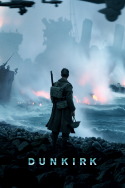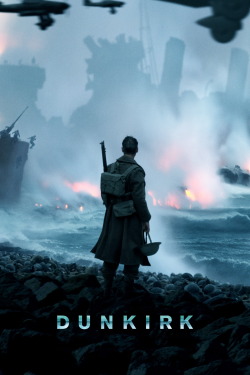
Review of Dunkirk (2017) by Kevin K — 06 Aug 2017
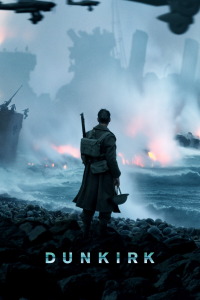
There is something truly mesmerizing about Christopher Nolan's epic film, "Dunkirk." As the director has stated in recent interviews, "Dunkirk" is not a war film; it is a film about survival. It turns out that "Dunkirk," a film that follows British forces during the events of World War II, is just that. In fact, this film goes against the status quo of most war movie epics of the past twenty or so years. "Dunkirk" is a PG-13, gore-less masterpiece. Unlike "Saving Private Ryan," "Hacksaw Ridge," "Platoon," and "Apocalypse Now" (among others) that rely heavily of blood and vulgarity, "Dunkirk" relies on the story itself to deliver relentless tension and shock to a film that is under two hours long.
The film follows three story lines: air, land and sea. It is important to note that each story, while connected with each other, serve different timelines. In fact, the land story arc, which follows Tommy (newcomer Fionn Whitehead) and the 400,000 stranded soldiers on the beaches of Dunkirk, shows time over the course of one week. The sea story arc, which follows Mr. Dawson (Academy Award winner Mark Rylance) and the civilian response to help rescue the stranded soldiers, is over the course of a day. Finally the air story arc, that follows Farrier (Tom Hardy) and his efforts to counter enemy combatants in the air, is over the course of one hour. Throughout the film, the story arcs shift to show different viewpoints of the evacuation of Dunkirk. While it may seem confusing with the overlapping story lines, the film never looses the viewer. Christopher Nolan masterfully directs the flow of the film to the point that each story ends with one another.
Throughout the film's 107 minute runtime, "Dunkirk" never lets go of the tension. The film begins with Tommy and his comrades being ambushed by unknown forces in a town outside the beaches of Dunkirk. From there, the film never lets up until the credits begin to roll less than two hours later. Part of this comes from the fantastic sound editing that mimics the sound of war perfectly. Bullets penetrating objects end with a sharp, piercing sound that gets the viewers attention. Explosions are sudden and catch you by surprise. In addition to the sound, the lack of CGI adds to the realism of the action set pieces. Christopher Nolan, instead of using an overabundance of CGI, used real military planes and warships to reenact the Battle of Dunkirk. In fact, there is so little CGI that Nolan decided to use cardboard fill ins for soldiers on the beach. It is the little details like those that add to the masterpiece that is "Dunkirk.".
While it has a lot of positives, "Dunkirk" does have its flaws. Due to a lack in dialogue and a short run time, "Dunkirk" almost feels like it is half filled. Besides Mr. Dawson, the characters introduced are never developed further than their names. This negatively affects the film as a whole when watching the action scenes. With little character development, I felt distant from the characters and did not have the want to root for them as much. While Christopher Nolan wanted to focus on the person's willingness to survive instead of his backstory, it does feel like something is missing. That being said, the horrors of World War II have been told in over a dozen films and Christopher Nolan acknowledges that. He wanted to focus on the fear of the soldiers and the courage of civilians without having this character's speak it. And it is done marvelously.
"Dunkirk" is an exceptional film about survival and courage. With less focus on CGI and more efforts going into story arcs that leaves us catching our breathes, "Dunkirk" is one of the best "war" films ever made. If anyone thinks that a bloodless war film would not be great, try this one.
Grade: A.
This review of Dunkirk (2017) was written by Kevin K on 06 Aug 2017.
Dunkirk has generally received very positive reviews.
Was this review helpful?