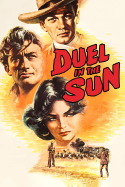
Review of Duel in the Sun (1946) by Christian B — 04 Jun 2009
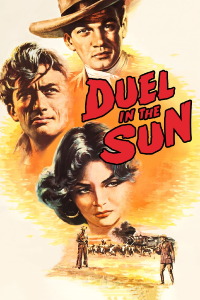
You've got to hand it to David O. Selznick. Not only did he somehow pull off massive epics with only a modicum of DeMille-style camp and improved novels that today amount to pulp fiction, he never lost sight of his source material's primal appeal amid the lavish special effects, swelling Max Steiner music, and unsubtle historical observations that could easily bury any other producer's literary adaptation. He deserves almost as much credit as King Vidor for Duel in the Sun, Selznick's flowery attempt at topping his own Gone With the Wind.
For one, Vidor left the production shortly before its completion, after one of those famous clashes of Hollywood egos film historians love to dwell on these days. For two, Duel in the Sun's bold, intense Technicolor cinematography unquestionably evokes Gone With the Wind's lush, romantic color scheme. Selznick's director of photography Lee Garmes shot both films, Gone With the Wind using broad, side-lit splashes of red and green to evoke the static longing of romance novel covers, and Duel in the Sun with searing swaths of red and, importantly, yellow, the Old West as if imagined by Kirchner. There's a painterly intensity to Duel in the Sun, but even though Orson Welles' absurd narration never lets us forget that this narrative of a tempestuous romance between a half-breed named Pearl (Jennifer Jones) and her borderline-psychotic cousin (Gregory Peck) happened long ago, the emotions feel immediate, not buried under nostalgia.
Maybe it's because, in his heart, Selznick was a screenwriter, and not just that, a storyteller. How much he actually contributed to the screenplay of Gone With the Wind is still unclear, but for Duel in the Sun he took the reins on the script, and it's hard not to see some sort of dialogue about female sexuality and liberation going on between Jones' passionate, yet melancholy and ultimately doomed temptress and the irrepressible Scarlett O' Hara. As much as Pearl seems to teeter on the edge of sanity, we never once lose our identification with her and her uncertain place in the racial/sexual/socio-political order of 1880s Texas, and that is due certainly to Selznick's superb characterization almost as much as Jennifer Jones' captivating take on Pearl as a self-aware virgin-whore archetype.
This is where Vidor perfectly intersects with the film. In what is often called his "delirious phase," with films like The Fountainhead and Beyond the Forest, he gave full license to his actresses to delve into hidden, and often campy, sexual depths. And in Duel in the Sun he pushes Pearl beyond the virgin-whore archetype of Selznick's script into a territory where the terms "promiscuity" and "chastity" have no meaning, and where Pearl neither titillates us nor evokes our pity about being sexually exploited. His camera doesn't linger on her in a way necessarily suggestive of the male gaze. That function already goes to Gregory Peck in the film. Rather she is presented as being a part of the landscape, and we're left to wonder if her turmoil is that found in nature, the rhythms of which are beautifully inculcated in Vidor's musical sense of cutting. And thus we have an operatic ending that is all at once a murder, a suicide, an accident, and an act of Nature.
This review of Duel in the Sun (1946) was written by Christian B on 04 Jun 2009.
Duel in the Sun has generally received positive reviews.
Was this review helpful?