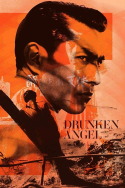
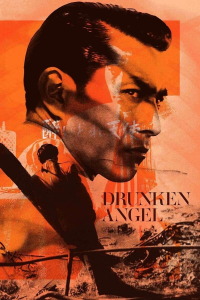
Review of Drunken Angel (1948) by Terry D — 05 Feb 2013
Takashi Shimura is terrific as Dr. Sanada, the "Drunken Angel", Toshirô Mifune is compelling in his first film with Kurosawa as a Yakuza (Japanese Mafioso) who finds out he has tuberculosis, and although not completely unfettered by censors, Kurosawa himself shows strong signs of his cinematic brilliance in this, the first film that was truly his own.
To illustrate this latter point, I feel inclined to focus on one deceptively simple scene: While having an evening meal with his grandmother and assistant, Dr. Sanada stabs his chopsticks into his bowl of rice - this is a gesture that Japanese people usually never do in such everyday circumstances as it is a funeral ritual and symbolizes death.
The scene then fades to a slow pan of the filthy and gurgling sump just outside the house and the center of both the geographical and thematic action of the film. It then deliberately fades back and forth once more between the sump and the contentious dinner table.
Kurosawa does this to emphasize 'cause and effect' in this unhealthy neighbourhood - i.e. 'death' (the chopsticks in the rice) and its cause (the sump). A master stroke from the master.
And there's also the song "Jungle Boogie" in the jazz club, not to be missed.
This review of Drunken Angel (1948) was written by Terry D on 05 Feb 2013.
Drunken Angel has generally received very positive reviews.
Was this review helpful?