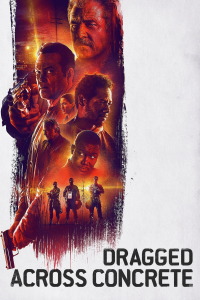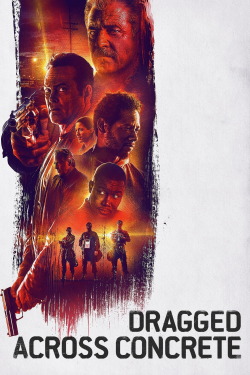
Review of Dragged Across Concrete (2019) by Bertaut1 — 07 May 2019
Ugly, crude, morally repugnant, very enjoyable.
Dragged Across Concrete is the third film from writer/director S. Craig Zahler, after the superb horror-western Bone Tomahawk (2015) and the fatalistic but excellent prison drama Brawl in Cell Block 99 (2017). Synthesising disparate genres, and featuring sudden and often extreme violence, both are methodically paced and emotionally dark. In Dragged, the gore has been toned down (although not the violence), the nihilistic worldview is made more apparent, the genre mashup more complex, and the pace more languorous. It's also morally repugnant, ugly and stoical, exploitative and demoralising. And immensely enjoyable.
Set in the fictional city of Bulwark, the film follows three stories. In one, Henry Johns (Tory Kittles) returns home from prison to find his mother (Vanessa Bell Calloway) turning tricks in her bedroom, whilst his younger brother (Myles Truitt) is kept quiet with videogames. In the second, Det. Brett Ridgeman (Mel Gibson) and Det. Anthony Lurasetti (Vince Vaughan) are suspended without pay after Ridgeman is filmed standing on the head of a Latino drug dealer during an arrest. Needing money to move his family out of the bad part of town in which they live, Ridgeman decides he's done playing by the rules. The third sees Kelly Summer (Jennifer Carpenter) reluctantly returning to work after maternity leave, despite suffering from severe separation anxiety.
Narratively, although Dragged is easily Zahler's most densely plotted film, much like his previous work, it's predicated on character rather than story, spending a lot of time on conversations that do little to advance the plot, but add layers of character information (think the "royale with cheese" scene from Pulp Fiction). One subplot in particular benefits from this technique, so that when it erupts in sickening violence, the emotional impact is all the stronger; think of the character of Breedan (Dennis Haysbert) in Michael Mann's Heat (1995), a subplot that hits as emotionally hard as it does because Mann spends so much time introducing us to the character.
Given what Zahler's films say about masculinity and violence, it's no surprise that he is seen as a quintessentially right-wing filmmaker in a very left-leaning Hollywood - although he claims he's not a Trump supporter, the Daily Beast still referred to him as "the Hollywood filmmaker making movies for the MAGA crowd", which is not only reductionist, it's not even accurate, as there is nothing in his films to suggest he subscribes to Trump's hateful and divisive rhetoric.
That said, if he isn't engaging in socio-political commentary here, then he is baiting outrage culture. Who does he cast as the two racist cops who complain about political correctness and trial by social media, and who use (gun) violence to try to set their world to rights? Noted Hollywood conservatives Mel Gibson (he of the 2010 "raped by a pack of n-----s" comment), and Vince Vaughan, who rather amusingly believes the way to tackle gun violence in the US is to introduce more guns. One can see Zahler getting considerable satisfaction from watching SJWs losing their minds trying to parse the metatextuality.
However, despite his claims that the film is apolitical, it's hard to deny that some of the dialogue has a political flavour. So, for example, the cops' boss, Lt. Calvert (Don Johnson, still effortlessly cool), states that "being branded a racist in today's public forum is like being accused of being a communist in the 50s [...] The entertainment industry, formerly known as the news, needs villains," a comment which will call to mind Trump's refrain of "fake news". Another example is when Ridgeman's wife (Laurie Holden) says, "I never thought I was a racist before living in this area." That's a hell of a loaded statement in a film that's apparently not interested in race relations. Moving away from racial issues, Ridgeman laments to Calvert, "yesterday, after we stop a massive amount of drugs from getting into the school system, we get suspended because we didn't do it politely", and it's hard not to hear Zahler behind such a sentiment; someone who believes (maybe correctly) that PC culture has gotten to a point of absurdity.
The line between critical commentary and ideological endorsement is generally razor thin, and it's a line that Zahler walks throughout, in the first film he's made that's more likely to alienate audiences because of its ideology than its violence. Certainly more to the right than the vast majority of Hollywood, Zahler may be positioning himself as a conservative ideologue against cookie-cutter Hollywood political correctness. You may see it as shining a light on racial intolerance in law enforcement. Or as commenting on how women are expected to be mothers and full-time workers. Or as appallingly racist itself. Or as full of misogyny. And this ambiguity, more than anything else, speaks to its quality as a provocative work of art.
This review of Dragged Across Concrete (2019) was written by Bertaut1 on 07 May 2019.
Dragged Across Concrete has generally received positive reviews.
Was this review helpful?