Review of Dracula (1958) by Mel V — 17 Dec 2004
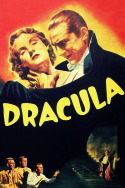
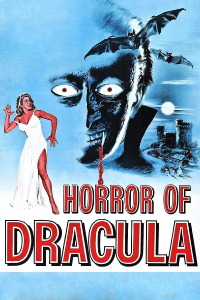
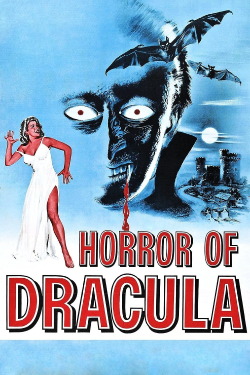
After the surprising commercial success of [I]The Curse of Frankenstein[/I], Hammer Studios decided to reunite its two key actors from that film, Peter Cushing (the Baron in [I]The Curse of Frankenstein[/I]) and Christopher Lee (Frankenstein?s ?monster?). Hammer Studios immediately turned to another Universal Studios staple, [I]Dracula[/I], filmed in 1931 with Bela Lugosi, a Hungarian stage actor, in the titular role. By the 1950s, Universal Studios had little use for their stable of now classic ?monsters? (besides Frankenstein?s monster and Dracula, they included the werewolf and the mummy), relegating them to comedic roles in Abbott and Costello?s immensely profitable film series. While only fitfully faithful to Stoker?s novel, Hammer Studios version of the Dracula story remains the epitome of the English gothic horror film, complete with lavishly dressed sets, a vivid use of color, art and production design that effectively used Technicolor?s oversaturated color scheme, fluid, but never obtrusive camerawork, compelling characters (and characterizations), and tightly paced storylines.
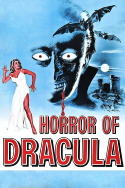
[I]Horror of Dracula[/I], directed by Terence Fisher, Hammer Studios resident auteur, and written by Jimmy Sangster (who also adapted [I]Frankenstein[/I] for Hammer Studios), opens with the arrival of Jonathan Harker (John Van Eyssen) at Dracula?s castle in the Bavarian Alps. Harker has been employed by the mysterious count as his personal librarian. Unlike previous incarnations, Harker isn?t a naïve businessman interested in selling Dracula (Christopher Lee) real estate in England. Instead, he?s fully aware of the count?s true nature as the king of the vampires, and has arrived at the castle with the intention of dispatching the count himself. The count, introduced dramatically in silhouette at the top of a grand staircase, is apparently unaware of Harker?s intentions, offers him food, lodging, and almost complete access to the castle and its environs. On his initial foray, Harker meets an eccentric, scantily clad woman (Valerie Gaunt), who claims the count is holding her against her will. Harker?s resolve begins to melt, but not before discovering that?s not the only one with hidden intentions.
Harker?s disappearance, and the discovery of his diary, leads Professor Van Helsing (Peter Cushing), a man dedicated to the pursuit of knowledge, both natural and supernatural, to the village lying at the outskirts of the count?s castle. Following the pattern created in earlier versions of the Dracula story, the villagers are, at best, unhelpful, at worst, xenophobic. For Van Helsing, the search for his missing friend reaches a literal dead end at the count?s now deserted castle. Back in his hometown, he discloses Harker?s disappearance (and apparent fate) to Lucy Holmwood (Carol Marsh), Harker?s fiancé, Lucy?s brother, Arthur Holmwood (Michael Gough) and Arthur?s wife, Mina (Melissa Stribling). Lucy, however, has been bedridden, suffering from an unknown, undiagnosed illness. Van Helsing quickly surmises that the count has moved into town, and is now stalking Lucy and, inevitably, Mina. Interestingly, in several exposition scenes, Van Helsing refers to Dracula as a plague-bearer, tying vampirism to disease (and fear of death), and describes the victim?s role vis-à-vis their vampire persecutor in drug addiction terms. Unfortunately, these ideas are referenced briefly, only to remain underdeveloped, with narrative momentum trumping the additional exploration of these themes and ideas.
As the character names and the brief synopsis indicate, Sangster and Fisher made significant changes to the Dracula story. Dracula, of course, is still the classic vampire, prone to light, garlic, and crucifixes, but Dracula is more clearly coded here as an anti-Victorian, transgressive figure, a sexual predator, combining bloodlust with sexual hunger (as his near-feral approach to the female characters make clear). In Lee, Hammer Studios found an actor worthy of the character who, in this version, says little. Lee defines Dracula through his long-limbed physical acting, coiled energy disguised as aristocratic detachment. In subsequent Hammer sequels, however, Lee?s presence was continually minimized and marginalized, and his dialogue practically eliminated (a disservice to Lee?s classical training and a rich, distinct baritone).
Audiences familiar with the Dracula mythos will find other, sometimes less than satisfying changes. Presumably due to budgetary restrictions, Sangster and Fisher pruned their screen version of several, well-known characters, including Renfield, Lucy?s suitors (she?s now Harker?s fiancé), and Mina are married to another man (and not Harker?s fiancé), with Dr. Seward limited to two scenes, neither of them pivotal to the main storyline. In addition, the crossing of the English Channel (or other body of water) and the eerie discovery of a desolate ship overtaken by a plague of rats (memorably filmed in F.W. Murnau?s [I]Nosferatu[/I]) are also missing from this adaptation. The shortage of characters has an unintended effect: it makes the climactic battle with Dracula feel small, cramped, and unimaginative.
Despite its minor shortcomings, contemporary audiences are still likely to find [I]Horror of Dracula[/I] one of the best novel-to-screen adaptations of one of gothic horror?s favorite characters. Audiences, of course, should not expect a high violence or action quotient. Most of Dracula?s attacks occur off screen, as the screen fades to black (although there is the occasional spurt of blood, a shock to audiences and censors in 1958, but relatively tame by contemporary standards). Instead, audiences will encounter a tightly paced storyline, competent direction, colorful sets and costumes, and most importantly, charismatic performances by Christopher Lee and Peter Cushing as antagonists.
This review of Dracula (1958) was written by Mel V on 17 Dec 2004.
Dracula has generally received positive reviews.
Was this review helpful?