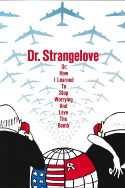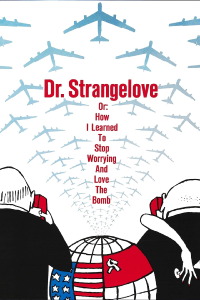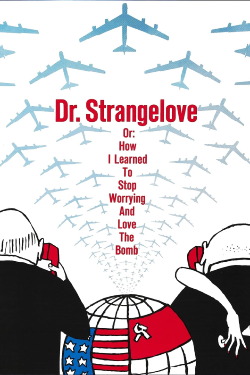
Review of Dr. Strangelove or: How I Learned to Stop Worrying and Love the Bomb (1964) by Will H — 10 Jan 2012
In 1964, the Cold War was at the full height of its breadth of paranoia, unease, and tension at the prospect of potential nuclear annihilation. The United States had suffered through the Cuban Missile Crisis barely a year earlier, and understandably, this led the nuclear arms race to become a rather touchy and frightening subject for the American people.
And film director Stanley Kubrick, fresh off his controversial Lolita, decided to tackle the subject by filming an adaptation of Peter George's thriller novel, Red Alert, a serious drama that would give people an idea that if a nuclear crisis were to begin, how it would realistically play out.
However, early into writing the screenplay, Kubrick came to a realization: Nuclear war would work as a drama-thriller, but it was also ripe for black comedic satire. And so, with the help of co-writer Terry Southern, and the multifaceted and multitalented thespian of comedy, Peter Sellers, Red Alert turned into Dr.
Strangelove or: How I Learned to Stop Worrying and Love the Bomb, and Kubrick crafted one of the darkest, most pointed, and funny satirical comedies of all time. The first film in which Kubrick had full creative control, Dr.
Strangelove shows the then-on-the-rise director unleashed, as he flawlessly directs a film about nuclear annihilation played for laughs, that is both surreal and realistic, satirical and intense, absurd but all-too-real and terrifying.
For a movie that clocks in at a mere 93 minutes, Dr. Strangelove is densed and multilayered, with multiple running plotlines, memorable characters, and some hammy yet phenomenal performances. After Kubrick, the man who easily deserves the most credit for this film's success is Sellers.
He plays not one, not two, but three major roles, each more amusing and quirky than the last. From his skittish and British Captain Lionel Mandrake, to his dry and people-pleasing President Merkin Muffley (Merkin? And he's bald? LMAO!), and of course, his now-iconic German cripple with an uncontrollable right arm, Dr.
Strangelove, Sellers completely owns this film. That he did not win the Academy Award for Best Actor is truly a travesty. The supporting cast must not be discounted, though. George C. Scott plays the Commie-hater General Buck Turgidson pitch-perfect, Sterling Hayden nails the insane General Jack D.
Ripper (again, LOL), and Keenan Wynn and Slim Pickens each have their own memorable moments, particularly Pickens' T.J. Kong rodeoing a nuclear warhead in flight. The only real complaint is that, considering his status as the title character and the iconic nature of his imagery in the film.
Dr. Strangelove gets less than ten minutes of screentime, and only a mere handful of lines, most of which are squashed into the final minutes of the movie. However, that is a minor niggle in the grand scheme of things.
Still as relevant and funny as ever, and also still as intense and implicative as ever, Dr. Strangelove is one of Kubrick's best, and the final step in his ascent to master auteur of filmmaking.
This review of Dr. Strangelove or: How I Learned to Stop Worrying and Love the Bomb (1964) was written by Will H on 10 Jan 2012.
Dr. Strangelove or: How I Learned to Stop Worrying and Love the Bomb has generally received very positive reviews.
Was this review helpful?