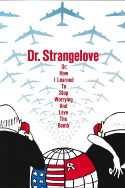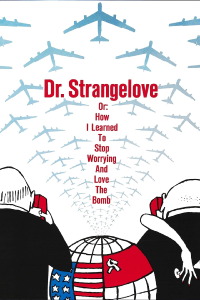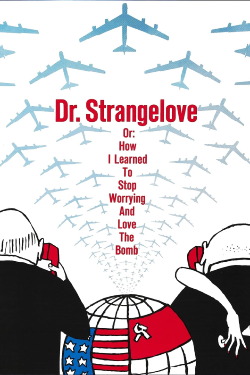
Review of Dr. Strangelove or: How I Learned to Stop Worrying and Love the Bomb (1964) by Colin Y — 15 Jan 2014
The 1950's were a time of paranoia. It was the decade when the communist threat loomed over every American. It was a time of black listing and finger pointing. To make matters worse, Americans lived in constant fear of a possible nuclear holocaust. People futilely built fallout shelters in their backyards and school children learned the useless duck and cover technique. Out of this paranoia came films like Invasion of the Body Snatchers and Red Planet Mars. These films reflected the palpable fears that pervaded American society. They dealt with the issues of invasion and the possibility of destruction of life with a serious tone and reinforced the distress that the country faced. When Dr. Strangelove came along in 1964 the threats of communist invasion and nuclear war were still very real, but audiences were growing weary of the same message delivered in the same solemn style. In the film the military and political leaders of our country are made to look like buffoons. The threat of total, global destruction does not come in the form of a foreign invader or communist plot but from the very people sworn to defend against such things. Sterling Hayden's character General Jack D. Ripper is the embodiment of the cold war fears of the 1950's. He rants throughout the film about the communist plot to poison his "essence" through the fluoridation of water. The character's deadpan delivery of his paranoid theories serves as a critique of people like Senator Joseph McCarthy. Ripper chomps on his phallic cigar, a symbol to represent the male dominated military, as he calmly orders a massive preemptive strike against Russia. The audience cannot help but laugh at such an asinine character and at the same time shiver at the eerily accurate satire. George C. Scott's character General Buck Turgidson is also comically obtuse. When asked if he thinks that the bomber that slipped by the Russian attack will be able to deliver its payload he proudly confirms, "...he can barrel that baby in so low..." He says this with a smile on his face and his arms spread wide emulating the plane. Again, we laugh at one of the ridiculous idiots that populate the film. At the same time we recoil at the thought of a General happy that his men can efficiently deliver the bomb that will end the world. Also laughable but frightening is how pleased he seems about the "...no more than ten to twenty million killed, tops.".
Dr. Strangelove was a landmark political satire that appealed to those who were fed up with the outmoded thinking of the previous decade. It captured the new attitude of the younger generation who would go on to protest the war in Vietnam and demand change. The film rejects the anxieties of the previous generation and does so in a hip fashion that would become synonymous with the new Hollywood.
This review of Dr. Strangelove or: How I Learned to Stop Worrying and Love the Bomb (1964) was written by Colin Y on 15 Jan 2014.
Dr. Strangelove or: How I Learned to Stop Worrying and Love the Bomb has generally received very positive reviews.
Was this review helpful?