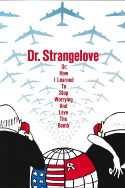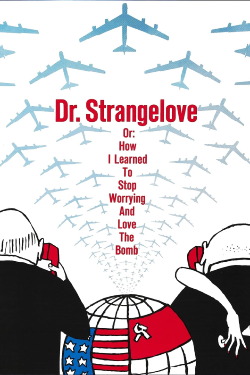
Review of Dr. Strangelove or: How I Learned to Stop Worrying and Love the Bomb (1964) by Chip M — 09 Mar 2014
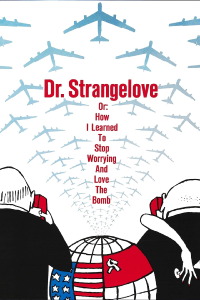
Dr. Strangelove or: How I Learned to Stop Worrying and Love the Bomb is a black comedy that satirizes the Cold War scare. Directed and co-written by Stanley Kubrick, Kubrick wrote a fictional story that takes place during the Cold War when the world is on the brink of nuclear annihilation (and ends up being so). There are three major Cold War ideologies that Kubrick mocks in the film Dr. Strangelove. These ideologies are mutually assured destruction, crackpot realism, and the Red Scare.
The biggest ideology that Kubrick satirizes was the concept of mutually assured destruction. The idea is that two sides with nuclear weapons have the potential to completely annihilate each other and thus bringing the world to an end if one spark were to ignite. In other words, if one side was to attack another nation with nuclear weapons, it was inevitable that that other nation would retaliate.
There are a few scenes or objects in Dr. Strangelove that satirize the idea of mutually assured destruction. The first to occur is when General Jack Ripper initiates Plan R, which orders his B-52s to drop atomic bombs on the Soviet Union. This action leaves us with the anticipation of whether the planes can be stopped or if they can drop the bombs and trigger the destruction of the earth. Because the film ends with a B-52 dropping the bomb and the end result of the world being completely blown up, the planes' order represents the idea of mutually assured destruction. The order represents the inevitability of this idea because once the attack/order is made, it is inevitable for a counter-attack to occur and will quickly lead to world destruction. Another scene that satirizes mutually assured destruction is when Dr. Strangelove explains the function of the doomsday machine. Dr. Strangelove describes the doomsday machine as a weapon that is triggered automatically through a complex computer system. It is impossible to un-trigger and it also rules out human meddling by decision making. The doomsday machine is another example of mutually assured destruction because once the American attack was made, it results in the inevitability of the doomsday machine to trigger. The machine reflects the human thought process when it comes to nuclear war. When Dr. Strangelove says that it rules out human meddling by decision making, it is a reflection of how humans also do this because they rule out the future of mankind just for the sake of attacking back. Also, the idea of the impossibility of the machine to be un-triggered also reveals that once human attacks are made, there is no stopping of the nuclear war.
Another ideology that is mocked was crackpot realism. Crackpot realism was the idea that the U.S.'s best shot at survival during the Cold War was preemptive strikes. Some other principles in crackpot realism was that the U.S. couldn't chance being attacked by the Soviet Union first, there was a huge missile gap that was in favor of the U.S. and it should be taken advantage of, and the U.S. would win with only a few million casualties. Ultimately, crackpot realism was the justification of the bomb. This ideology is attributed to Curtis LeMay, a U.S. Air Force general, who believed in these principles. He believed that this was how the U.S. should have handled its situation with the Soviet Union. This sounds very much like the character General Buck Turgidson in Dr. Strangelove. They both were U.S. generals and they share the principles of crackpot realism. In one scene in the War Room, Turgidson gives a piece of his mind to President Merkin Muffley when it comes to what Muffley should do. Tugidson recommends that the President order all-out coordinated attacks against the Soviet Union's airfields and military, "catching 'em with their pants down." He also mentions that they could destroy 90% of the Soviet's nuclear capabilities. He tries to convince the President that there is nothing to worry about because the U.S. has a huge advantage over the Soviet Union in terms of how many nukes the U.S. has. Following that, he tries to justify the mass murders by comparing the 150 million Soviet deaths to the no more than 10-20 million American casualties; "Mr. President, I'm not saying we wouldn't get our hair mussed." It's safe to say that General Buck Turgidson matches the characteristics of General Curtis LeMay and crackpot realism.
The final major Cold War ideology that is satirized in Dr. Strangelove was the Red Scare in the 1950s. The Red Scare was basically the fear of communism in the United States. It primarily focused on foreign communists infiltrating the U.S. government. General Jack Ripper's theory of communist infiltration correlates with the Red Scare. Ripper's theory is that commies are infiltrating and tainting our "precious bodily fluids" without us knowing it. He claims that the most dangerous commie plot was fluoridation, which he describes as the process of commies tainting our water, juice, and other liquids with foreign substances. It is because of his wild theory that results in him ordering Plan R. His theory ultimately makes him go crazy. Part of this may be because of what was going on in the world when he discovered his theory in 1946 ("during the physical act of love.") In 1946, communist tension was getting tight around the world; the Chinese Civil War was going on at that time. Also, it could be because of everything that had happened since then. For example, the events of the success of Joe 1 in 1949, the rise of communist China in 1950, the containment policy in North Korea, and McCarthyism all could have attributed to Ripper's paranoia. Although, the film does not explain the effects of this "fluoridation," we can interpret Ripper's paranoia as a parallel to the Red Scare phenomenon.
If one can find the satirical jokes/situations in Dr. Strangelove or: How I Learned to Stop Worrying and Love the Bomb, he or she would certainly hail it as a brilliant film. It implements a black humor style of film to satirize the nuclear scare. Genius! Dr. Strangelove will always be one of the greatest satires of all time.
This review of Dr. Strangelove or: How I Learned to Stop Worrying and Love the Bomb (1964) was written by Chip M on 09 Mar 2014.
Dr. Strangelove or: How I Learned to Stop Worrying and Love the Bomb has generally received very positive reviews.
Was this review helpful?