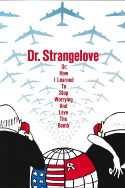
Review of Dr. Strangelove or: How I Learned to Stop Worrying and Love the Bomb (1964) by Ernesto J. M — 20 Jul 2014
(Sorry for my bad english) "Dr. Strangelove's" humor is generated by a basic comic principle: People trying to be funny are never as funny as people trying to be serious and failing. The laughs have to seem forced on unwilling characters by the logic of events.
A man wearing a funny hat is not funny. But a man who doesn't know he's wearing a funny hat ... ah, now you've got something. "Dr. Strangelove" and "2001: A Space Odyssey" (1968) are Kubrick's masterpieces.
The two films share a common theme: Man designs machinery that functions with perfect logic to bring about a disastrous outcome. The U.S. nuclear deterrent and the Russian "doomsday machine" function exactly as they are intended, and destroy life on earth.
The computer HAL 9000 serves the space mission by attacking the astronauts. Stanley Kubrick himself was a perfectionist who went to obsessive lengths in order to get everything in his films to work just right.
He owned his own cameras and sound and editing equipment. He often made dozens of takes of the same shot. He was known to telephone projectionists to complain about out-of-focus screenings. Are his two best films a nudge in his own ribs?
This review of Dr. Strangelove or: How I Learned to Stop Worrying and Love the Bomb (1964) was written by Ernesto J. M on 20 Jul 2014.
Dr. Strangelove or: How I Learned to Stop Worrying and Love the Bomb has generally received very positive reviews.
Was this review helpful?