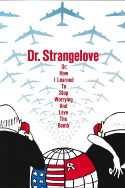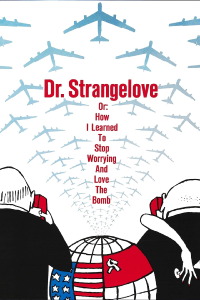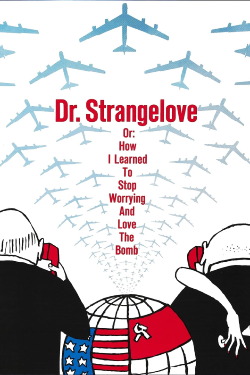
Review of Dr. Strangelove or: How I Learned to Stop Worrying and Love the Bomb (1964) by Cameron H — 22 Dec 2014
If I were to write a thesis on comedy (though I am a math major), I would study the process of how a comedy is written. That is, how the story is formed or structured. My hypothesis is that a comedy should first start as a drama.
Then you look for moments where there could be outside-perspective humour, without destructing any of the drama within the context of the story. However Dr. Strangelove was conceived and developed, the 1964 Stanley Kubrick-directed film flawlessly sets itself up as a harrowing, apocalyptic Cold War thriller, only to lighten up by deforming into a relentlessly funny take on the circumstances.
You need not be politically fluent or active to understand the satire, or plain silliness, of the story in its smaller elements. The "Peace is Our Profession" signs present in a speech about destroying the commies were the first indicator I saw that this was tongue-in-cheek.
Matters get much darker, thus more hilarious, after Plan R (bombing the hell out of Soviet Russia) is established. Our cast includes Peter Sellers as a mediator-like U.S. president, Peter Sellers as a loyal, but rational executive military officer, Peter Sellers as the ex-Nazi weapons expert Dr.
Strangelove, George C. Scott as a commie-fearing military ambassador, and Sterling Hayden as the similarly war-hungry general responsible for the entire conflict. The shockingly ridiculous script, as greatly written as it is, is brought to its highest peak on screen, grouped with the actors' fiery-in-their-dedication performances, Kubrick's unique specificity of the spatial relationship between action and the camera, and the occasional ironically-uplifting score.
This review of Dr. Strangelove or: How I Learned to Stop Worrying and Love the Bomb (1964) was written by Cameron H on 22 Dec 2014.
Dr. Strangelove or: How I Learned to Stop Worrying and Love the Bomb has generally received very positive reviews.
Was this review helpful?