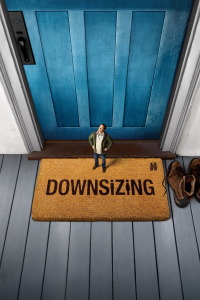
Review of Downsizing (2017) by Trevorsview — 28 Dec 2017
You know those annoying one-sided political ads by progressive groups? Or maybe those Facebook users who always complain about global crises without taking initiative on the real issue? Downsizing is exactly that—a tedious political ad about surface level issues.
Director Alexander Payne’s (The Descendants, Sideways) big premise conveys no excitement, consequently wobbling around a dark comedy in the start, a more Middle Earth-ish backdrop in the end, all tied together without a genre to pinpoint. You may notice these inconsistent tonal shifts too much to accept the social message, especially with an odd psychedelic acid trip thrown into the middle chunk. No clarity decides on whether to stay realistic or embrace a fantasy, since shrinking a person breaks the law of conservation of mass.
The casting decisions merely increases the number of wrong moves, primarily Christoph Waltz (Django Unchained, Inglourious Basterds), in his irritable, indistinguishable accent. Although lead actor Matt Damon (Good Will Hunting, The Martian) may not be an absolute pain to watch, his lack of enthusiasm brings out no inner ambition.
Except some cast members do try to make up for the scrambled material; attention particularly deserves to go to Thai actress Hong Chau’s (Inherent Vice) performance as a Vietnam escapee. Her motivated English-as-a-third-language speech patterns expresses an ambition to speak up in response to her origins.
So yes, potential lies about somewhere within this project; Payne’s visualization skills worked so well in the past (look at the simple monochrome cinematography in Nebraska), and now, his visuals illustrate the grandest of America’s wealth. For instance, stark white symmetrical rooms introduce the downsizing process, where behind the walls, people about to go small get their hair and teeth removed. Once shrunk down to action figure height, the new tiny city resembles the finest of America’s glory days. The journey eventually goes into the beautiful Norwegian landscapes, the mountains serving to remind us of our common smallness compared to true beauty away from the industries.
Both sides of the ultimate remedy to overpopulation mark fair arguments in some respects; the downsizing advertisements emphasize the unbelievably cheap diamonds sold in the small city, and later a regular sized saltine cracker comes in, fit to feed a whole shrunken family over a week. Plus, four years’ worth of the downsized population’s non-compostable waste can fill a single regular sized black trash bag! Likewise, the reality about a seemingly wonderful solution blows its horn: the downsizing community costs money and jobs for the regular sized folks.
Yet the terribly unbalanced moments still outweigh the good qualities; crucial beats rush past our attention, such as when the lead and his wife say goodbye to loved ones before they take on the permanent downsizing process. They share an empty relationship with one another, neither one motivated by anything to follow the societal trend to go green, just two cardboard flats cut in the shape of familiar celebrities to draw us into Paramount’s braindead pond. In screenwriting terms, there are two types of protagonists: an active protagonist and a passive protagonist. The writer wants to avoid the latter—it means events merely happen to the character, who then thoughtlessly accepts his fate, in turn boring down the story, as what happens here. The on the nose dialogue disrupts the situations’ believability, and the unnecessary time jumps don’t give the story the time it deserves to unveil in its full potential.
If Payne instead made the Vietnamese escapee the shoes we follow in the story, rather than some dull White American male, then an interesting experience could achieve the intended goal. Also, such an idea might work better in the format of a television series, since such a high concept needs exploration beyond a couple of hours. No other high hopes exist in Payne’s hollow technocratic machine, its downhearted look at the future simply says, “we’re meant for something bigger” but never defines that something. The word “selfie” is even said at one point, which caused me to question out of confusion whether I’m watching a potential future or an alternate present.
This review of Downsizing (2017) was written by Trevorsview on 28 Dec 2017.
Downsizing has generally received mixed reviews.
Was this review helpful?